
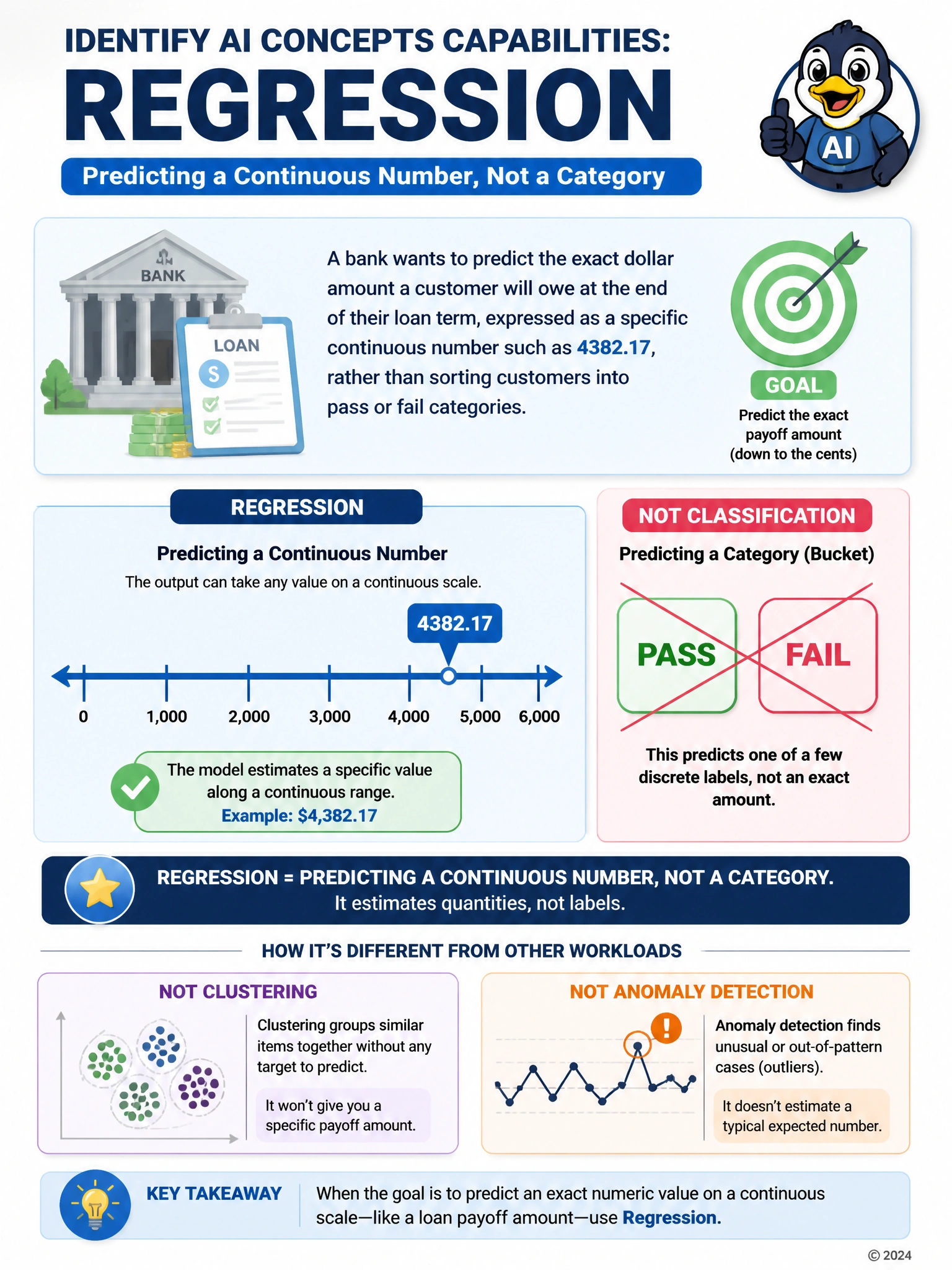
A bank wants to predict the exact dollar amount a customer will owe at the end of their loan term, expressed as a specific continuous number such as 4382.17, rather than sorting customers into pass or fail categories. Which AI workload type fits this goal?
Select an answer to reveal the explanation.
Short Explanation
The giveaway here is that the bank wants an exact number, not a bucket. If they wanted to sort customers into groups like likely to default versus not, that would be about assigning categories. But asking for a specific dollar figure down to the cents is a different kind of prediction entirely, one where the output slides along a continuous scale rather than landing in one of a few fixed buckets. That's the workload built for estimating quantities rather than sorting things into categories. Grouping similar customers together without any specific target to predict is a different exercise altogether, and it wouldn't hand you a payoff figure at all. And flagging unusual, out-of-pattern cases is about spotting outliers, not about estimating a typical expected number for a given customer.
Full Explanation
The correct answer is D. Regression is the workload type used to predict a continuous numeric value, such as a specific dollar amount, which matches the bank's goal of estimating an exact figure rather than sorting customers into discrete groups. Option A is incorrect because classification assigns records to a discrete category or label, such as pass or fail, and it is not designed to produce a specific continuous number like a precise dollar amount. Option B is incorrect because clustering is an unsupervised technique that groups similar records together based on shared characteristics without any target value to predict at all, so it could not produce a specific predicted payoff amount for a customer. Option C is incorrect because anomaly detection is designed to flag unusual or outlier data points, not to estimate a typical continuous outcome such as an expected payoff amount.