
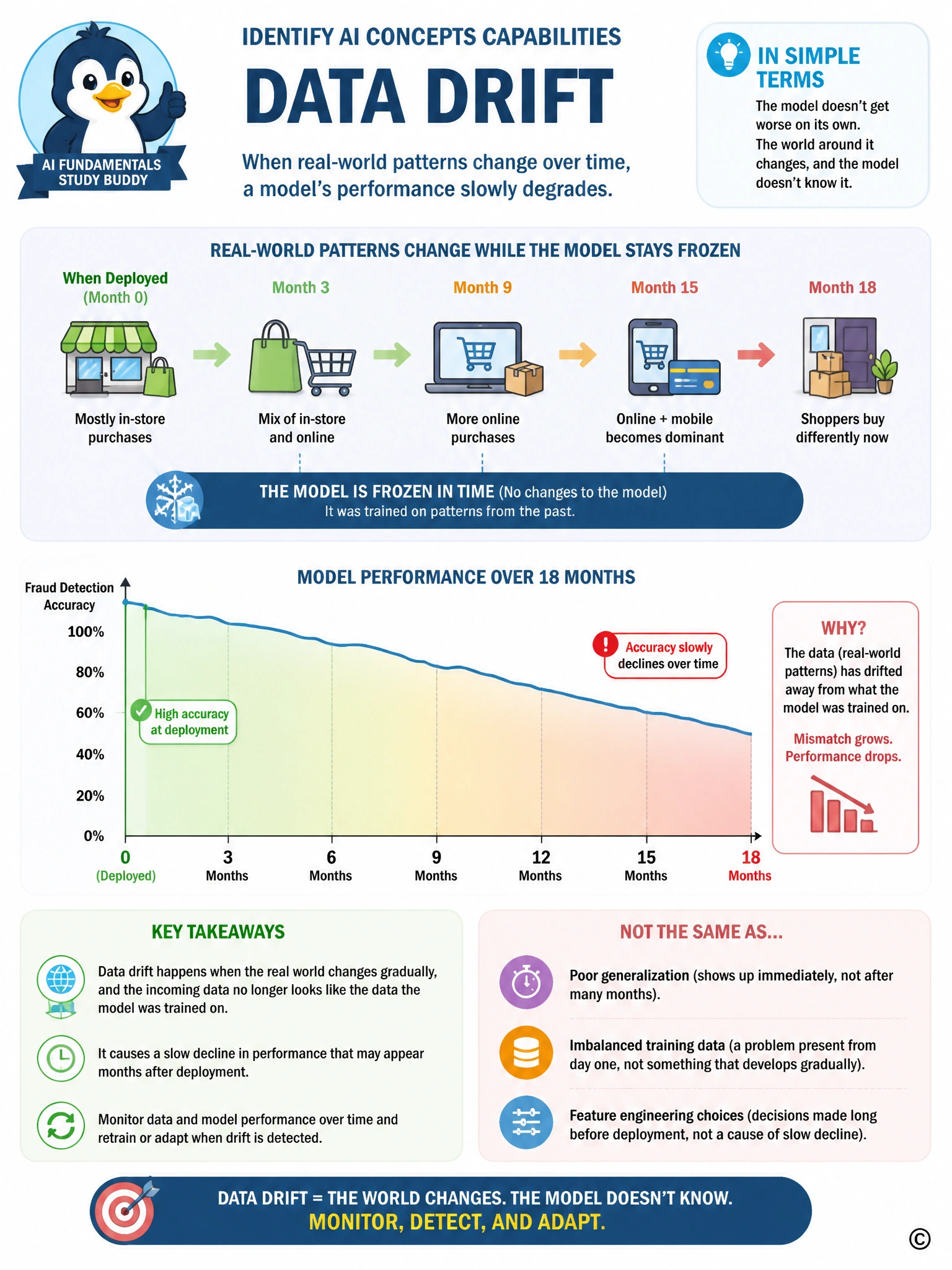
A payments company's fraud-detection model performed well when first deployed. Eighteen months later, without any change to the model itself, it starts missing fraud patterns because customers have gradually changed how and where they shop. Which concept describes why a previously accurate model degrades over time as real-world patterns change?
Select an answer to reveal the explanation.
Short Explanation
A model doesn't get worse on its own, the world around it changes and the model doesn't know it. It was trained on shopping patterns from a certain point in time, and if customers gradually start buying different things in different ways, the patterns the model learned start to look less and less like reality. That mismatch between what a model was trained on and what it's now seeing in production is exactly the kind of slow decay described here. It's not the same as a model that never generalized well in the first place, that kind of problem shows up right away, not eighteen months later. It's also not about the original training data having too few examples of one category, that's a property baked in from day one, not something that develops gradually. And it's not about how the input variables were chosen and shaped during model building either, that process happened long before deployment and doesn't explain a slow decline after the fact.
Full Explanation
The correct answer is C. Data drift describes the phenomenon where the statistical properties of real-world data change over time relative to what the model was originally trained on, causing a previously accurate model to gradually perform worse even though the model itself has not changed, which matches the gradual shopping-pattern shift described here. Option A is incorrect because overfitting describes a model that fit the training data too closely from the start, which would show up as poor generalization immediately after deployment rather than as a gradual decline eighteen months into otherwise stable performance. Option B is incorrect because class imbalance refers to a disproportionate number of examples per category within the training data itself, a property of the original dataset, and it does not explain why an already-trained model's accuracy would decline after a long period of good performance. Option D is incorrect because feature engineering refers to the process of selecting and transforming input variables during model building, not a phenomenon that explains performance changes after a model has already been deployed and left unchanged.