
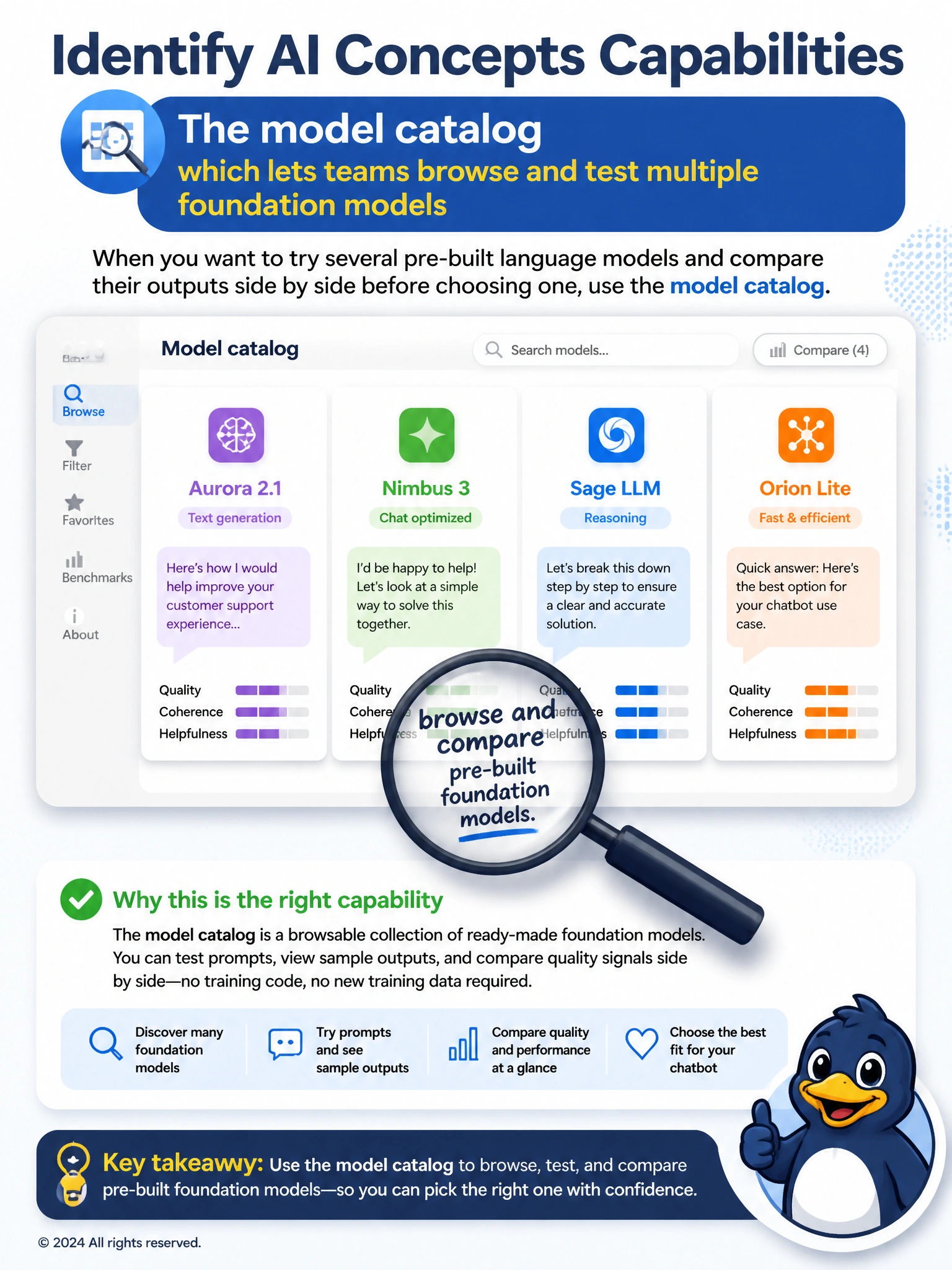
A startup wants to compare the output quality of several pre-built large language models side by side before choosing one to power its customer chatbot, without writing any training code or collecting new training data. Which Azure AI Foundry capability directly supports this goal?
Select an answer to reveal the explanation.
Short Explanation
When a team just wants to kick the tires on a bunch of pre-built language models before committing to one, they don't need to train anything themselves, they need a place to line those models up and see how each one actually performs. That's exactly what this capability is built for: a browsable collection of ready-made models you can try out and compare side by side. The other options are useful tools, just not for this job. One is built for teaching a system to recognize objects in photographs, which has nothing to do with comparing chatbot responses. Another turns spoken audio into written text, which doesn't help you judge how well a language model converses. And the last one is built for spotting unusual blips in streams of numeric data over time, which is a completely different problem than picking a chatbot's brain.
Full Explanation
The correct answer is B. The model catalog is built specifically for browsing, comparing, and testing multiple pre-built foundation models, including large language models, without requiring the team to write training code or assemble a training dataset, which matches exactly what the startup wants to do. Option A is incorrect because Custom Vision is designed for training image classification and object detection models from labeled photographs, and it has no role in comparing language model output for a text-based chatbot. Option C is incorrect because Speech to Text converts spoken audio into written text, which is unrelated to evaluating or comparing the conversational output quality of candidate language models. Option D is incorrect because Anomaly Detector is designed to flag unusual points in time-series data such as sensor readings, which has nothing to do with selecting or comparing large language models for a chatbot.