
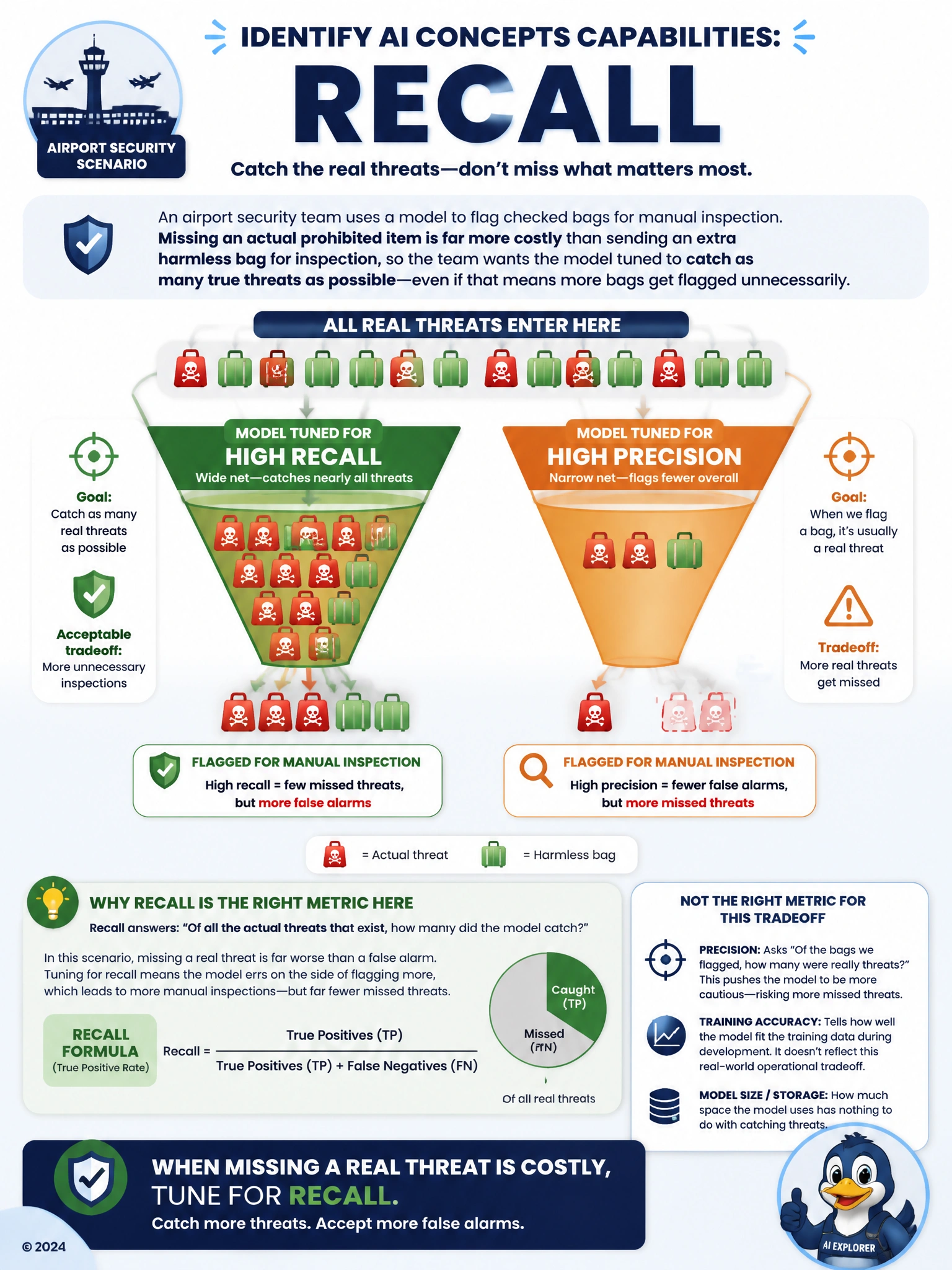
An airport security team uses a model to flag checked bags for manual inspection. Missing an actual prohibited item is far more costly than sending an extra harmless bag for inspection, so the team wants the model tuned to catch as many true threats as possible even if that means more bags get flagged unnecessarily. Which evaluation metric should the team prioritize when tuning the model?
Select an answer to reveal the explanation.
Short Explanation
When missing a real threat is far worse than a false alarm, you want a model that errs on the side of flagging too much rather than too little. That's exactly what this metric captures: out of all the actual threats that exist, how many did the model actually catch. Tuning for that means accepting more unnecessary inspections in exchange for fewer missed threats, which is exactly the tradeoff the team says they're willing to make. The metric that instead asks 'of the bags we flagged, how many were really threats' would push the model toward being more cautious about flagging at all, which is the wrong direction here since it risks letting more real threats slip through. A number describing how well the model fit its training data during development doesn't tell you anything about this operational tradeoff. And how much storage space the model takes up has nothing to do with catching threats at all.
Full Explanation
The correct answer is A. Recall measures the proportion of actual threats the model successfully catches out of all the real threats present, so prioritizing recall directly aligns with the team's goal of missing as few genuine prohibited items as possible, accepting more false alarms as an acceptable tradeoff. Option B is incorrect because precision measures the proportion of flagged bags that turn out to actually contain a threat; optimizing for precision would push the model to be more conservative about flagging, which increases the risk of missing real threats, the opposite of what the team wants. Option C is incorrect because training loss is an internal measure of how well the model fits the training data during the optimization process itself, and it does not directly describe how well the deployed model balances catching threats versus generating false alarms. Option D is incorrect because model file size relates to storage and deployment considerations, and it has no bearing on detection quality or the tradeoff between missed threats and false alarms.