
A startup wants to compare the output quality of several pre-built large language models side by side before choosing one to power its customer chatbot, without writing any training code or collecting new training data. Which Azure AI Foundry capability directly supports this goal?
Select an answer to reveal the explanation.
Short Explanation
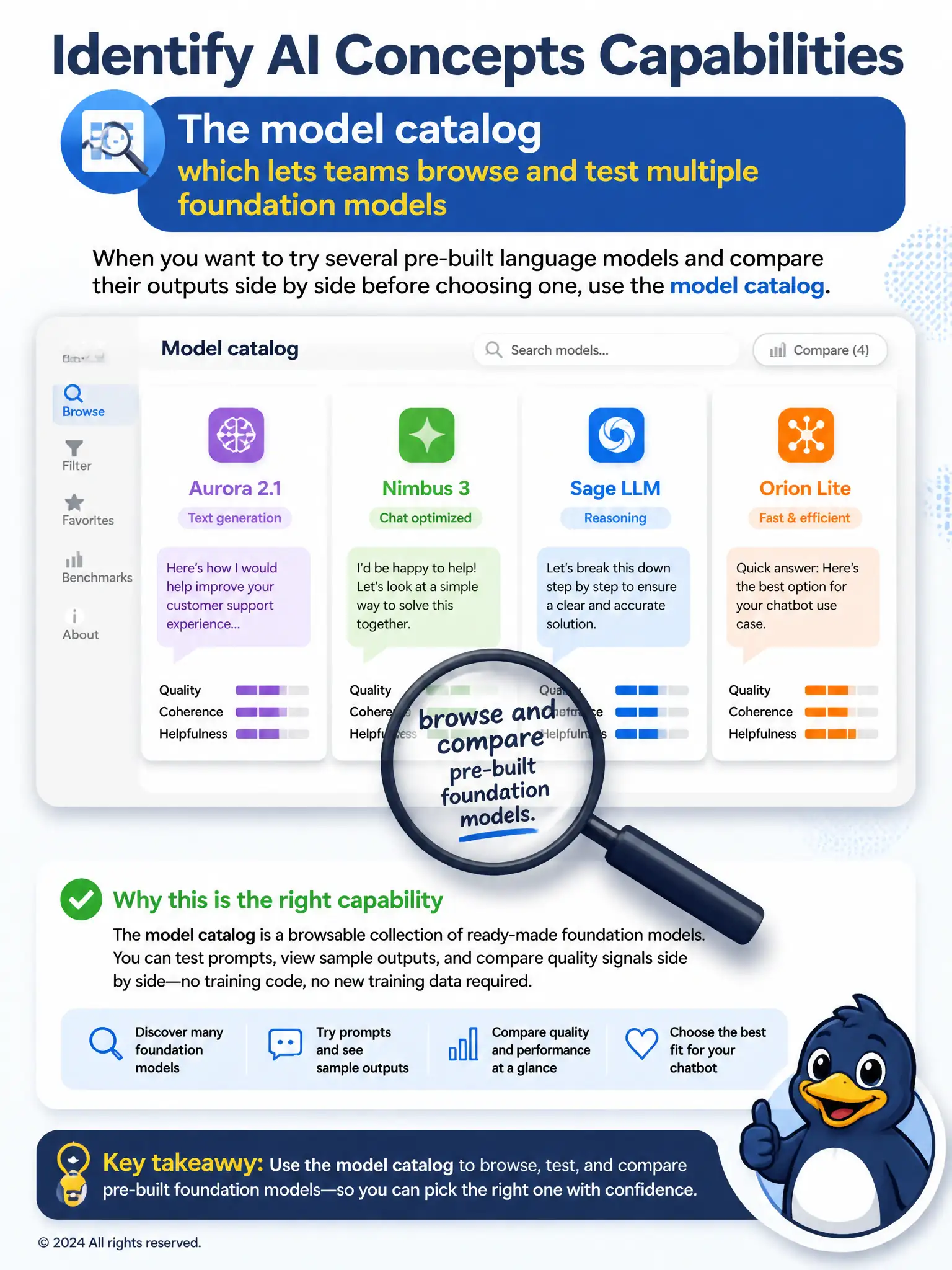
You just want to kick the tires on pre-built language models, so you need a place to line them up and compare their output side by side. The model catalog gives you that browsable collection of ready-made models to test without training anything. The other tools are useful, just not for judging chatbot responses.
Full Explanation
The correct answer is the model catalog, which lets teams browse and test multiple foundation models. It is built specifically for browsing, comparing, and testing multiple pre-built foundation models, including large language models, without requiring the team to write training code or assemble a training dataset, which matches exactly what the startup wants to do. Custom Vision, which trains image classifiers on labeled photos, is incorrect because it is designed for training image classification and object detection models from labeled photographs, and it has no role in comparing language model output for a text-based chatbot. Speech to Text, which transcribes spoken audio into text, is incorrect because it converts spoken audio into written text, which is unrelated to evaluating or comparing the conversational output quality of candidate language models. Anomaly Detector, which flags unusual data points in time series, is incorrect because it is designed to flag unusual points in time-series data such as sensor readings, which has nothing to do with selecting or comparing large language models for a chatbot.