
Before launching a public-facing Foundry-hosted assistant on its website, a retailer's security team wants to reduce the chance that the deployment is exploited for abusive purposes and wants ongoing visibility if abuse happens after launch. Which two actions should they take? (Select TWO.)
Select all correct answers, then click Submit.
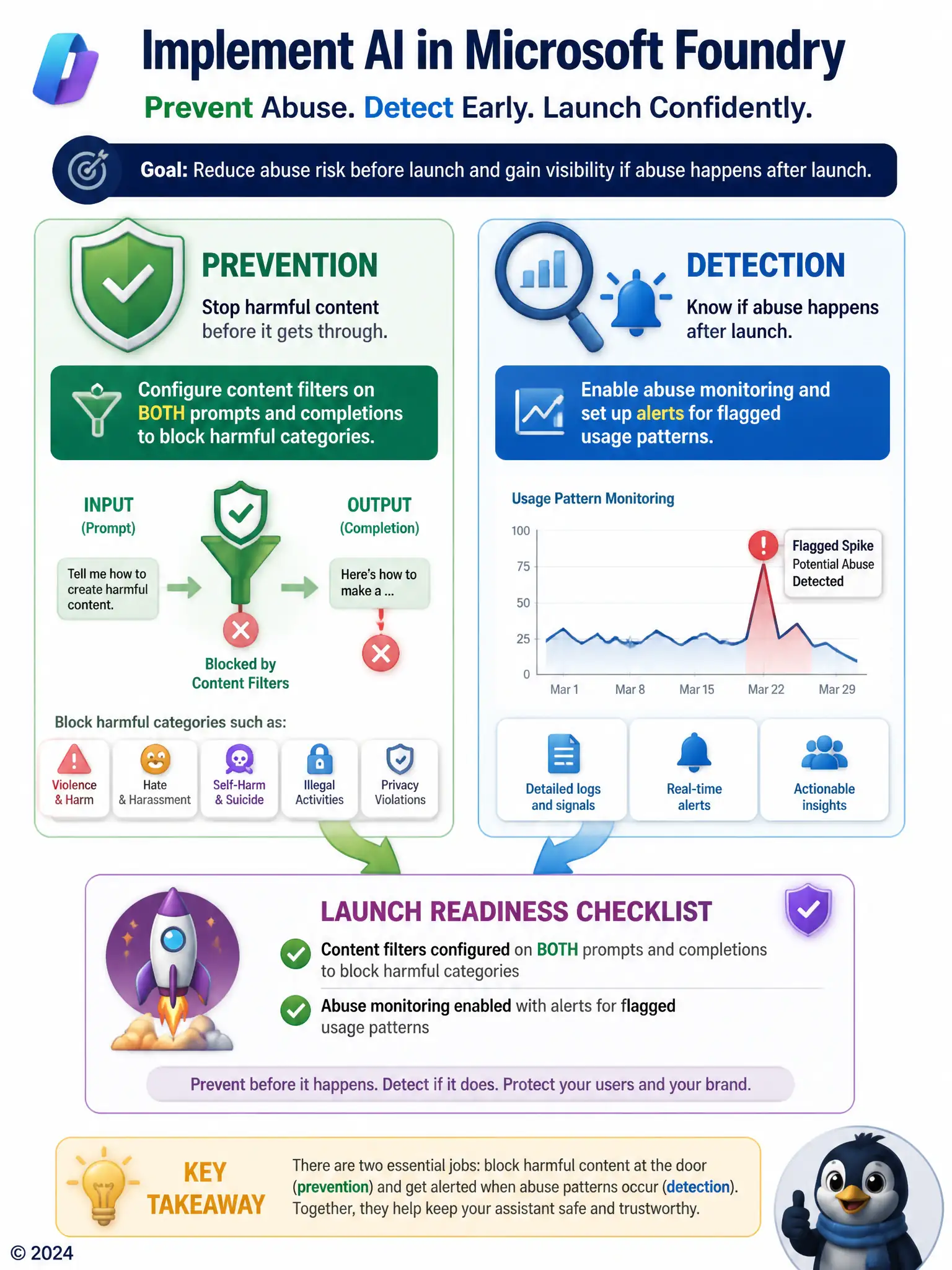
Short Explanation
You need to block harmful content going in and coming out, and you need alerts when abuse patterns show up. Content filters on prompts and completions stop bad stuff at the door, while abuse monitoring with alerts gives you visibility after launch. Temperature zero and disabled logging don't help; one just makes responses repeatable, the other hides the evidence.
Full Explanation
The correct actions are enabling abuse monitoring with alerts for flagged usage patterns and configuring content filters on both prompts and completions to block harmful categories. Content filters on prompts and completions reduce exploitation before harmful input reaches the model or before a harmful response reaches the user, directly addressing the pre-launch prevention goal. Abuse monitoring with alerts provides ongoing visibility after launch by notifying the security team when usage patterns look abusive, allowing investigation and response, which satisfies the after-the-fact visibility requirement. The temperature-zero approach is incorrect because setting temperature to zero only makes responses more deterministic and repeatable; it does not detect or prevent abusive prompts or outputs. The disable-logging approach is incorrect because disabling logging of prompts and completions removes the data needed to investigate flagged usage and understand what happened during a suspected abuse event, working against the goal of ongoing visibility. Together, content filtering and abuse monitoring address prevention at the point of interaction and detection and follow-up over time, which is why these two actions form the correct pre-launch checklist.