
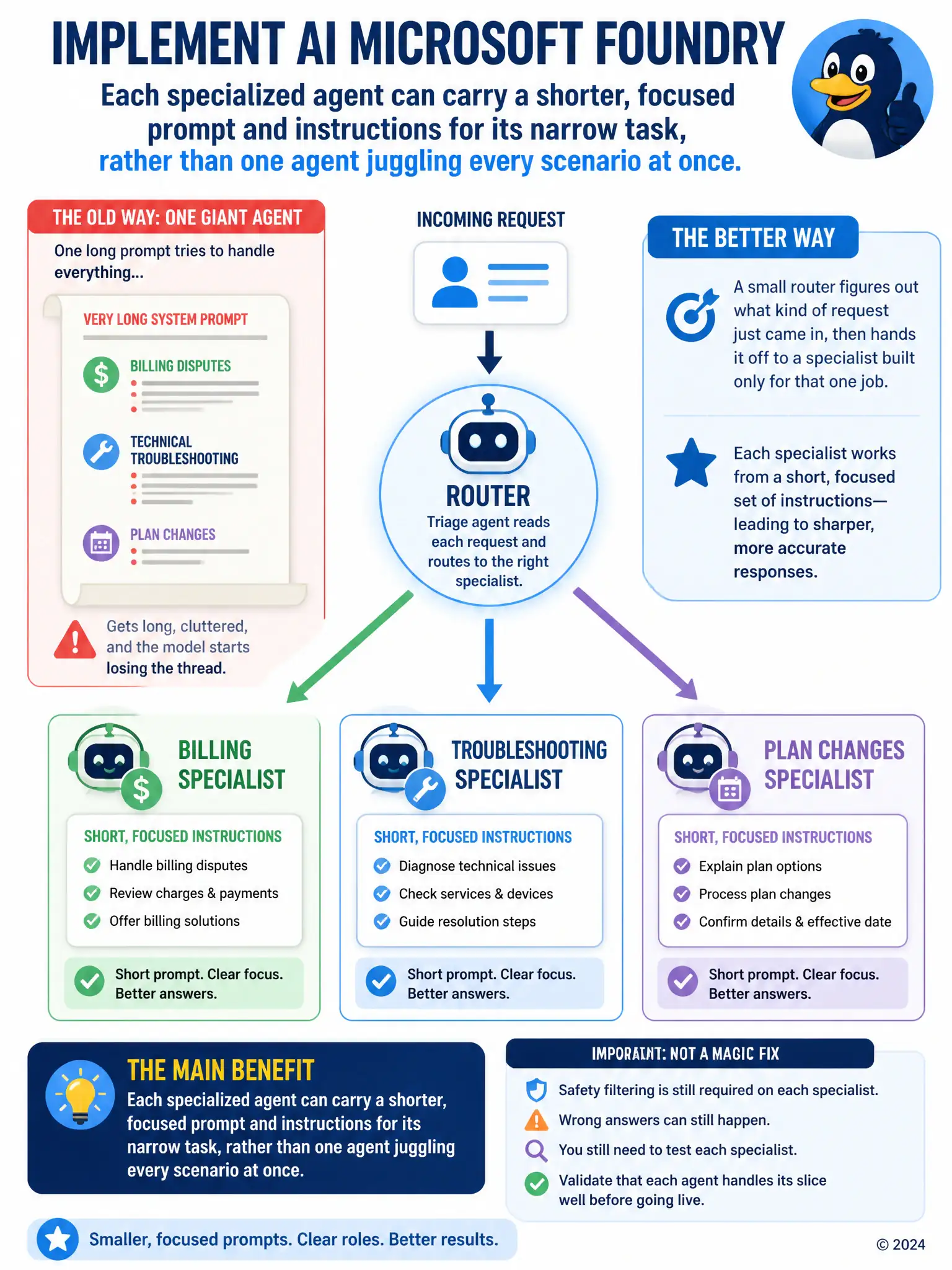
A telecom provider's support system currently uses one large Foundry agent that tries to handle billing disputes, technical troubleshooting, and plan changes all with a single, very long system prompt covering every scenario. Response quality has dropped as the prompt has grown. A team proposes restructuring so a lightweight triage agent reads each incoming request and hands it off to one of three smaller, specialized agents built for billing, troubleshooting, or plan changes. What is the main benefit of this restructuring?
Select an answer to reveal the explanation.
Short Explanation
Trying to cram billing disputes, technical troubleshooting, and plan changes into one giant prompt makes the model lose the thread. You split the work so a triage agent routes each request to a specialist, and each specialist gets a shorter, focused prompt for just its narrow job. That focus is what sharpens responses, but it doesn't remove safety, accuracy, or testing needs.
Full Explanation
The main benefit is that each specialized agent can carry a shorter, focused prompt and instructions for its narrow task, rather than one agent juggling every scenario at once. Splitting one overloaded agent into a triage agent plus specialized agents lets each specialized agent hold a shorter, targeted prompt built only for its own scenario—billing, troubleshooting, or plan changes—instead of one long prompt trying to cover every case at once; that focus is what typically improves reliability compared to a single agent managing every scenario. The claim that this removes the need for any content safety configuration on the specialized agents is incorrect because content safety filtering is a separate deployment concern from prompt structure, and specialized agents still need it configured just as the original single agent did. The claim that it guarantees the system will never produce an incorrect answer to a customer is incorrect because no orchestration pattern removes the possibility of incorrect answers; multi-agent routing improves focus and manageability but is not a guarantee against every mistake. The claim that it eliminates the need to evaluate the specialized agents before deployment is incorrect because splitting responsibilities across agents does not reduce the need for evaluation; if anything, each specialized agent, along with the triage logic that routes to it, still needs to be evaluated to confirm it performs its narrower job correctly before going live.