
A team is building a semantic search feature: users type a question, and the system must find the most similar passages from a document library by comparing meaning rather than exact keywords. They plan to deploy a model from the Foundry catalog to convert both the stored passages and each incoming query into numeric vectors for that comparison. What kind of model should they deploy for this step?
Select an answer to reveal the explanation.
Short Explanation
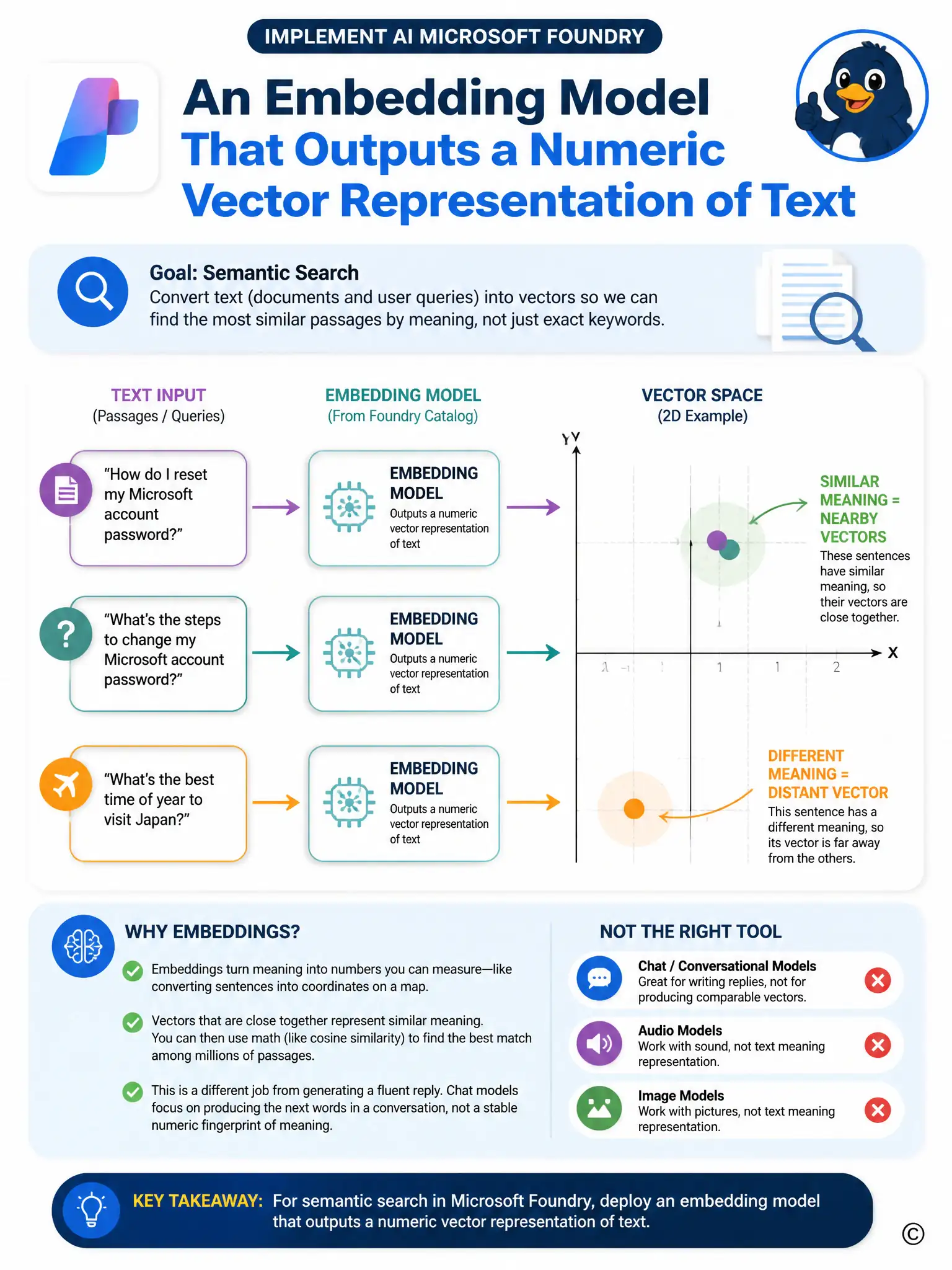
You need an embedding model because it turns text into numeric vectors you can compare. That vector comparison is what lets semantic search find passages that mean the same thing, not just passages that share exact words. Chat, speech, and image models don't give you the meaning fingerprints you need.
Full Explanation
An embedding model is designed specifically to convert text into a numeric vector, and comparing vectors by distance or similarity is exactly how semantic search matches a query to the most relevant passages by meaning rather than exact word overlap. The chat-completion model tuned for multi-turn conversation is incorrect because it is built to generate conversational text responses; it does not natively produce a fixed-length vector suited for similarity comparison, and using it for that purpose would be the wrong tool even though it can process language. The text-to-speech model that renders written text as audio is incorrect because it converts text into audio output, which has nothing to do with representing meaning as a vector for comparison. The image-generation model configured for text-to-image synthesis is incorrect because it produces pictures from text prompts, a completely different modality with no role in matching query meaning against stored passages.