
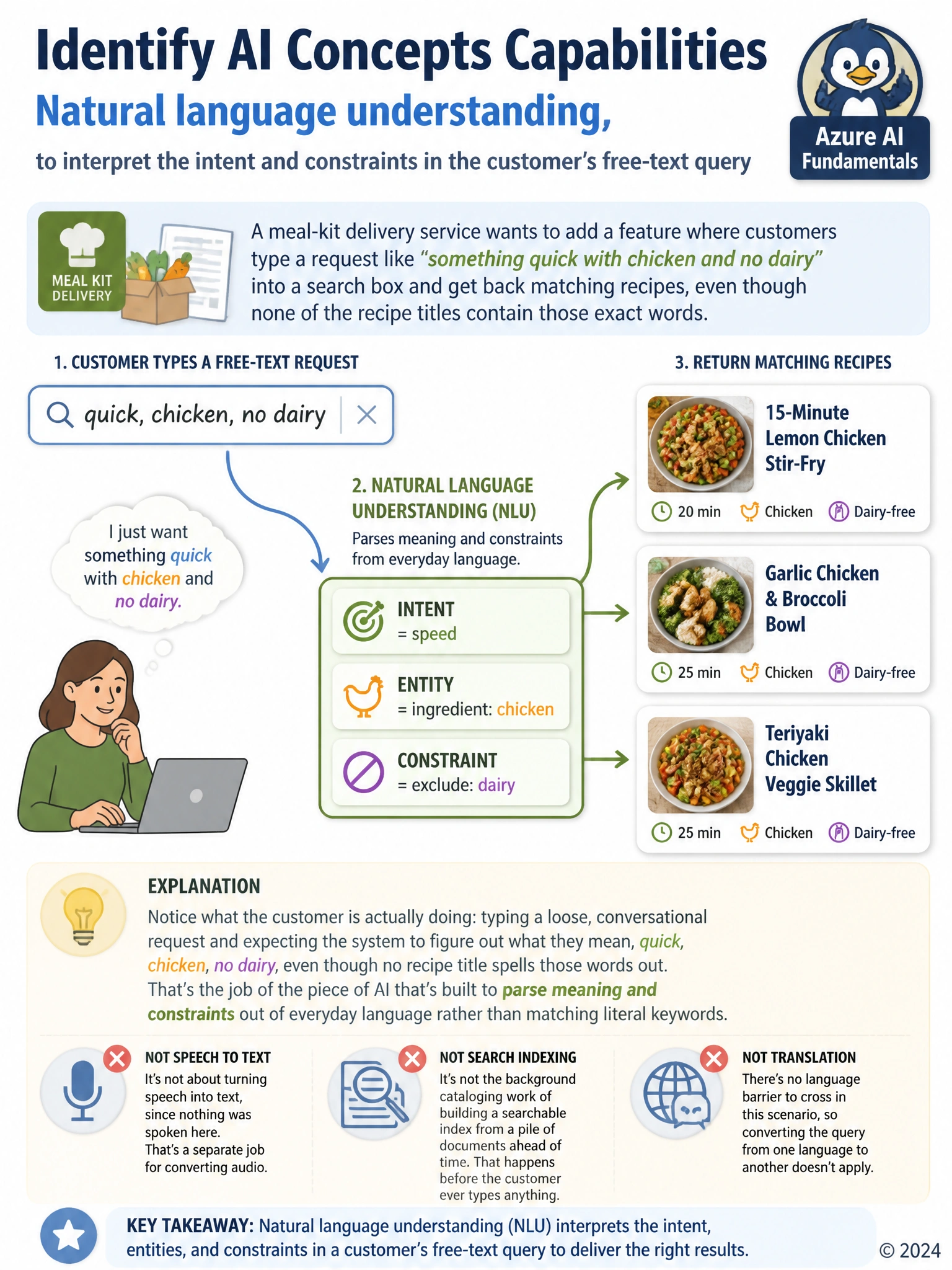
A meal-kit delivery service wants to add a feature where customers type a request like 'something quick with chicken and no dairy' into a search box and get back matching recipes, even though none of the recipe titles contain those exact words. Which Azure AI capability is the customer directly interacting with when they type that request?
Select an answer to reveal the explanation.
Short Explanation
Notice what the customer is actually doing: typing a loose, conversational request and expecting the system to figure out what they mean, quick, chicken, no dairy, even though no recipe title spells those words out. That's the job of the piece of AI that's built to parse meaning and constraints out of everyday language rather than matching literal keywords. It's not about turning speech into text, since nothing was spoken here, that's a separate job for converting audio. It's also not the background cataloging work of building a searchable index from a pile of documents ahead of time, that happens before the customer ever types anything. And there's no language barrier to cross in this scenario, so converting the query from one language to another doesn't apply either.
Full Explanation
The correct answer is D. The customer is typing a free-form request that expresses intent ('something quick') and constraints ('with chicken', 'no dairy') in ordinary language rather than exact keywords, and the system must parse that meaning to match relevant recipes. Interpreting intent and entities from natural free text is what natural language understanding does, and it is the capability the customer is directly engaging with at the moment they submit the query. Option A is incorrect because the customer typed the request rather than spoke it, so no audio-to-text conversion is happening in this interaction. Option B is incorrect because knowledge mining describes the behind-the-scenes work of indexing and extracting structure from the recipe documents ahead of time; it is not the capability the customer is interacting with when they type a query. Option C is incorrect because there is no indication of a language mismatch between the query and the recipe database, so translating between languages is not part of what's happening here.