
A nonprofit is building a mobile app that lets field workers photograph plant leaves to identify crop diseases. Leaves can be affected by more than one disease at once, and the app must return every disease it detects in a single photo, not just the most likely one. Which computer vision capability should the development team use? (Select TWO.)
Select all correct answers, then click Submit.
Short Explanation
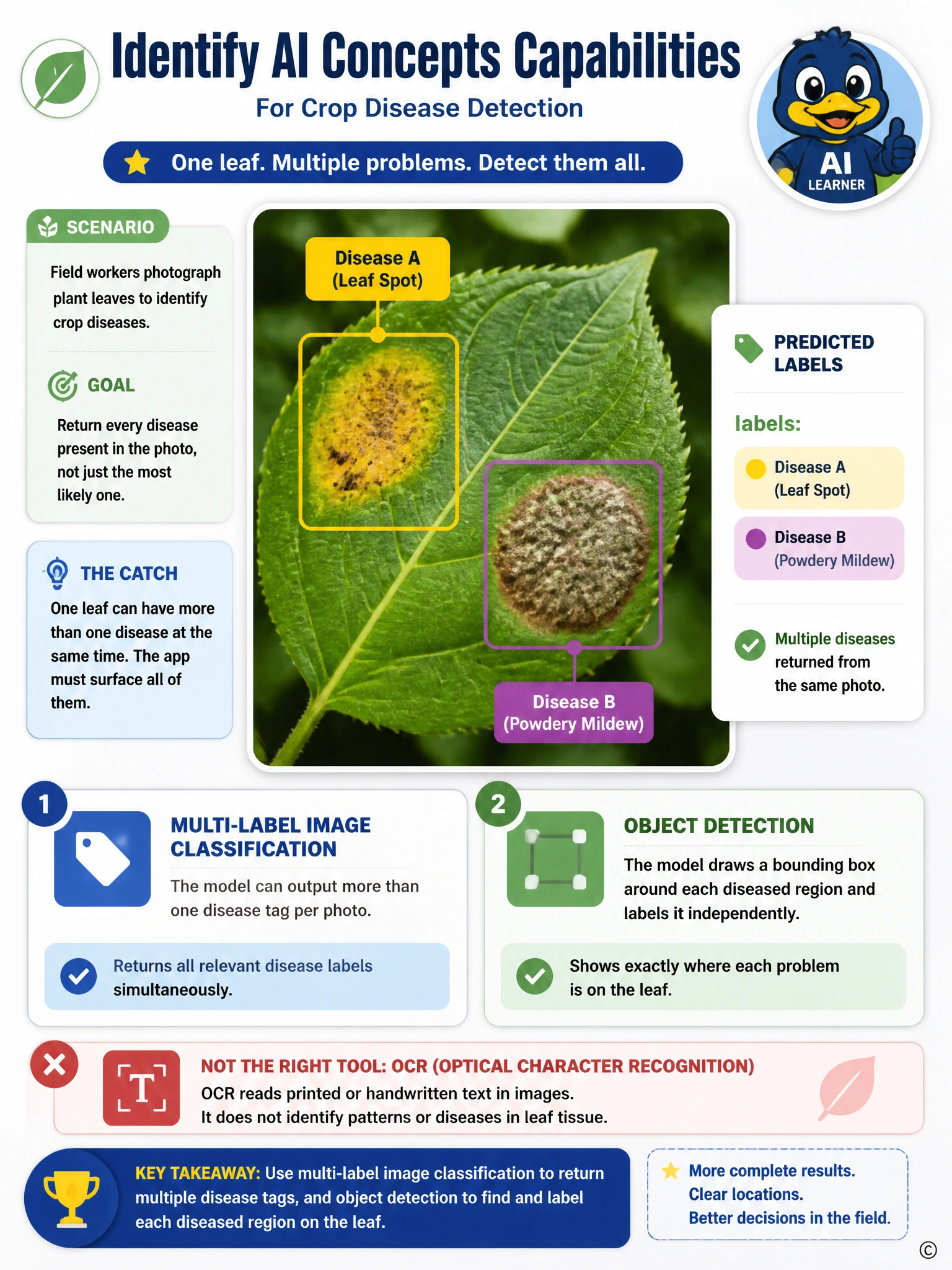
The catch in this scenario is that one leaf can carry more than one problem at the same time, and the app has to surface all of them instead of picking a winner. Any vision approach that limits itself to a single tag per photo automatically fails that requirement, so a model forced to output just one confident answer is out. What actually works is letting an image carry multiple labels at once, or going a step further and having the system find each affected patch on the leaf individually and label it on its own, which also happens to show the worker exactly where the problem sits. Reading printed text off a photo is a completely different skill from spotting disease patterns in leaf tissue, so that tool doesn't belong here at all.
Full Explanation
The correct answers are C and D. The requirement is to detect multiple co-occurring diseases in one photo rather than forcing a single verdict. Multi-label classification is built exactly for this: it lets the model attach more than one tag to the same image when multiple conditions are present. Object detection also satisfies the need because it locates each affected region separately with its own bounding box and label, which lets the app report multiple distinct disease findings and even show the worker where on the leaf each one appears. Option A is incorrect because optical character recognition extracts printed or handwritten text from an image; it has no role in identifying disease patterns on a leaf's surface and would only be relevant if the photos contained text labels, which is not what's described. Option B is incorrect because single-label classification forces the model to pick just one answer per image, which directly contradicts the stated requirement that every disease present in the photo be returned, not just the top match.