
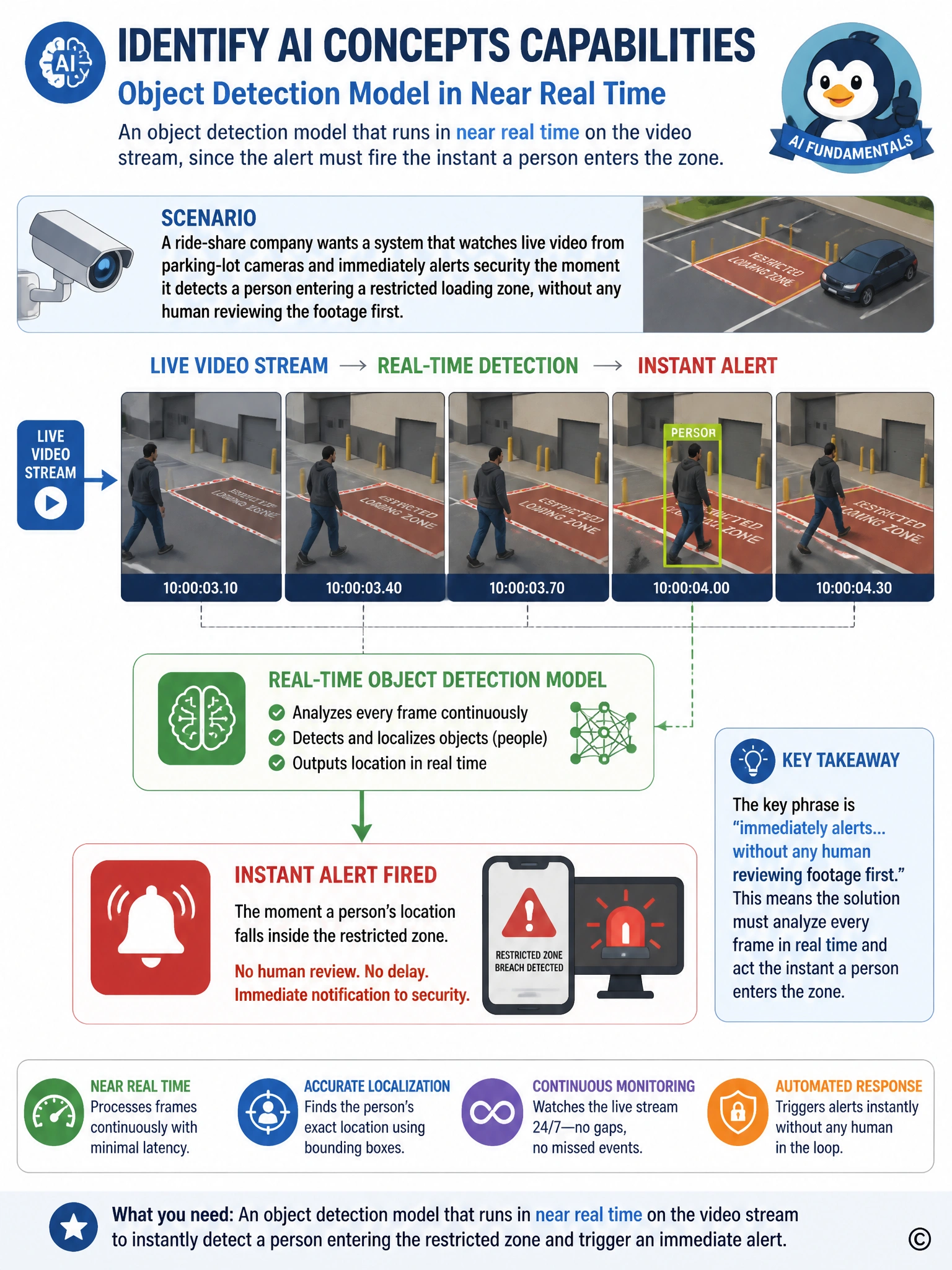
A ride-share company wants a system that watches live video from parking-lot cameras and immediately alerts security the moment it detects a person entering a restricted loading zone, without any human reviewing the footage first. Which combination of considerations should the team prioritize when choosing a computer vision approach for this specific requirement?
Select an answer to reveal the explanation.
Short Explanation
The key phrase to hold onto is 'immediately alerts... without any human reviewing footage first.' That rules out anything that produces a result for a person to look at later, and it rules out anything that only checks in occasionally rather than continuously. A once-an-hour snapshot check would let someone walk in and out of a restricted zone completely unnoticed for most of that hour, so periodic sampling can't satisfy an immediate-alert requirement. Generating a written description of a frame for a guard to read afterward also fails the test, since that still depends on a human closing the loop. And a tool built to read text off signage answers a completely different question, whether the zone is labeled, not whether someone just walked into it. What's actually needed is a model that can find a person's location within each frame of a continuously running feed and fire the moment that location falls inside the restricted area.
Full Explanation
The correct answer is A. The requirement is immediate detection of a person entering a specific zone within a live video feed, which demands locating where a person is within each frame and doing so continuously enough to trigger an alert the moment the event happens; that combination of localization and near real-time processing is what object detection on a video stream provides. Option B is incorrect because sampling only one frame per hour would miss the vast majority of the time window during which a person could enter and exit the zone, directly contradicting the requirement for an immediate alert. Option C is incorrect because generating a text caption for a human to read later introduces a delay and a manual review step, which the scenario explicitly says should not happen. Option D is incorrect because reading signage with OCR addresses whether the zone is labeled correctly, not whether a person has entered it, so it does not fulfill the detection-and-alert requirement at all.