
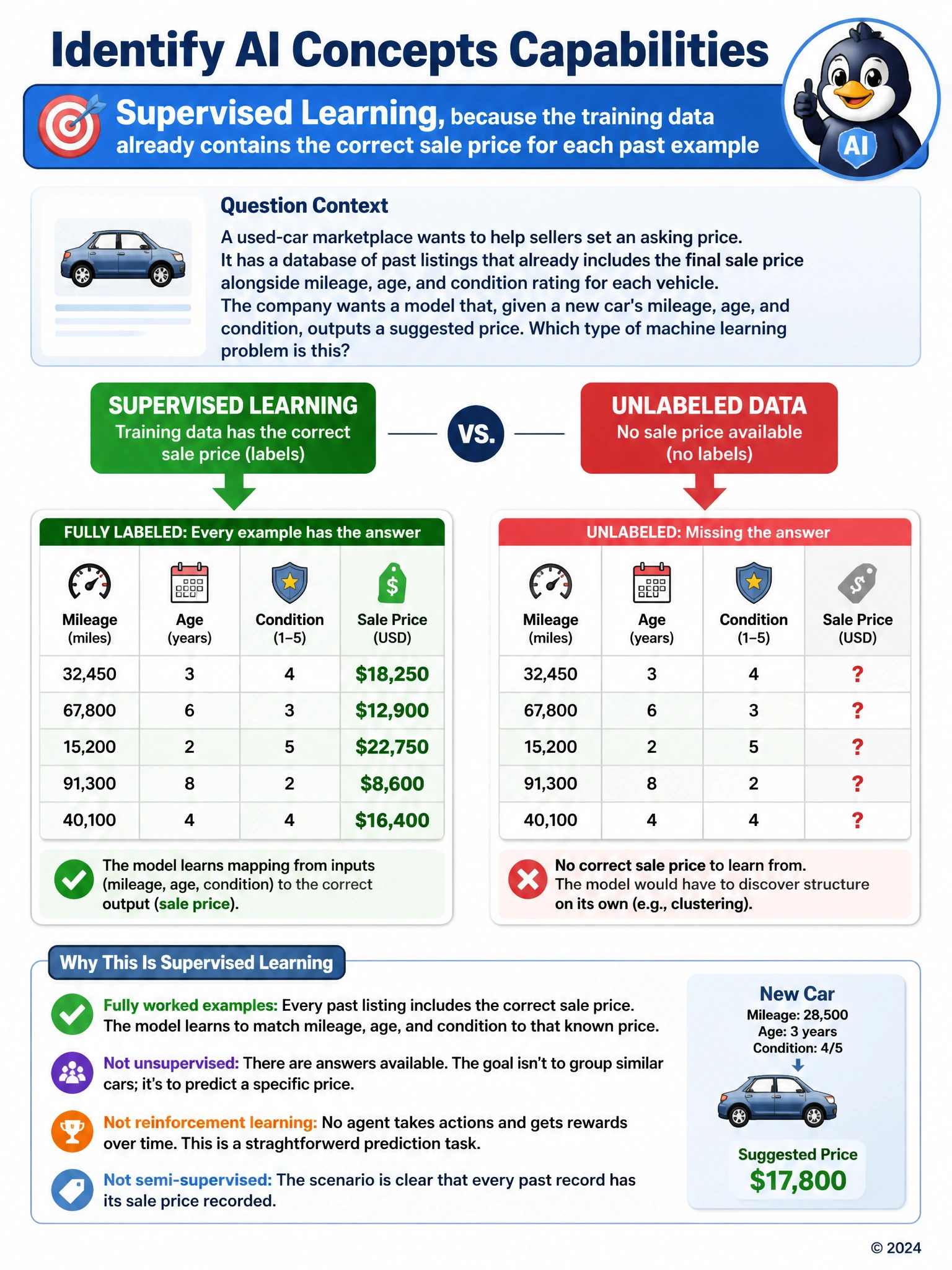
A used-car marketplace wants to help sellers set an asking price. It has a database of past listings that already includes the final sale price alongside mileage, age, and condition rating for each vehicle. The company wants a model that, given a new car's mileage, age, and condition, outputs a suggested price. Which type of machine learning problem is this?
Select an answer to reveal the explanation.
Short Explanation
Look at what's sitting in that historical data: every single past listing already comes with the answer attached, the price it actually sold for. Whenever your training examples already carry the correct outcome alongside the inputs, you're squarely in the camp where the model learns from fully worked examples, matching mileage and age and condition to a price it was explicitly shown. That's different from a setup where the model has to find its own structure with no answers given at all, which fits problems like grouping similar cars together rather than pricing one. It's also different from a system that learns by acting and getting rewarded or penalized over time, since nothing here involves an agent taking sequential actions. And it's not a case of only partial labels being available, because the scenario is clear that every past record already has its sale price recorded.
Full Explanation
The correct answer is B. Every historical listing in the dataset already carries the outcome the model is meant to predict, the actual final sale price, alongside the input features of mileage, age, and condition. Training a model on inputs paired with known correct outputs is the definition of supervised learning, and since the target is a continuous price, it is specifically a regression task within that category. Option A is incorrect because unsupervised learning is used when there are no labeled outcomes at all, such as grouping listings by similarity without knowing any sale prices, which does not match this dataset. Option C is incorrect because reinforcement learning requires an agent taking actions in an environment and receiving reward signals over time, not a static table of past sales with known prices attached. Option D is incorrect because the scenario states the database already includes the final sale price for each past example, meaning every record is labeled, not just a partial subset, so there is no missing-label condition to justify a semi-supervised approach.