
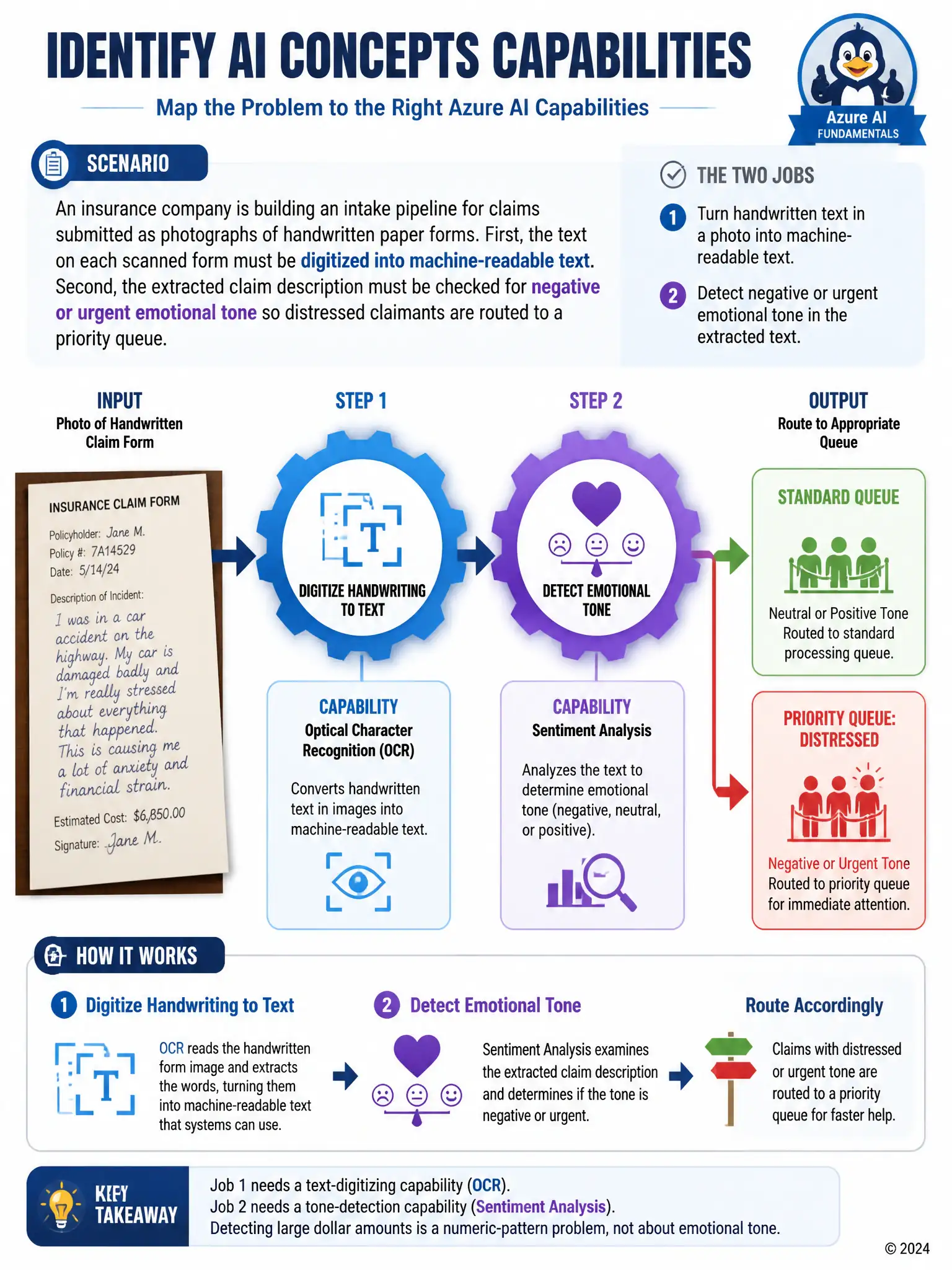
An insurance company is building an intake pipeline for claims submitted as photographs of handwritten paper forms. First, the text on each scanned form must be digitized into machine-readable text. Second, the extracted claim description must be checked for negative or urgent emotional tone so distressed claimants are routed to a priority queue. Which two Azure AI capabilities does this pipeline require? (Select TWO.)
Select all correct answers, then click Submit.
Short Explanation
Break the pipeline into its two jobs. You need optical character recognition to turn the handwritten photo into machine-readable text, then sentiment analysis to spot distressed or urgent wording. You don't need bounding boxes or unusual dollar-amount checks.
Full Explanation
The required capabilities are optical character recognition and sentiment analysis. Optical character recognition is needed first to convert the handwritten text in the scanned photographs into machine-readable text, and sentiment analysis is needed second to examine that extracted text and detect negative or urgent emotional tone so distressed claimants can be prioritized. The object detection option, which draws bounding boxes around each form field, is incorrect because the pipeline only needs the text content digitized, not the locations of individual fields marked with bounding boxes; object detection solves a localization problem the scenario never asks for. The anomaly detection option, which flags unusual claim amounts, is incorrect because anomaly detection is built to flag unusual numeric patterns, such as an oddly large claim amount, which is a different concern from judging the emotional tone of written text and was not part of what the scenario described needing checked. Since the pipeline explicitly needs text digitized from images and then screened for tone, the two required capabilities are optical character recognition and sentiment analysis.