
A city parks department wants to know, ahead of time, how many visitors will show up at each park each day so it can schedule enough staff. It has three years of daily attendance records along with the day's weather and whether it was a holiday. It wants to feed in tomorrow's forecasted weather and get back a predicted attendance number for each park. Which Azure AI Foundry capability best fits this need?
Select an answer to reveal the explanation.
Short Explanation
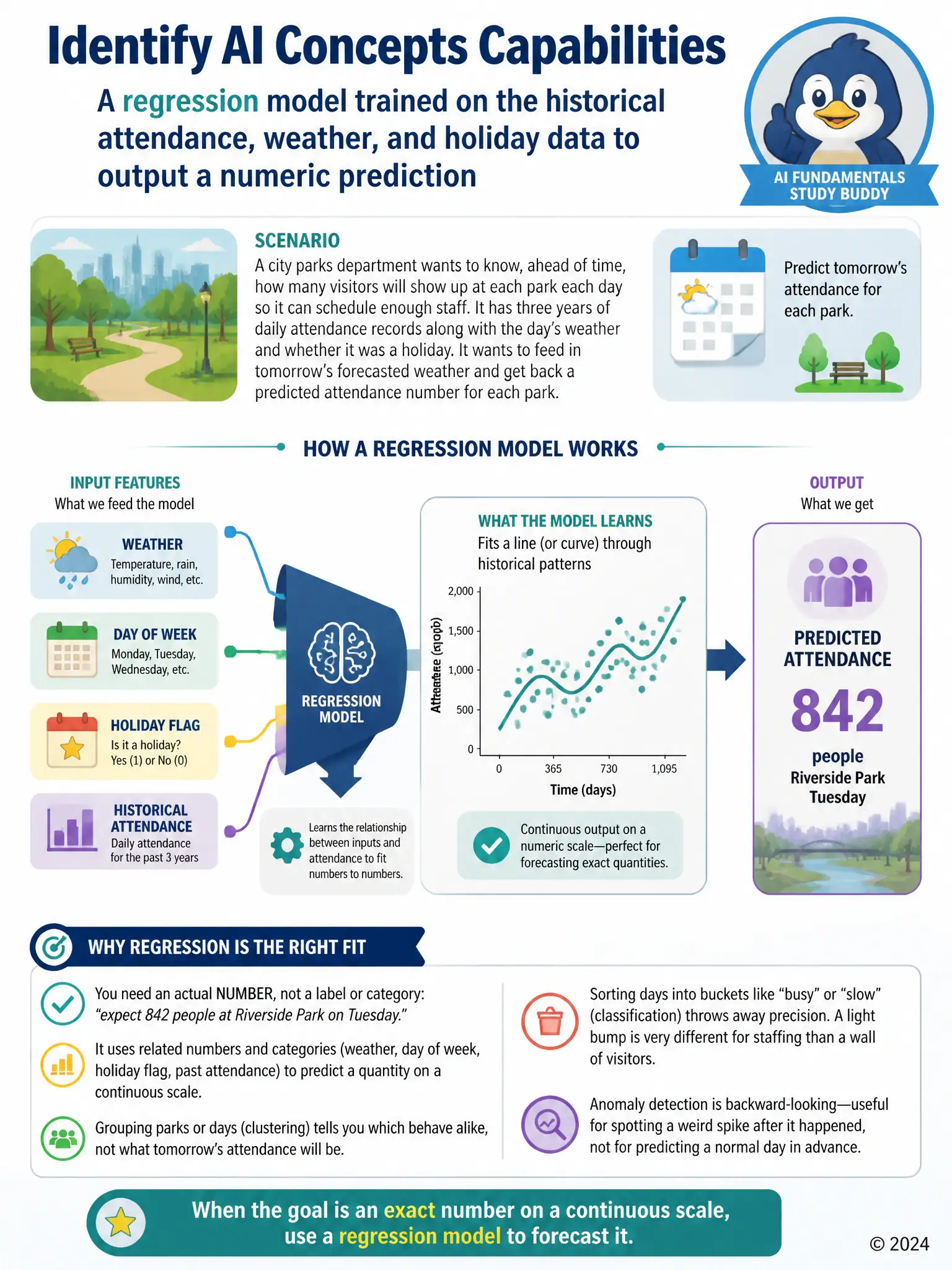
You need a real headcount, not a bucket or a group, so you want the regression model trained on attendance, weather, and holiday data. It maps those inputs to a numeric prediction you can use for staffing.
Full Explanation
The best fit is the regression model trained on historical attendance, weather, and holiday data to output a numeric prediction. The department needs a specific numeric forecast, attendance count for a specific day at a specific park, produced from continuous historical data plus predictor variables like weather and holiday status. That is exactly the regression task: learning a function that maps inputs to a continuous output. The classification model trained to sort each day into a small set of attendance categories such as 'low' or 'high' is wrong because it would only sort days into discrete buckets like 'low' or 'high' attendance, losing the precise headcount the department needs for staffing decisions. The clustering model that groups parks with similar historical attendance patterns together is wrong because clustering is an unsupervised technique for discovering groupings among parks themselves, such as parks with similar visitor patterns, not for predicting a future number for a specific day. The anomaly detection model that flags days when attendance deviated sharply from the recent trend is wrong because anomaly detection identifies unusual days that don't fit the normal pattern; it is useful for spotting outliers after the fact but does not produce a forward-looking staffing forecast for an ordinary day.