
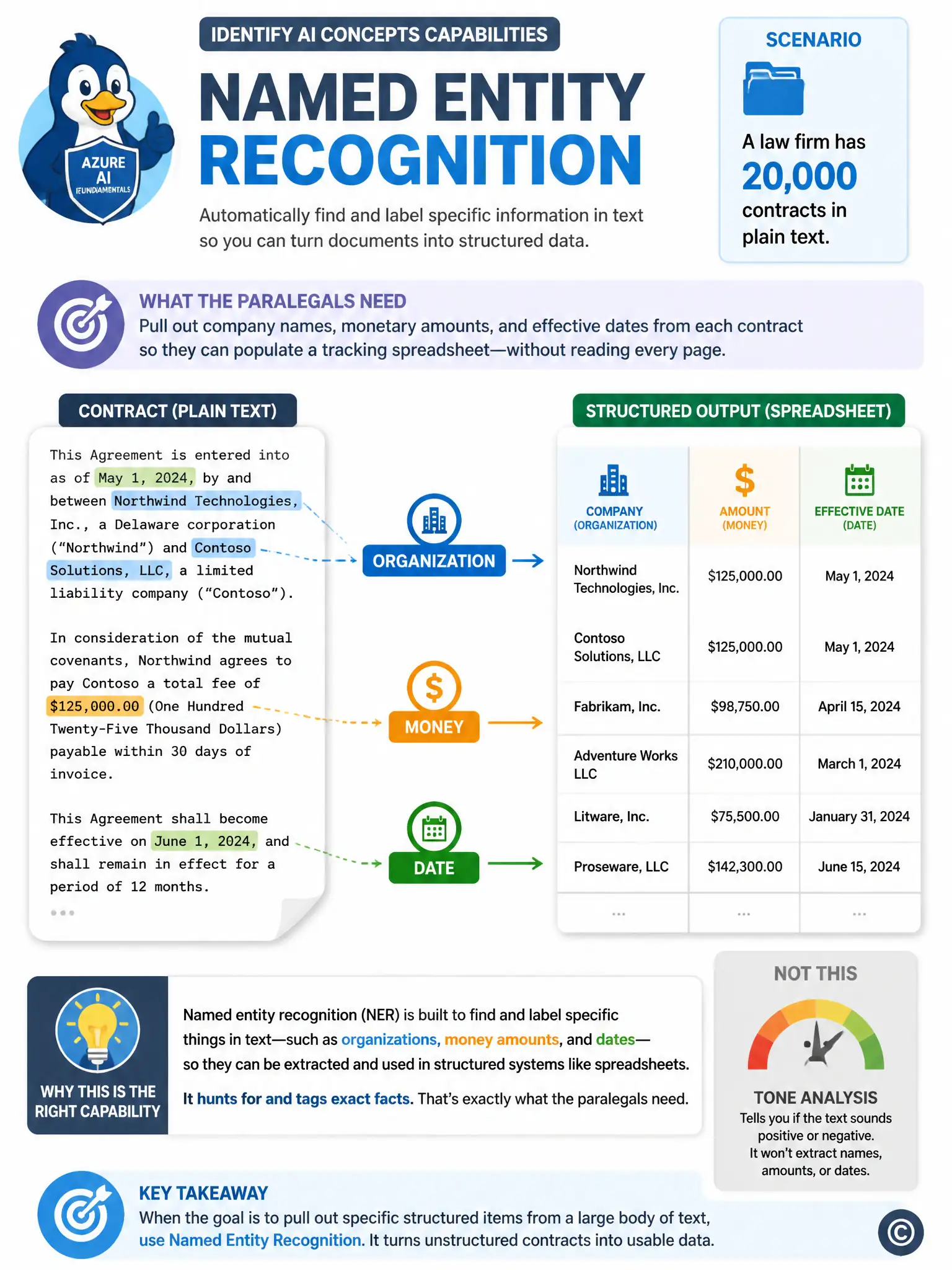
A law firm's document review team has 20,000 signed contracts as plain text and wants an automated step that scans each contract and pulls out structured items such as company names, monetary amounts, and effective dates, so paralegals can populate a tracking spreadsheet without reading every page. Which Azure AI Language capability fits this need?
Select an answer to reveal the explanation.
Short Explanation
You need a capability that spots and labels specific structured items—company names, monetary amounts, and effective dates—inside each contract so you can drop them into a tracking spreadsheet. That's named entity recognition. Sentiment analysis, language detection, and summarization don't extract those exact fields.
Full Explanation
Named entity recognition identifies and categorizes specific structured items within text, such as organization names, monetary values, and dates, which is exactly what the paralegals need extracted into a tracking spreadsheet. The sentiment analysis option is incorrect because it measures whether text expresses a positive, negative, or neutral tone, which has no bearing on pulling out company names or dollar figures from a contract. The language detection option is incorrect because it simply identifies which language a piece of text is written in and does not extract any structured details from within the document. The text summarization option is incorrect because it condenses a document into a shorter overview of its content, which would not reliably surface every specific entity like a dollar amount or an effective date in a structured, extractable form. Since the team needs specific categories of structured information pulled out of unstructured contract text, named entity recognition is the right capability.