
A circuit board manufacturer wants a vision system that can look at photos of assembled boards and flag three defect types unique to its own product line, such as a specific solder bridge pattern that only appears on its custom connectors. A general-purpose image tagging service returns labels like 'circuit board' and 'metal' but has no concept of these specific defect types. What should the manufacturer do?
Select an answer to reveal the explanation.
Short Explanation
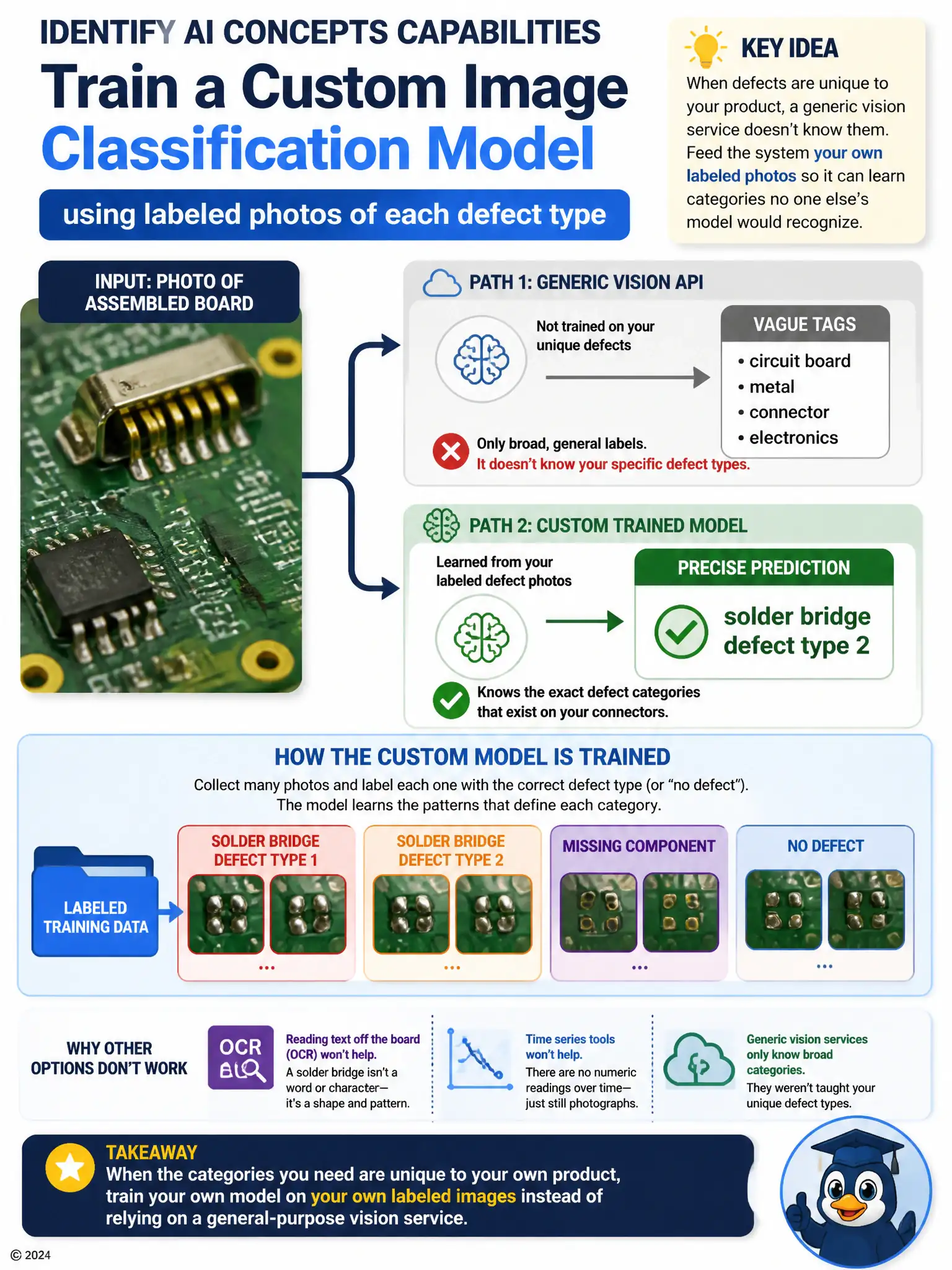
These defects are unique to your product line, so a generic vision service that only knows broad tags won't recognize them. You need to train a custom image classification model on your own labeled photos of each defect type. Reading text off the board or analyzing time-series sensor data doesn't fit because the problem is visual patterns in still photographs.
Full Explanation
Training a custom image classification model lets the manufacturer supply its own labeled photos of each specific defect type, so the model learns categories that a general-purpose service was never trained to recognize. Using the prebuilt Computer Vision API's generic image tagging as-is is incorrect because it only returns broad, generic tags like 'circuit board' or 'metal' and has no way to distinguish the manufacturer's proprietary defect patterns without additional training. Running optical character recognition on the board photos is incorrect because optical character recognition extracts printed or handwritten text from an image, but solder bridge defects are visual patterns, not text, so it would not detect them. Applying an anomaly detection model built for time-series sensor data is incorrect because that approach is designed for numeric time-series data, such as sensor readings over time, not for classifying visual defects within a single photograph. Because the defects are specific to this manufacturer's product and involve image content rather than text or numeric sequences, a custom-trained classifier is the right tool.