
A retailer has three years of purchase history for its loyalty members but has never assigned any of them to a segment or category. A data scientist wants an algorithm to examine the purchase patterns and discover natural groupings of similar shoppers on its own, without being told in advance what the groups should be. Which type of machine learning task is this?
Select an answer to reveal the explanation.
Short Explanation
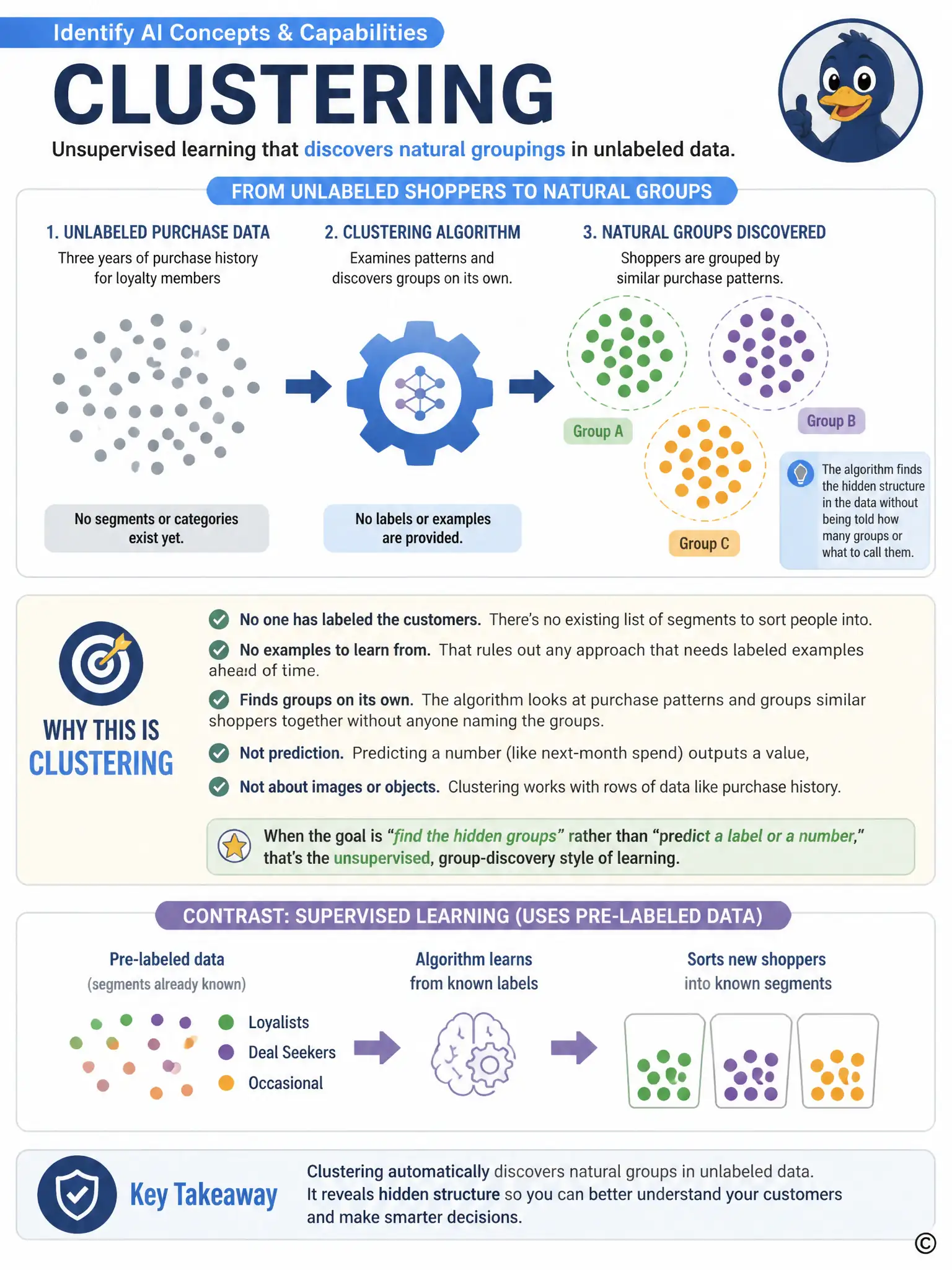
You've got no existing labels or segments to sort shoppers into, so the algorithm has to find the groups on its own. Clustering does exactly that: it looks at purchase patterns and groups similar customers without being told what the groups should be. Predicting a number or sorting into known categories is a different job.
Full Explanation
Clustering is the correct task because it is an unsupervised learning approach that groups data points by similarity without relying on predefined labels. That matches a retailer with three years of purchase history but no existing segment assignments, where the goal is to discover natural groupings of similar shoppers on its own. The classification option is incorrect because classification is supervised learning that assigns new data to categories the model was already trained on using labeled examples, but here no labels exist yet. The regression option is incorrect because regression predicts a continuous numeric value, such as forecasted spend, rather than discovering groupings among customers. The object detection option is incorrect because object detection identifies and locates items within images, which has nothing to do with analyzing tabular purchase history to find customer segments. Because the retailer wants unlabeled data organized into meaningful groups rather than sorted into known categories or used to predict a number, clustering is the appropriate approach.