
A retailer's Foundry-hosted support agent answers customer questions about product availability. Inventory levels change by the minute, and the model's training data has no knowledge of current stock, so a plain prompt-engineered response would either guess or refuse to answer. The team wants the agent to retrieve the live stock count from the retailer's existing inventory API before it replies. Which Foundry capability should they configure to accomplish this?
Select an answer to reveal the explanation.
Short Explanation
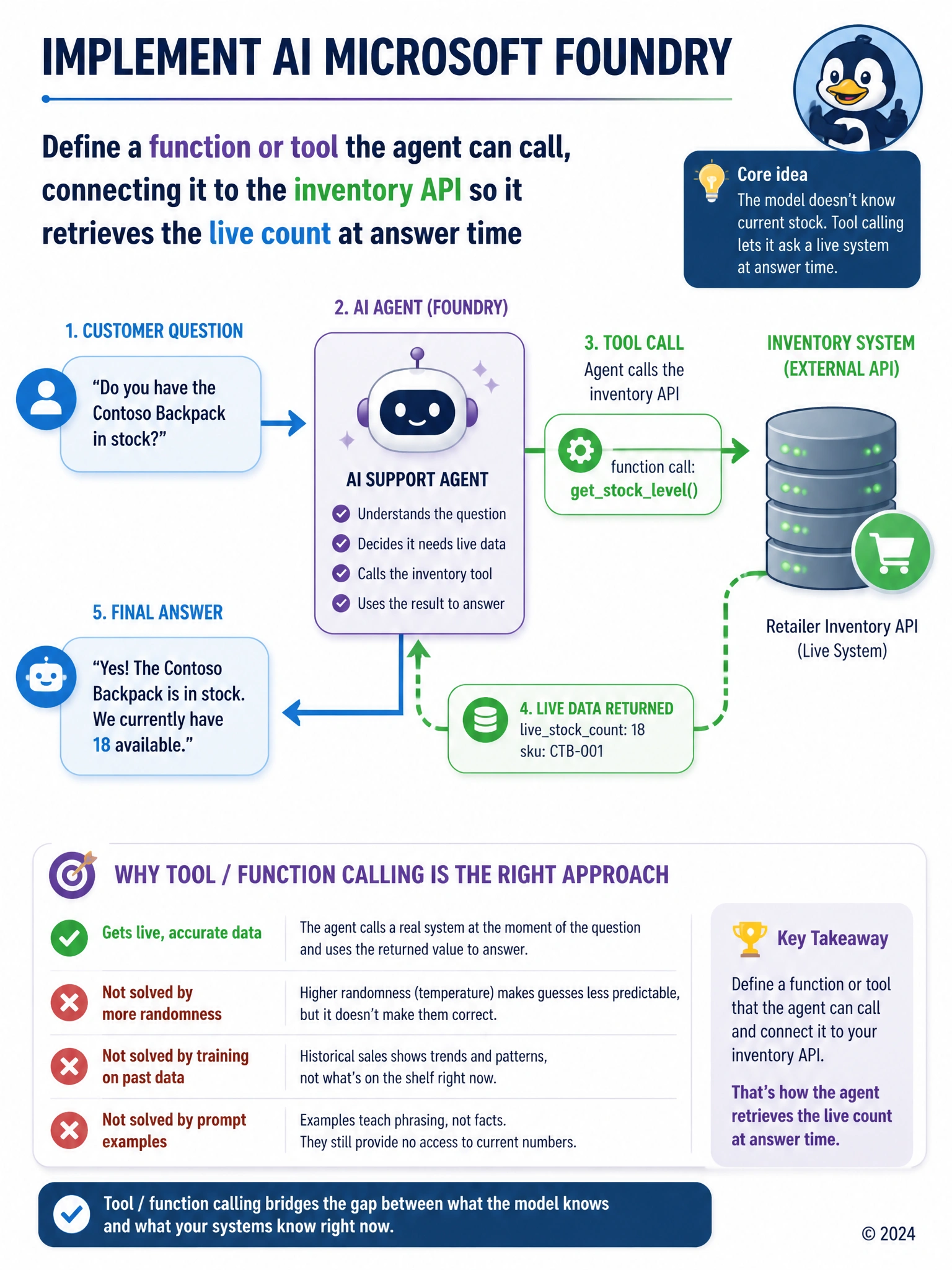
The core issue here is that the model simply doesn't know, and can't know, what's in stock right now, because that number changes constantly and nothing about training a model on old data fixes that. What it needs is a way to reach out and ask a live system the question at the moment a customer asks. That's exactly what tool or function calling is for: you describe the inventory lookup as a callable action, and the agent uses it mid-conversation to pull the real number before it answers. Cranking up randomness just makes an uninformed guess less predictable, it doesn't make it correct. Training the model on a year of past sales teaches it seasonal patterns and trends, which is a different problem entirely from knowing what's on the shelf this afternoon. And loading the system message with sample answers about typical stock levels only teaches the model how to phrase a response, it gives it no actual access to current numbers. Connecting a live tool call to the real inventory system is the only approach that gets a trustworthy, up-to-date answer.
Full Explanation
The correct answer is D. The agent needs a fact that changes constantly and cannot be baked into the model at training or fine-tuning time, so it must reach out to a live data source at the moment of the question. Foundry supports defining functions or tools that an agent can invoke mid-conversation; connecting one to the retailer's inventory API lets the agent fetch the actual current count and ground its answer in real data rather than a prediction. Option A is incorrect because raising temperature increases response variety and creativity, which makes an already-uninformed guess less consistent, not more accurate. Option B is incorrect because fine-tuning on historical sales data teaches the model patterns from the past, but stock levels an hour from now are not derivable from last year's trends, and fine-tuning does not create a live data connection. Option C is incorrect because adding illustrative examples to the system message only shapes response style and format, it does not give the model access to information it was never trained on and cannot retrieve on its own. Tool calling is the mechanism designed specifically for pulling in real-time external data.