
A publisher is deploying a Foundry-hosted generative model to help authors draft fictional dialogue for a mature drama series. The default content filter configuration blocks any violent language, even when it is clearly part of a fictional narrative rather than real instructions to cause harm. The team still wants the deployment to block outputs describing real-world weapon creation or hate speech. What should they do?
Select an answer to reveal the explanation.
Short Explanation
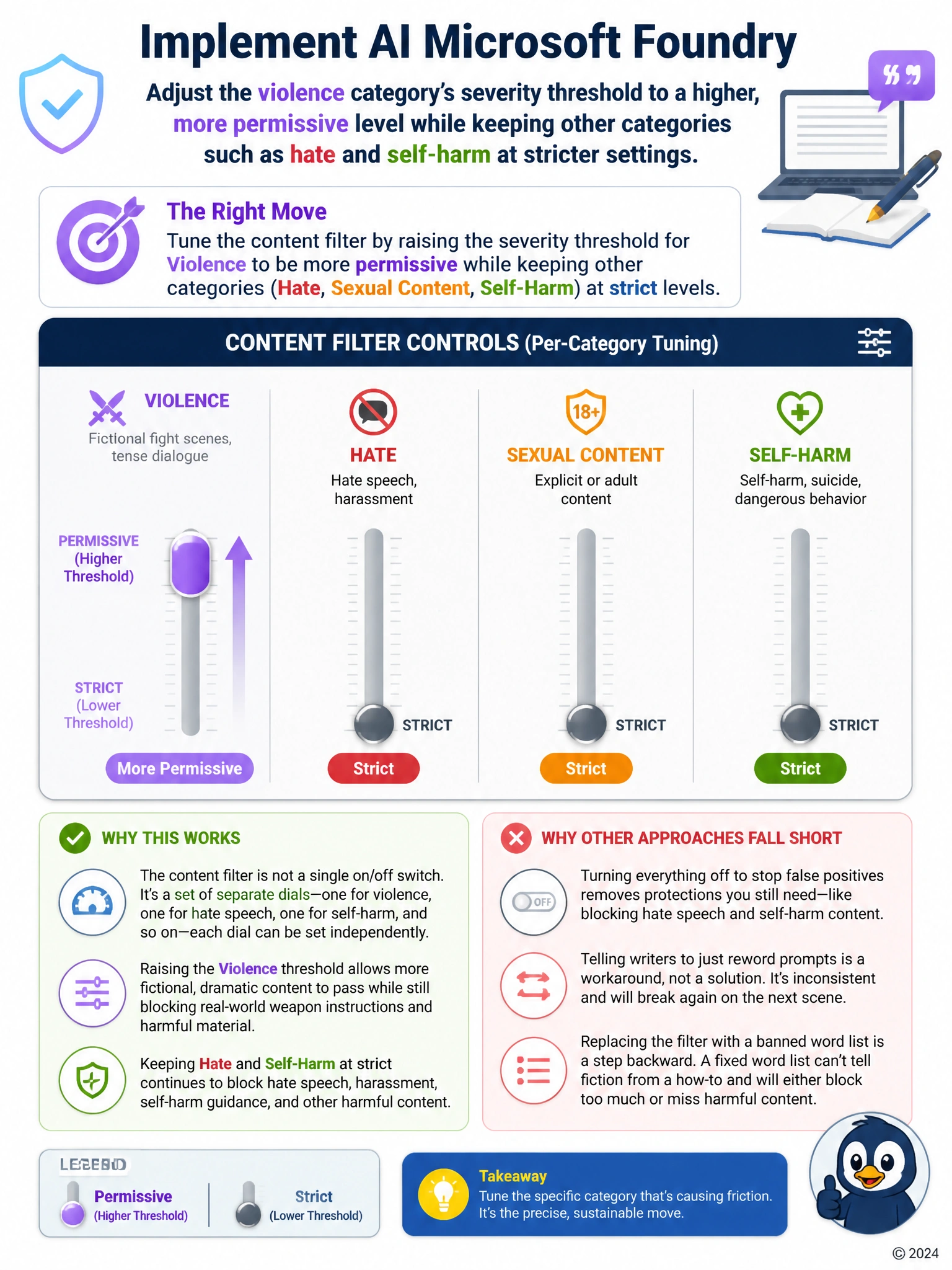
The filter isn't one on-off switch, it's a set of separate dials, one for violence, one for hate speech, one for self-harm, and so on, and each dial can be turned to a different level. So when the problem is specifically that fictional fight scenes and tense dialogue keep getting flagged, the fix is to loosen just that one dial while leaving the others where they were. Turning everything off to stop the false positives throws out protection the publisher still wants, like blocking hate speech, right along with the fix. Telling writers to just reword their prompts until something slips through isn't a real solution, it's a workaround that will break again on the next scene. And swapping in a list of banned words instead of the built-in filter is a step backward, because a fixed word list can't tell a dramatic confrontation from an actual how-to and will either block too much or miss things that matter. Tuning the specific category that's causing friction is the precise, sustainable move.
Full Explanation
The correct answer is C. Foundry's content filtering lets each harm category, including violence, hate, sexual content, and self-harm, be configured with its own severity threshold, so a team can loosen filtering for fictional violent dialogue specifically while leaving hate speech and other categories at their stricter defaults. This targets the actual problem, overly aggressive blocking of narrative content, without removing protection the firm still wants. Option A is incorrect because disabling filtering entirely removes protection against hate speech and real-world harmful content too, which the publisher explicitly still wants blocked. Option B is incorrect because it leaves the underlying problem unsolved; authors rephrasing prompts to dodge an overly strict filter is unreliable, wastes their time, and does not represent a supported or repeatable configuration. Option D is incorrect because a keyword blocklist cannot distinguish fictional dialogue from genuine harmful content the way a severity-tuned classifier can, and it will both over-block legitimate dramatic language and under-block harmful phrasing that avoids the listed words. Per-category severity tuning is the mechanism built for exactly this kind of selective adjustment.