
A support team serving customers across a dozen languages wants to add a model to their Foundry deployment. Before choosing, they need evidence that a candidate model performs well specifically on non-English support conversations, not just on the English benchmarks quoted in marketing material. Where in Foundry should they look to compare candidate models on this basis?
Select an answer to reveal the explanation.
Short Explanation
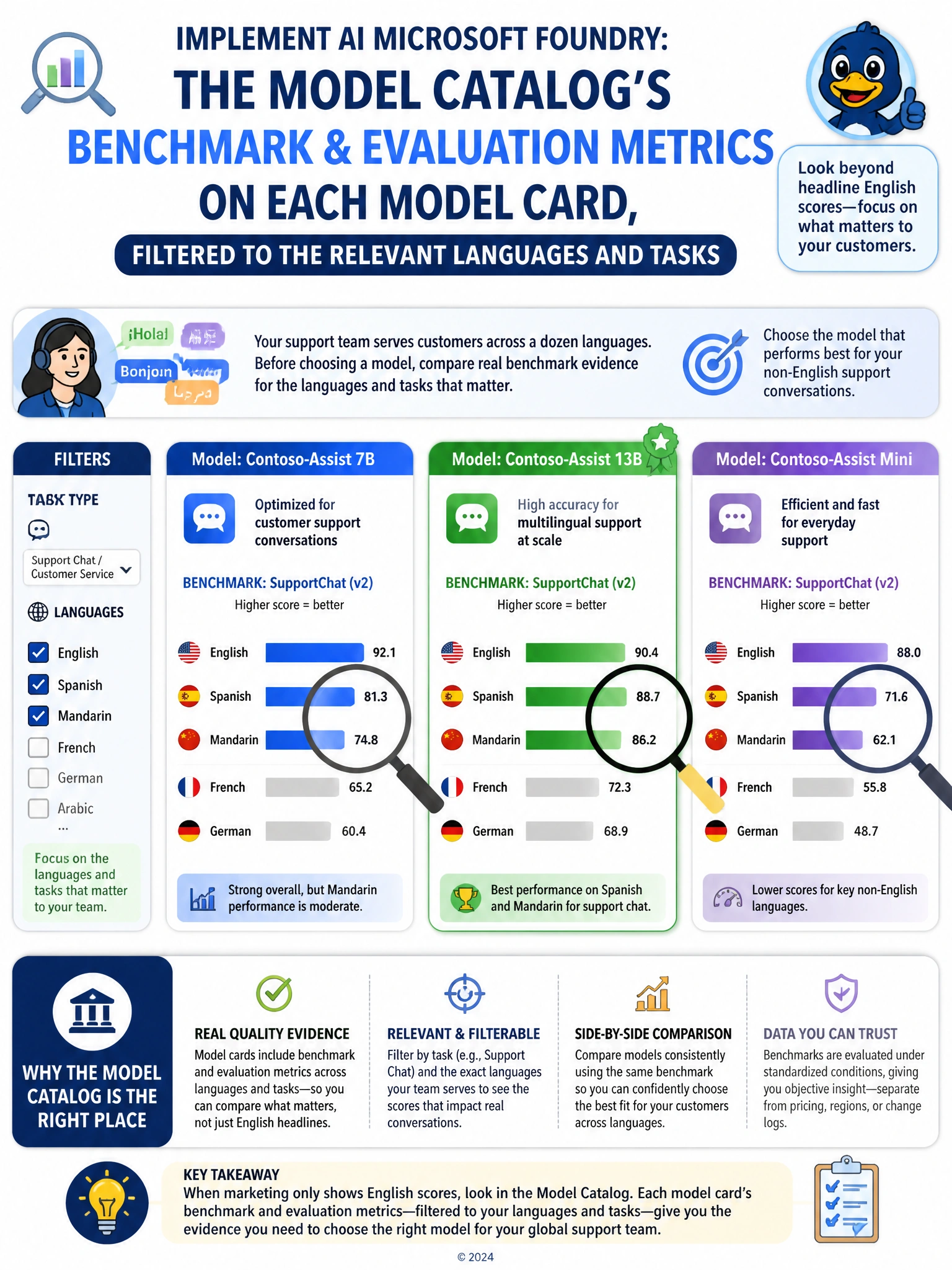
When marketing copy only brags about English scores, that tells you nothing about how a model handles a conversation in another language, so you need a different source of evidence. The model catalog is built for exactly this: each entry carries benchmark and evaluation results you can look at, and you can focus on the languages and task types that actually matter to your support team instead of taking the headline number at face value. A pricing page tells you what something costs, not whether it's any good at the job. A map of which regions host a model is about deployment logistics, like latency or data residency, and has nothing to do with how well the model actually converses in another language. And a log of past deployment changes is just a record of what got configured when, not a measure of quality at all. If you want a real comparison across languages, the benchmark data attached to each model in the catalog is the place built to give you that evidence.
Full Explanation
The correct answer is A. Each model in the Foundry model catalog has a model card that includes published benchmark and evaluation results, and these can be filtered or reviewed by task and language, giving the team concrete, comparable evidence of how a candidate performs on non-English support-style conversations rather than relying on a vendor's general marketing claims about English performance. Option B is incorrect because the cost management page shows pricing information, which has no bearing on how well a model handles multilingual conversation quality. Option C is incorrect because a region availability map only indicates where a model can be deployed for latency or compliance reasons, it says nothing about the model's language capability or accuracy. Option D is incorrect because an activity log is an operational audit trail of what configuration changes were made and when, not a source of model quality or performance data. Reviewing the catalog's benchmark data filtered to the languages and tasks that matter is the direct way to make an evidence-based model choice instead of assuming general-purpose marketing claims will hold across languages.