
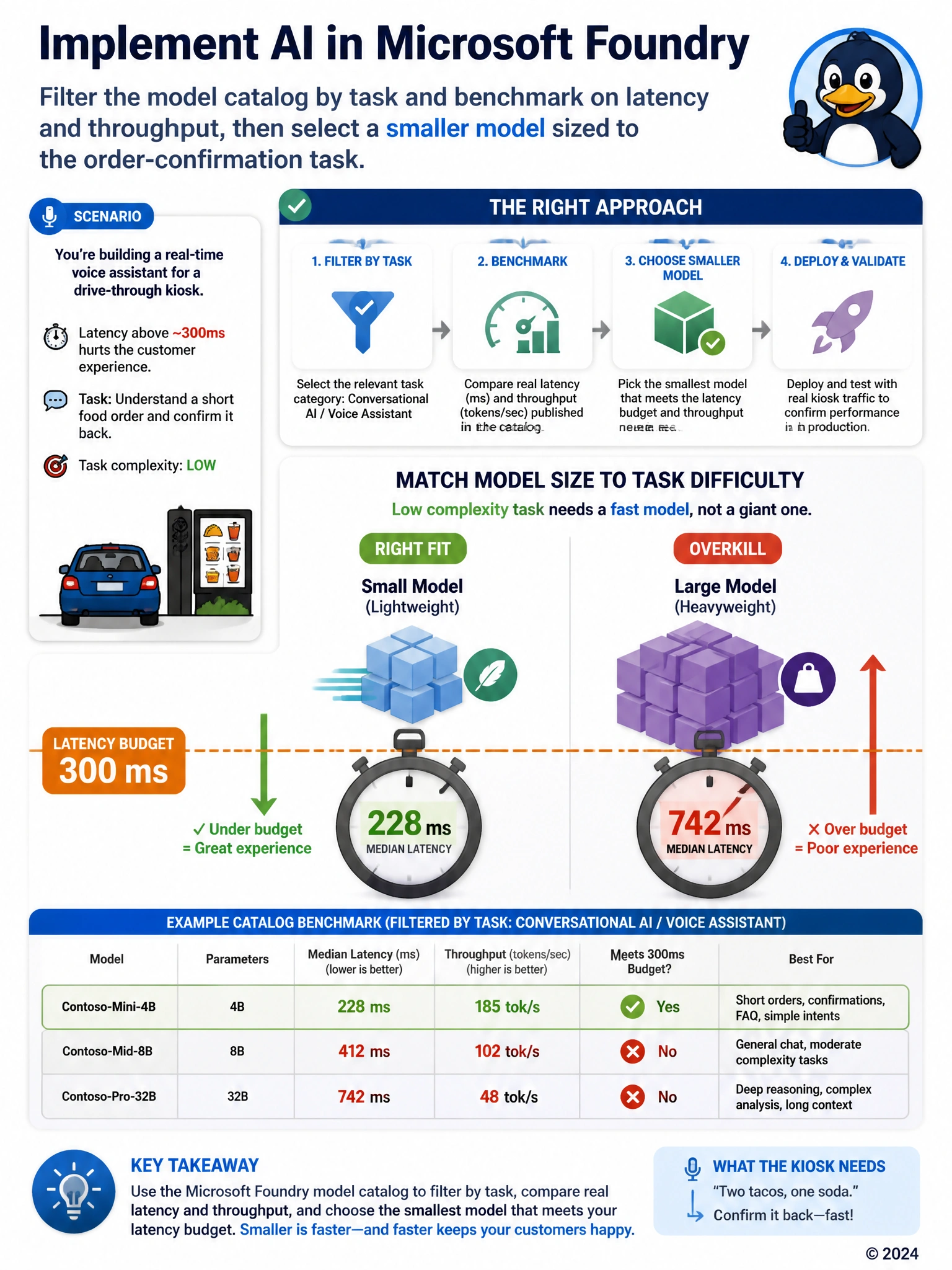
A team is building a real-time voice assistant for a drive-through kiosk using Microsoft Foundry. Response latency above roughly 300 milliseconds noticeably degrades the customer experience, and the assistant's task, understanding a short food order and confirming it back, does not require deep reasoning. Which model-selection approach in the Foundry model catalog best fits this scenario?
Select an answer to reveal the explanation.
Short Explanation
Think about what the kiosk assistant actually has to do: hear 'two tacos, one soda' and confirm it back fast. That is not a job that needs a giant, do-everything model, it needs a quick one. The catalog exists so you can filter by task and check real latency and throughput numbers before you deploy, rather than assuming bigger always wins. Bigger models carry more compute per response, and every extra hundred milliseconds is something a customer standing at a speaker notices. Running two large models and blending their answers sounds thorough but it doubles your wait time for a task that barely needs one careful answer, let alone two. And fine-tuning the largest model in the catalog on your own audio data solves an accuracy problem you don't really have here, while doing nothing about the speed problem you do have. The right move is matching model size to task difficulty and checking the benchmark numbers Foundry already publishes, so you land on something small and fast enough to keep the drive-through line moving.
Full Explanation
The correct answer is B. The task, confirming a short food order, is narrow and low-complexity, while the binding constraint is latency, not reasoning depth. Foundry's model catalog lets teams filter candidate models by task type and compare published latency and throughput benchmarks, so the team can pick a smaller model that meets the sub-300-millisecond target while still handling order confirmation reliably. Option A is incorrect because model size does not translate directly into fitness for a task; a large model adds inference time and cost without improving accuracy on a simple confirmation task, and may actually push latency past the acceptable threshold. Option C is incorrect because running two large models and averaging outputs multiplies latency and cost while adding complexity, working against the stated goal of a fast response. Option D is incorrect because fine-tuning the largest available model is an expensive, slow path that still leaves the team with a large model's inference latency; it addresses accuracy on domain-specific audio, not the speed constraint that is actually driving the decision here. Sizing the model to the task using catalog benchmarks is the direct, low-cost way to meet a hard latency requirement.