
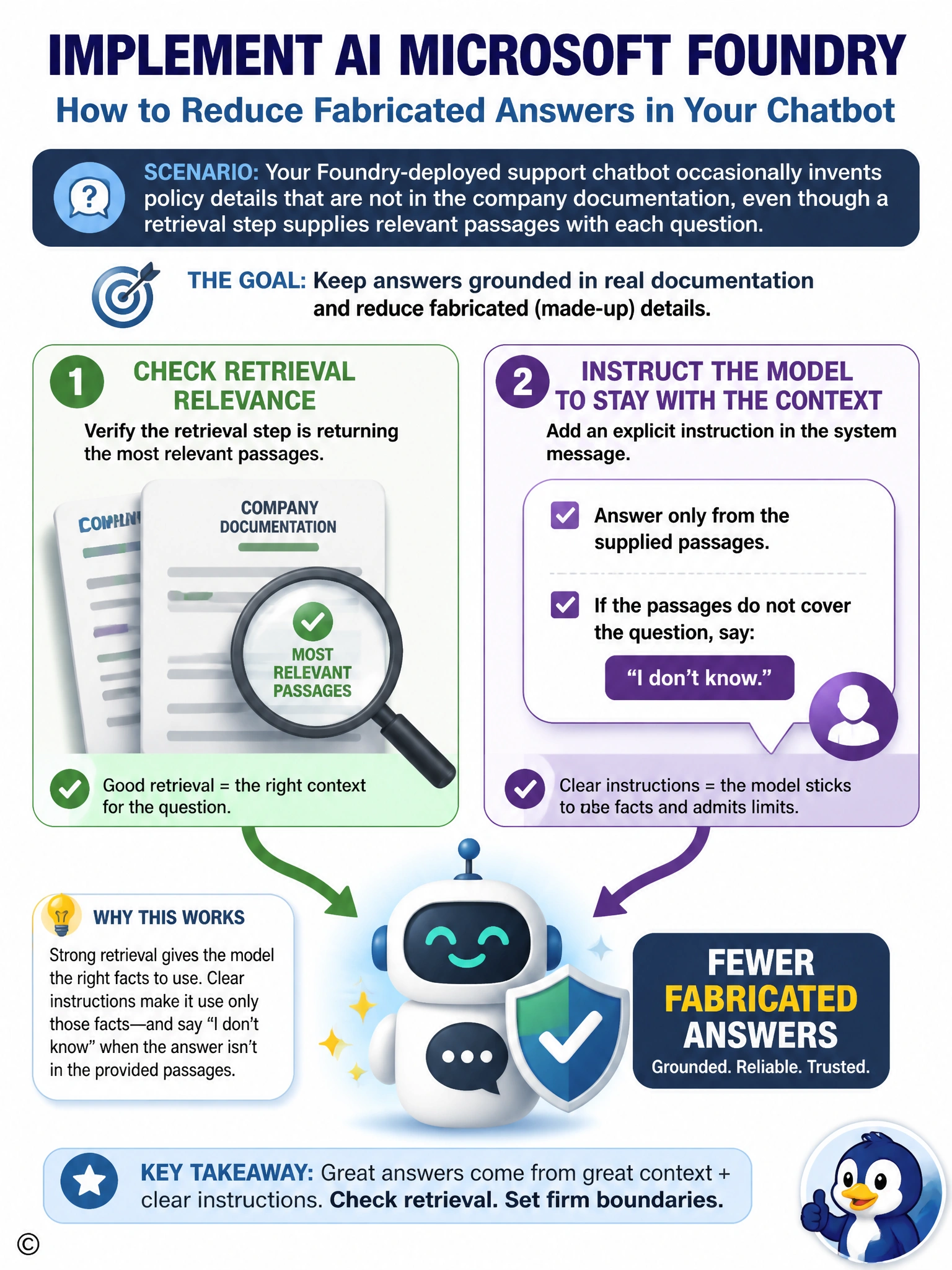
A team's Foundry-deployed support chatbot occasionally invents policy details that are not in the company's actual documentation, even though a retrieval step supplies relevant passages with each question. To reduce these fabricated answers, which two changes should the team make? (Select TWO.)
Select all correct answers, then click Submit.
Short Explanation
If a chatbot is making things up even though it's being handed relevant passages, there are really only two places the problem can live: either the passages it's getting aren't actually the right ones, so it's guessing to fill the gap, or it's not being told firmly enough to stick to what's in front of it and admit when the answer just isn't there. So you check the retrieval side first, making sure it's actually surfacing the passages that matter for the question being asked, and then you tighten up the instructions so the model knows sticking to those passages, and saying it doesn't know when they don't cover something, is non-negotiable. Making answers longer doesn't touch either of those problems, and pulling the grounding step out entirely only removes the one thing keeping the model tied to real documentation in the first place, which would make the invented details worse, not better.
Full Explanation
The correct answers are A and B. Explicitly instructing the model to answer only from the supplied passages and to admit when it does not know closes off the model's tendency to fill gaps with plausible-sounding invention, and checking that retrieval actually surfaces the most relevant passages addresses the other common cause: if the model is not given the right grounding text in the first place, it has no choice but to fall back on its own guesses. Option C is incorrect because raising the maximum output token limit only allows longer responses; it does nothing to anchor those responses in the actual documentation and could give the model more room to elaborate on fabricated details. Option D is incorrect because removing the retrieval step entirely eliminates the one mechanism that grounds answers in company-specific facts, which would make fabrication worse, not better, since the model would be answering purely from general training data with no connection to actual policy. Tightening the instructions and verifying the quality of what gets retrieved are the two changes that directly target why the chatbot is inventing details despite having a retrieval step in place.