
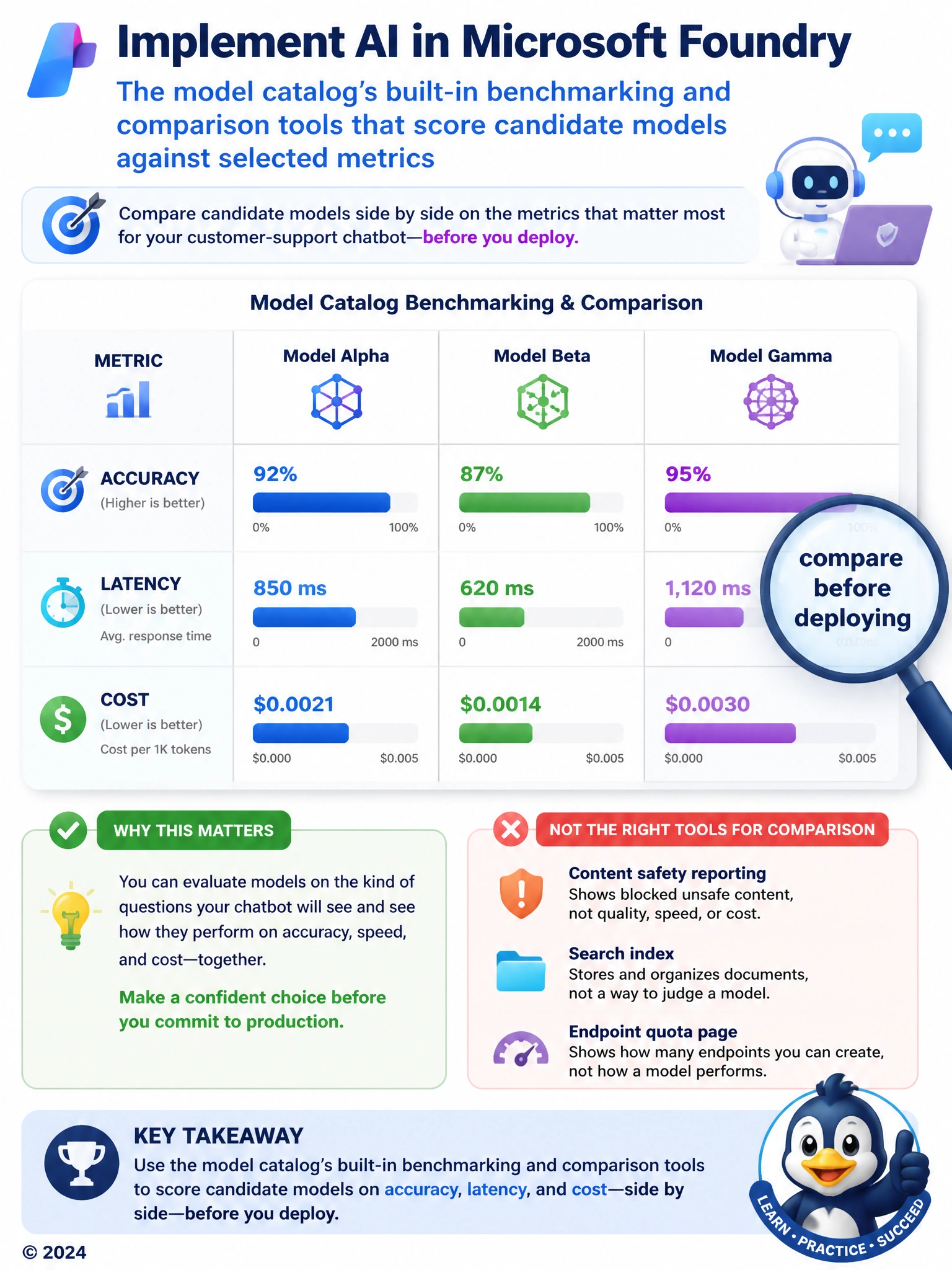
Before committing to a model for a customer-support chatbot, a team wants to compare several candidate models in the Azure AI Foundry catalog side by side on accuracy, latency, and cost for their specific type of question, before deploying any of them. Which Foundry capability directly supports this comparison?
Select an answer to reveal the explanation.
Short Explanation
Before locking in a model, you want a way to line candidates up next to each other and see how they actually perform on the kind of questions your chatbot will get, not just take a guess based on a model's reputation. A tool that reports on blocked unsafe content isn't measuring quality or speed at all, and a search index is just where your documents live, not a way to judge a model. A page showing how many endpoints you're allowed to spin up is purely a capacity number and tells you nothing about performance either. What actually does the comparing is a built-in benchmarking view in the catalog, where you can look at accuracy, latency, and cost together across several candidates before you've committed a single one of them to production.
Full Explanation
The correct answer is B. The model catalog's built-in benchmarking and comparison tools let the team evaluate multiple candidate models side by side on metrics such as accuracy, latency, and cost, which is exactly the kind of pre-deployment evaluation this scenario calls for, all without committing to a full deployment first. Option A is incorrect because the content safety filter configuration reports on how often content gets blocked for policy reasons, which has nothing to do with comparing model accuracy, speed, or price. Option C is incorrect because an Azure AI Search index stores and retrieves the chatbot's knowledge documents; it plays a role in a RAG pipeline but does not benchmark or compare candidate models. Option D is incorrect because the deployment quota page only shows how many endpoints a subscription is allowed to create, a capacity limit unrelated to evaluating which model performs best for the task. The benchmarking and comparison tools are purpose-built for exactly this kind of side-by-side, metric-driven model selection before deployment.