
A financial-services company has spent months refining system-message instructions and few-shot examples to get a Foundry-deployed model to consistently format outputs to the firm's compliance-mandated document template and tone, but the model still drifts back to its default style after a few conversational turns. The company has thousands of correctly formatted prior documents. What should they do next?
Select an answer to reveal the explanation.
Short Explanation
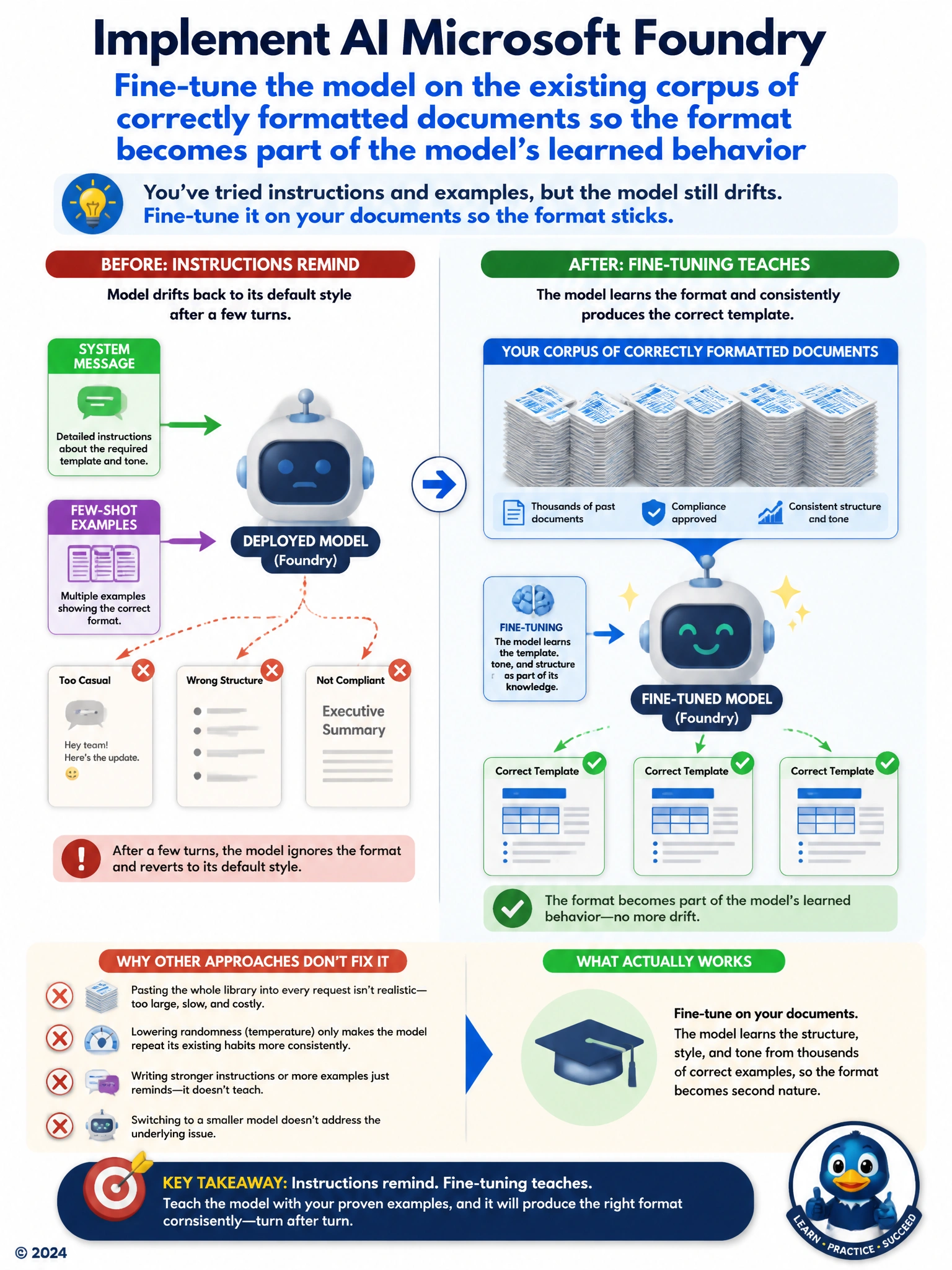
When you've already tried explaining the format in the instructions and shown examples over and over, and the model still wanders back to its own habits a few turns later, that's a sign the instructions aren't sticking, not that you need to write them more forcefully. Pasting the whole library of past documents into every request isn't realistic either, since there's far too much of it to fit and it would be slow and costly to resend constantly. Turning down the randomness setting just makes the model repeat itself more consistently, which isn't the same as actually knowing the right template. Swapping to a smaller model doesn't touch the underlying issue at all. What actually works here is training the model itself on that big pile of correctly formatted examples, so the format stops being something you have to remind it of and becomes part of how it naturally responds.
Full Explanation
The correct answer is A. Fine-tuning trains the model's weights on the company's thousands of correctly formatted documents, embedding the required tone and template as learned behavior rather than something reasserted through instructions every turn, which addresses the drift that prompt-based approaches have already failed to fix. Option B is incorrect because a corpus of thousands of documents will not fit within any model's context window, and even if a subset did fit, repeating it in every request would be prohibitively slow and expensive at scale. Option C is incorrect because lowering temperature to zero makes outputs more deterministic and repetitive but does not teach the model the specific compliance format; it can still confidently drift toward its default style, just more consistently. Option D is incorrect because switching to a smaller model does not address the root cause, which is that the model was never trained to prefer this template, and a smaller model is if anything more likely to drift, not less. Fine-tuning is the option that changes what the model has actually learned, rather than relying on instructions it must be reminded of every time.