
A crisis-support hotline is deploying a Foundry-hosted chat model to have supportive conversations with people describing self-harm thoughts. Because the topic itself involves sensitive language that a generic filter might block outright, the team needs the conversation to continue while still blocking genuinely dangerous instructional content. What should they configure?
Select an answer to reveal the explanation.
Short Explanation
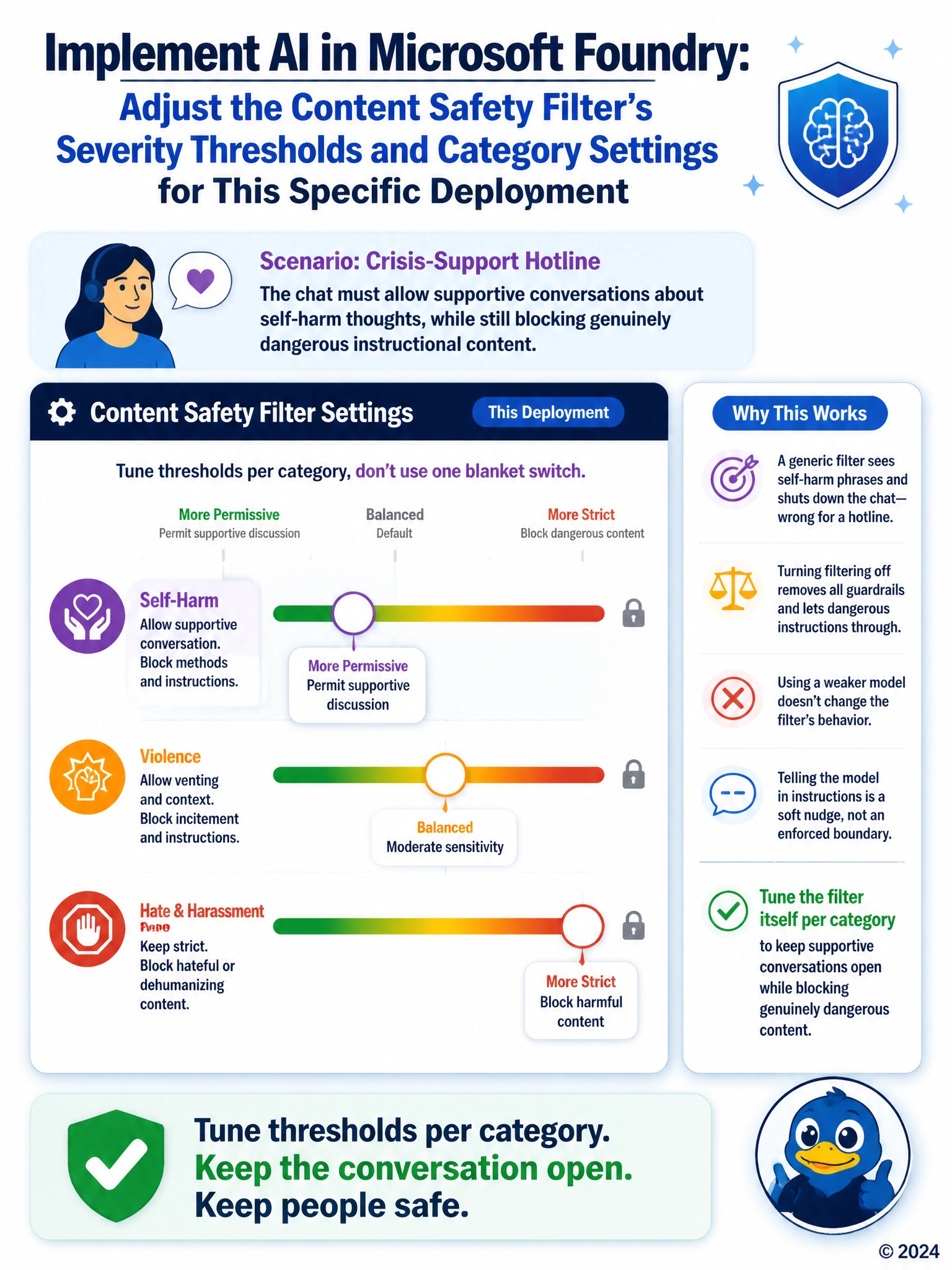
A generic filter tuned for the average app is going to see phrases about self-harm and slam the door shut, which is exactly the wrong reaction for a hotline whose entire job is to talk through that topic supportively. But swinging the other way and switching filtering off completely throws out the baby with the bathwater, since now genuinely dangerous instructional content has no gate at all. Swapping to a weaker model doesn't touch the filter's behavior either, and just telling the model in its instructions to be careful is a soft nudge it might not reliably follow, not an enforced boundary. What actually fits is going into the filter's own settings and tuning how sensitive it is to each category for this particular deployment, so the supportive conversation can continue while the genuinely dangerous stuff still gets caught.
Full Explanation
The correct answer is C. Adjusting the content safety filter's severity thresholds and category settings for this specific deployment lets the hotline allow discussion of self-harm topics at a level appropriate to supportive counseling, while still keeping protections active against genuinely dangerous instructional content. Option A is incorrect because turning off filtering entirely removes protection against the very content the team still wants blocked, such as detailed self-harm instructions, which is the opposite of what a hotline needs. Option B is incorrect because swapping in a smaller model with weaker general capabilities does not change how the content safety filter behaves, and it risks degrading the quality of supportive responses without solving the filtering mismatch at all. Option D is incorrect because a note in the system message is only a soft instruction the model may or may not consistently follow; it is not an enforced gate the way the configured content safety filter is, so genuinely harmful content could still slip through or sensitive-but-appropriate content could still get blocked upstream. Tuning the filter's own configured thresholds is the mechanism designed for exactly this kind of nuanced, deployment-specific balance.