
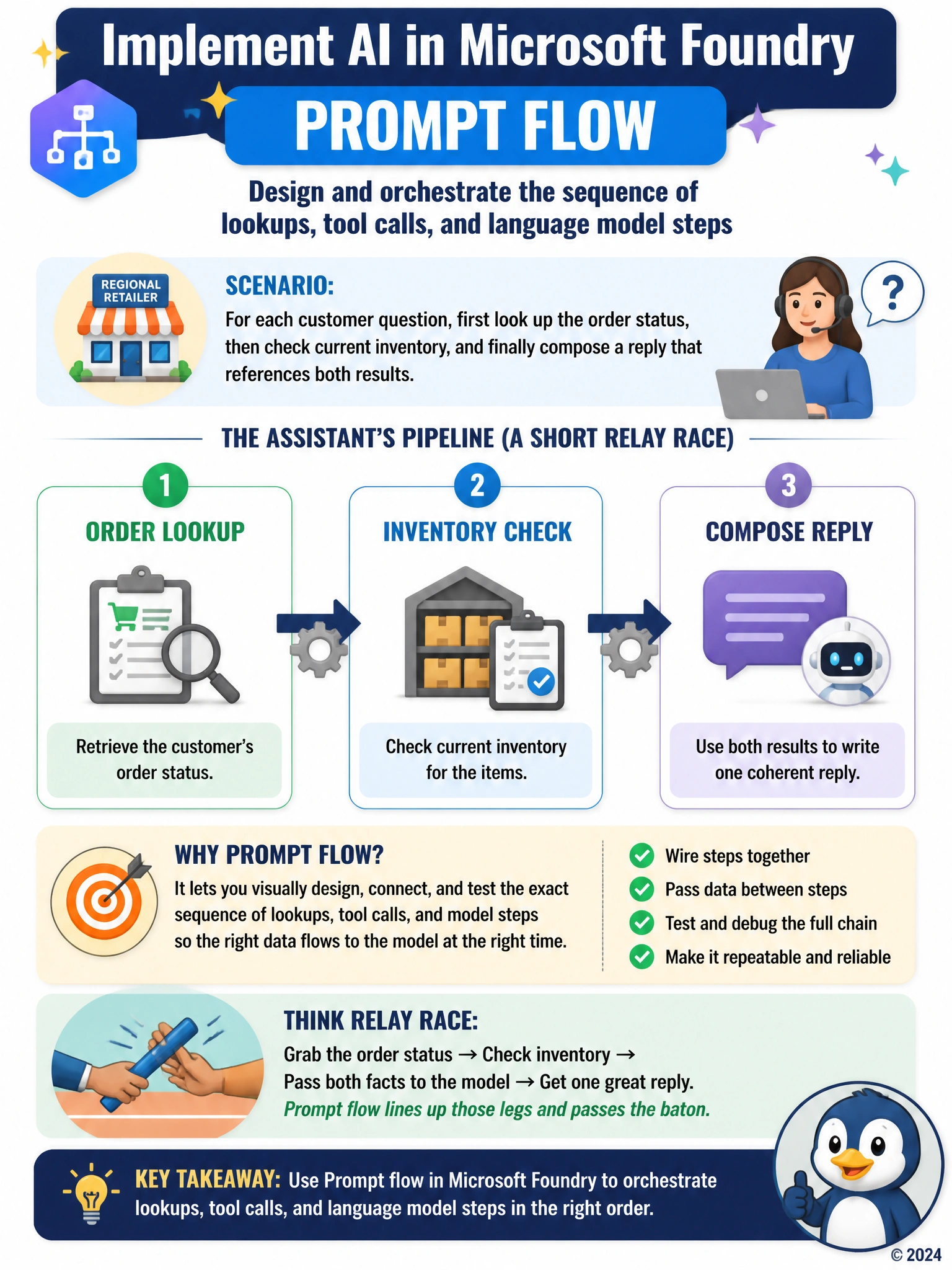
A regional retailer is building an internal support assistant that must, for each customer question, first look up the order status, then check current inventory, and finally compose a reply that references both results. The team needs a way to visually design and connect these steps as a repeatable pipeline in Microsoft Foundry. Which tool should they use?
Select an answer to reveal the explanation.
Short Explanation
Picture the assistant's job as a short relay race: first grab the order status, then check what is in stock, then hand both facts to the model so it can write one coherent reply. You need something that lines up those legs of the race in order and passes the baton between them, and that is exactly what the flow-design tool in Foundry is for, letting you wire steps together and test the whole chain before it goes live. A tool built only to screen replies for harmful language never touches that sequencing problem. A search index is great at finding matching records but will not connect a lookup step to a model step on its own. And skipping the real lookups entirely and just letting the model guess at order status and stock levels is the fastest way to hand a customer confidently wrong information.
Full Explanation
The correct answer is C. Prompt flow in Microsoft Foundry is the orchestration tool built for exactly this need: it lets a team lay out a sequence of steps, such as an order lookup, an inventory check, and a final language model call, connect their inputs and outputs visually, and test the whole chain before publishing it as an endpoint. Option A is incorrect because Content Safety screens content for harmful categories such as violence or hate speech; it does not sequence lookups or calls between systems. Option B is incorrect because Azure AI Search indexes and retrieves documents or records for search and grounding, but it does not by itself orchestrate a multi-step pipeline that mixes tool calls with a model response. Option D is incorrect because asking a model to guess order status and inventory without querying the real systems produces answers that are not grounded in current data and will likely be wrong, defeating the purpose of connecting real backend information. For a pipeline with distinct, ordered steps like this one, prompt flow provides the visual design surface and execution engine the retailer needs.