
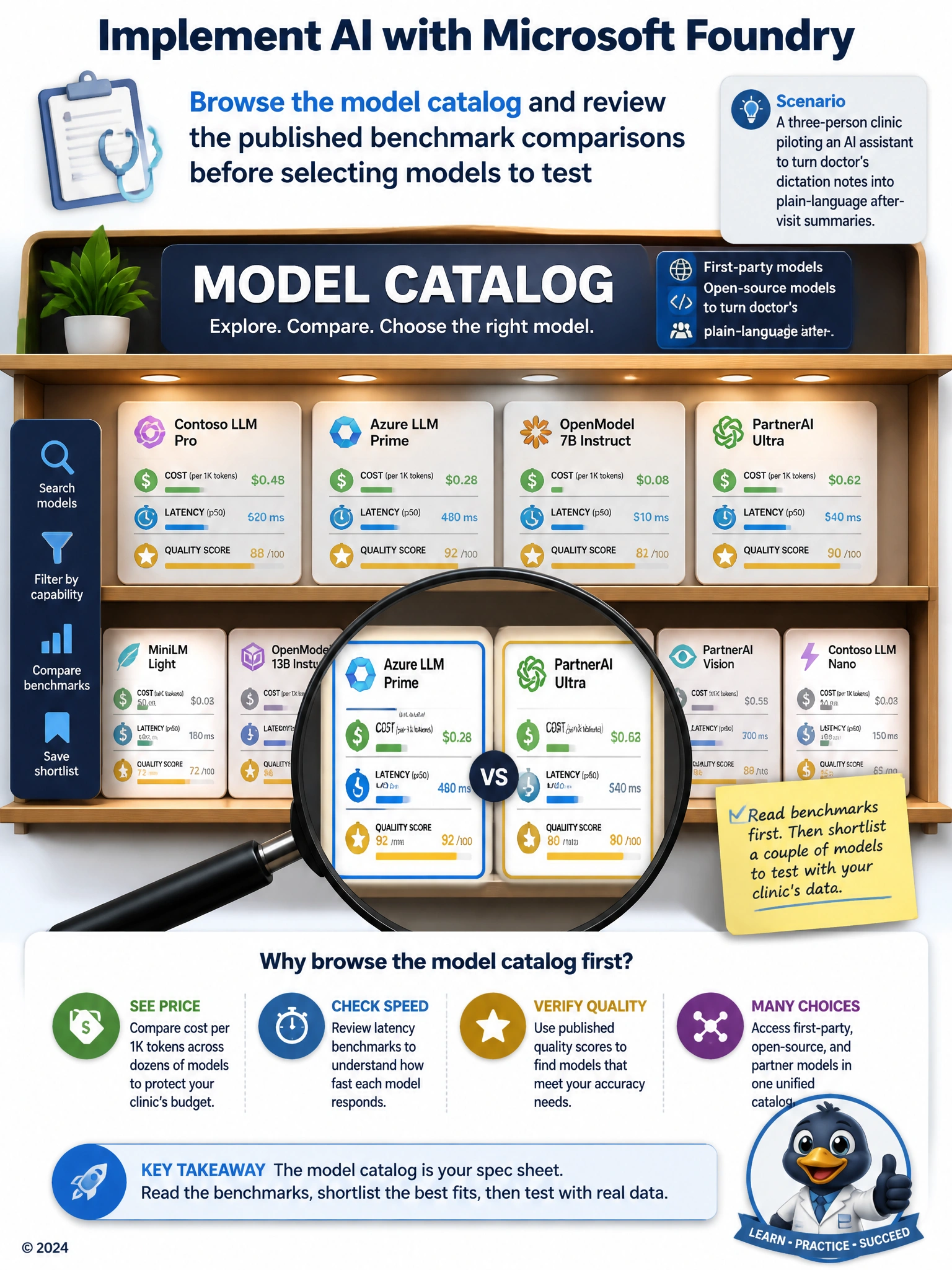
A three-person clinic is piloting an AI assistant to turn doctor's dictation notes into plain-language after-visit summaries. Before committing budget, the team wants to compare several candidate language models side by side on cost, latency, and quality benchmarks without writing custom evaluation code. Which capability of Microsoft Foundry should they use first?
Select an answer to reveal the explanation.
Short Explanation
Think of the model catalog like a spec sheet at a car dealership before you test-drive anything: it shows you price, speed, and quality numbers for dozens of models side by side so you are not guessing. Jumping straight to one model and deploying it skips that comparison step entirely. Assuming only one provider's models are available is also a trap, since Foundry actually brings together first-party, open-source, and partner models in the same catalog. And retraining every candidate before comparing them is backwards and expensive; the whole point of a catalog is that the heavy lifting of benchmarking is already done for you. For a small clinic watching its budget, reading the benchmark data first, then shortlisting a couple of models to try against real dictation notes, is the fastest and cheapest path to a decision that fits both quality needs and cost limits.
Full Explanation
The correct answer is B. The Microsoft Foundry model catalog lists many first-party, open-source, and partner models with published benchmark data on quality, cost, and latency, letting the clinic compare candidates before deploying anything, which fits their goal of choosing without writing custom evaluation code first. Option A is incorrect because Foundry projects can host and switch between many deployed models, not just one at a time. Option C is incorrect because the catalog includes models from multiple providers, including open-source and third-party options, not only Azure OpenAI models. Option D is incorrect because retraining every candidate model from scratch is unnecessary and costly; the catalog's benchmarks are designed specifically to support informed selection before any training or fine-tuning work begins. Choosing through the catalog first lets the clinic narrow to a shortlist, then test those few against real dictation samples, saving both money and staff time during the pilot phase of the project.