
A mid-size law firm wants an internal chatbot that answers questions strictly from its own contract archive and can point staff to the specific clause it used, rather than relying only on what a general-purpose language model already knows. Which approach in Microsoft Foundry best meets this requirement?
Select an answer to reveal the explanation.
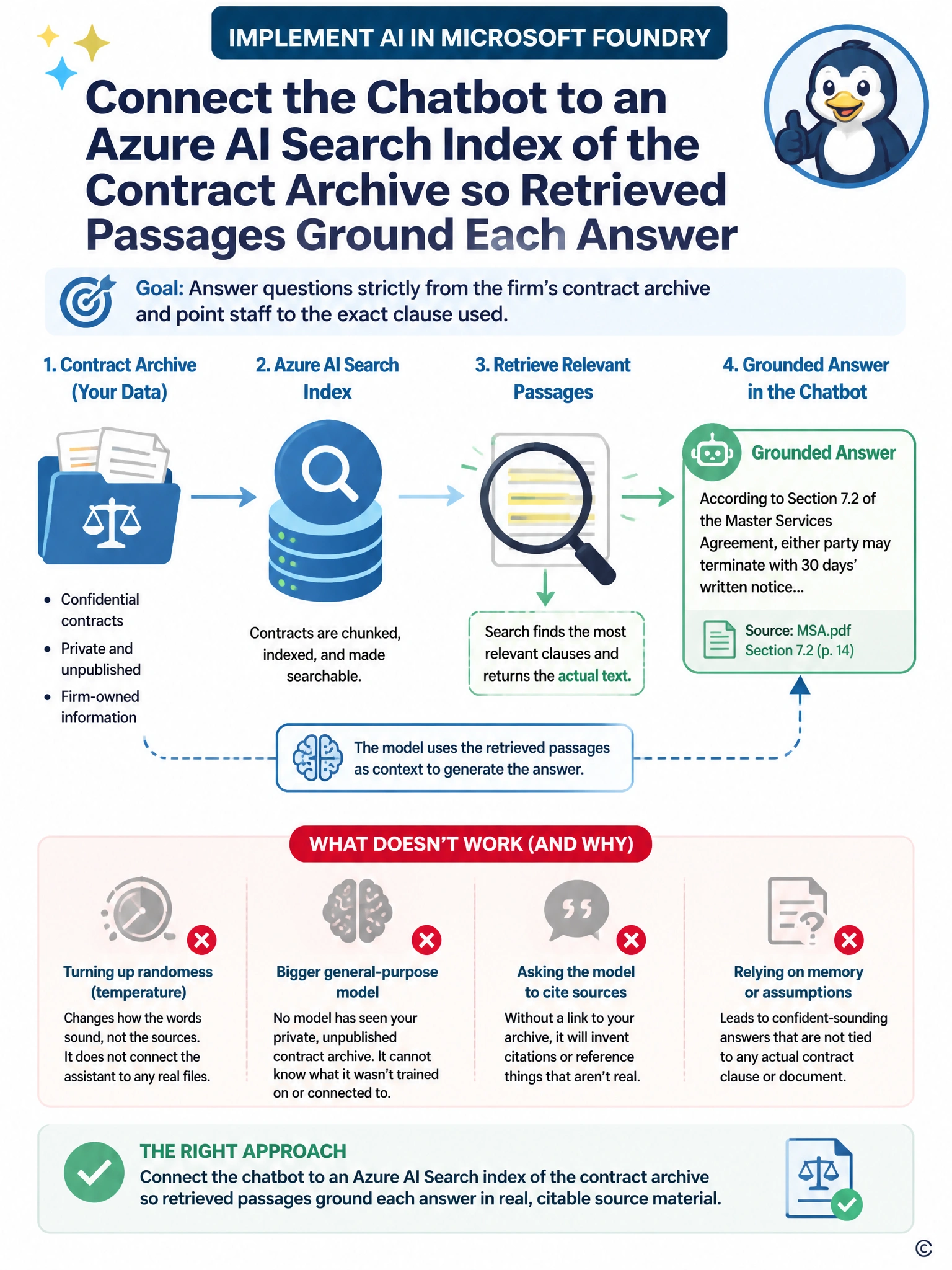
Short Explanation
Think of it like giving the assistant a librarian instead of just a good memory. Wiring the chatbot to a search index over the firm's contract archive means that when someone asks a question, the system actually goes and pulls the relevant clause first, then hands that real text to the model to build an answer around, so what comes back can be traced to an actual document. Turning up the randomness dial just changes how the wording sounds; it does not connect the assistant to any real files. Assuming a bigger general-purpose model would somehow already know the contents of a private, unpublished contract archive is wishful thinking; no model has seen documents it was never trained on or connected to. And asking the model to cite sources when it has no link to the firm's actual archive just invites confident-sounding answers that are not tied to anything real.
Full Explanation
The correct answer is D. Connecting the chatbot to an Azure AI Search index built from the firm's own contract archive implements the retrieval-augmented generation pattern: relevant passages are retrieved at query time and passed to the model as context, so answers are grounded in the firm's actual documents and can reference the specific clause used. Option A is incorrect because raising temperature only changes how varied or creative the wording of a response is; it does nothing to connect the model to private data or improve factual grounding. Option B is incorrect because no foundation model, regardless of size, has been trained on a specific firm's private, unpublished contracts, so a larger model cannot inherently know their contents. Option C is incorrect because a model with no connection to the firm's data can only reference its general training sources, which do not include the firm's confidential archive, so any citation it produces would be fabricated or irrelevant. Grounding through a search index over the firm's own content is what allows accurate, traceable answers tied to real clauses rather than plausible-sounding guesses.