
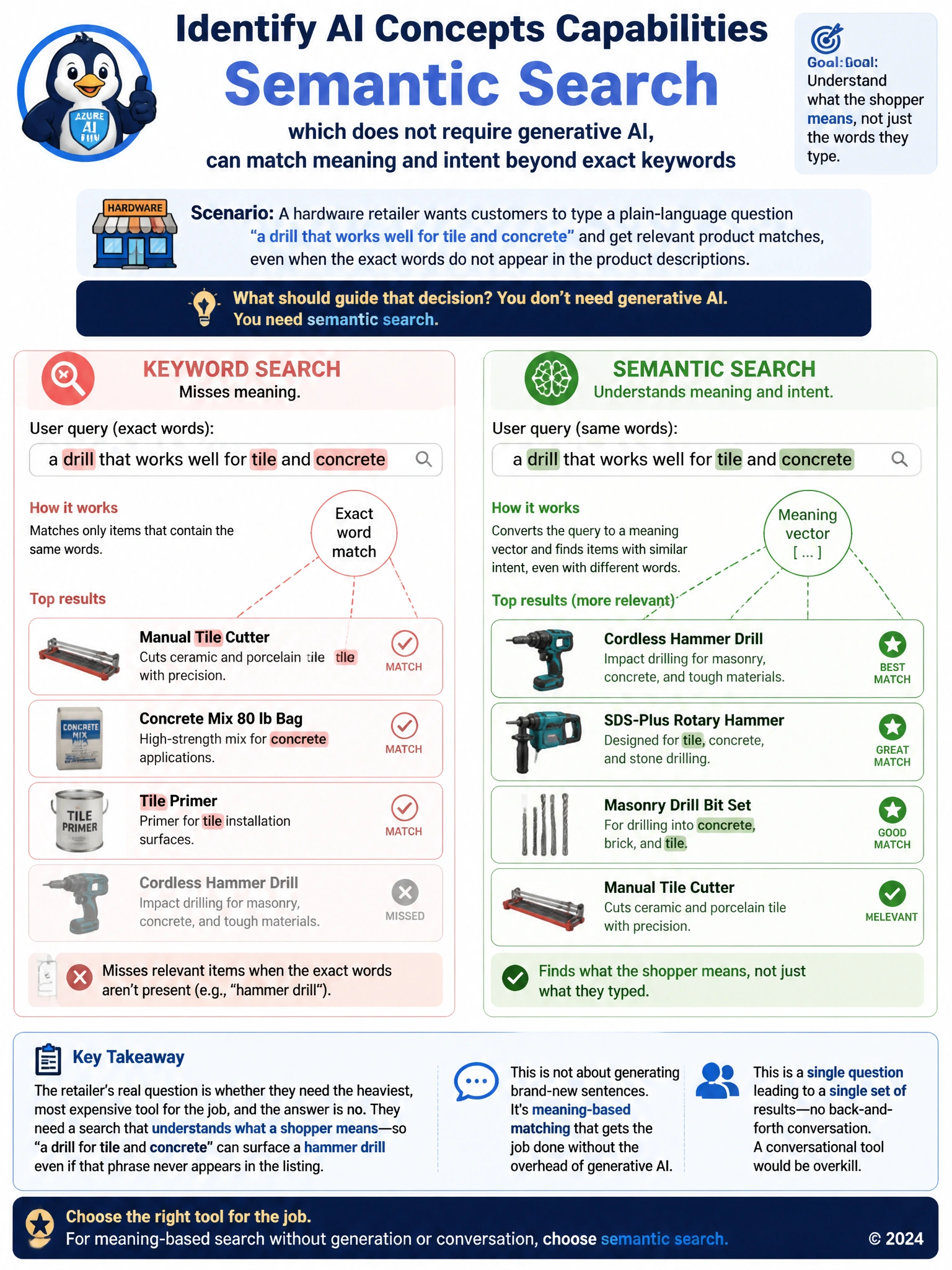
A hardware retailer wants to add a search feature that lets customers type a plain-language question like 'a drill that works well for tile and concrete' and get relevant product matches, even when the exact words do not appear in the product descriptions. The retailer is evaluating whether this requires generative AI or a simpler approach. What should guide that decision?
Select an answer to reveal the explanation.
Short Explanation
The retailer's real question is whether they need the heaviest, most expensive tool for the job, and the answer is no. What they actually need is a search that understands what a shopper means, not just the literal words typed in, so that 'a drill for tile and concrete' can surface a hammer drill even if that phrase never appears anywhere in the listing. That kind of meaning-based matching is a distinct capability from generating brand-new sentences, and it gets the job done without the overhead of a full generative model. Plain keyword matching is exactly the weak spot they are trying to escape, since it only catches literal word overlap and misses anything phrased differently. And nothing about this scenario involves a back-and-forth conversation, it is a single question leading to a single set of results, so reaching for a conversational, multi-turn tool would be solving a problem that was never posed.
Full Explanation
The correct answer is A. Semantic search is built to understand the meaning and intent behind a query, matching a question like a drill for tile and concrete to relevant products even when those exact words are absent from the descriptions, and it does this through vector-based similarity rather than needing a generative model to write new text. Option B is incorrect because processing natural language questions does not require a generative model specifically, since semantic search and other language understanding techniques can interpret intent without generating novel text. Option C is incorrect because plain keyword search only matches literal words present in the text, which is the exact limitation the retailer is trying to overcome. Option D is incorrect because this scenario describes a single-turn product lookup, not an extended back-and-forth conversation, so there is no requirement for multi-turn dialogue handling here.