
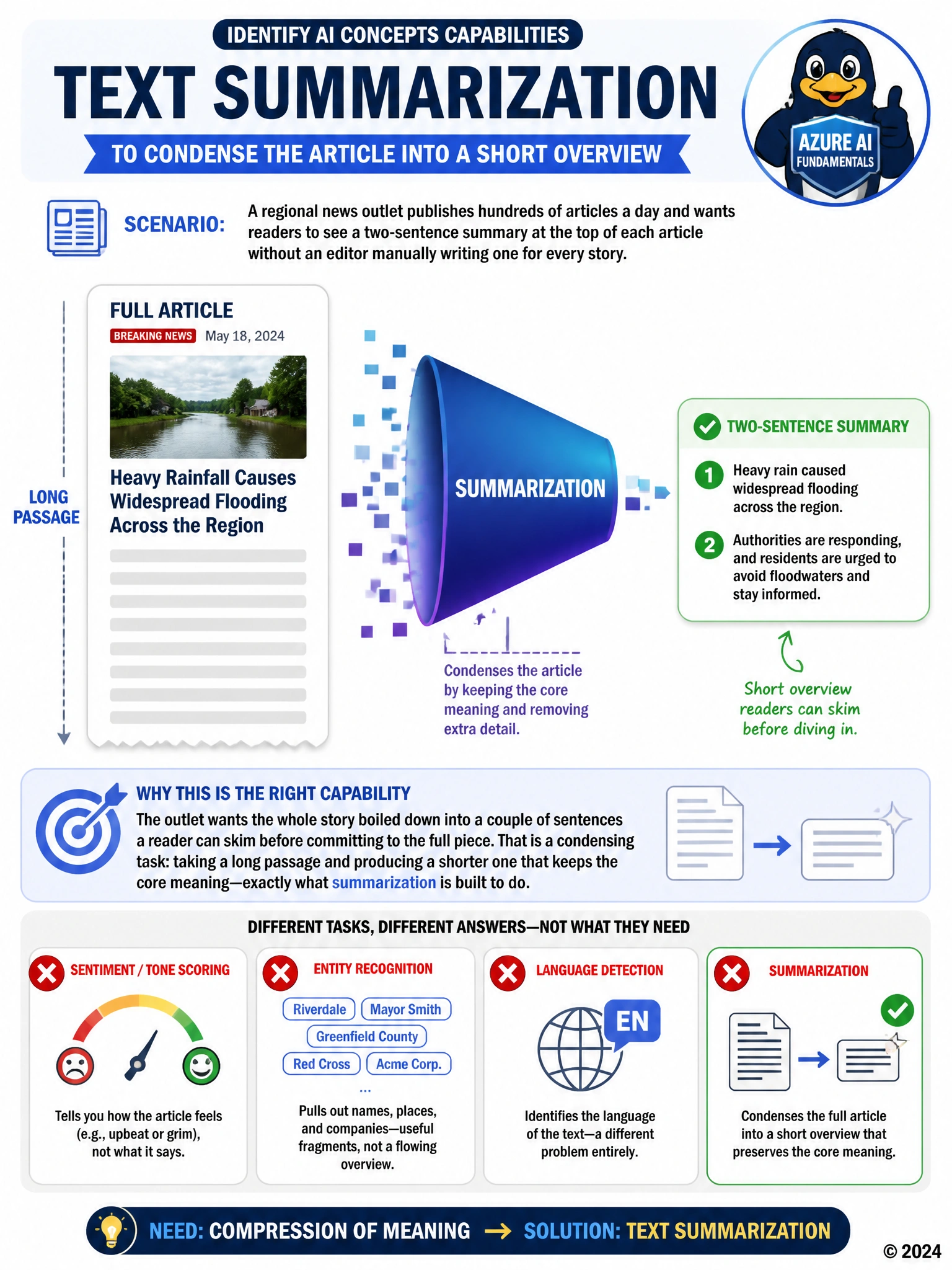
A regional news outlet publishes hundreds of articles a day and wants readers to see a two-sentence summary at the top of each article without an editor manually writing one for every story. Which Azure AI Language capability addresses this need?
Select an answer to reveal the explanation.
Short Explanation
The outlet is not asking whether an article feels upbeat or grim, and it is not asking for a list of names and companies mentioned, it wants the whole story boiled down into a couple of sentences a reader can skim before committing to the full piece. That is a condensing task, taking a long passage and producing a shorter one that keeps the core meaning, and that is precisely what a summarization capability is built to do. Scoring tone would tell you how the article feels, not what it says. Pulling out entities gives you fragments like names and organizations, not a flowing overview. And figuring out what language the text is written in solves a completely different problem, one the outlet does not even have since it already knows what language it publishes in. The need here is compression of meaning, and that points to summarization.
Full Explanation
The correct answer is D. Text summarization is designed to take a longer body of text, such as a full news article, and automatically condense it into a shorter overview while preserving the key points, which is exactly the two-sentence preview the news outlet wants to generate without manual editing effort. Option A is incorrect because sentiment analysis measures whether a piece of text reads as positive, negative, or neutral, which tells the outlet nothing about condensing the article's content into a summary. Option B is incorrect because named entity recognition pulls out specific mentions like people, places, and organizations, producing a list of entities rather than a coherent short overview of the story. Option C is incorrect because language detection simply identifies which language a piece of text is written in, which is irrelevant once the outlet already knows its articles are published in a known language and just wants a condensed version of the content.