
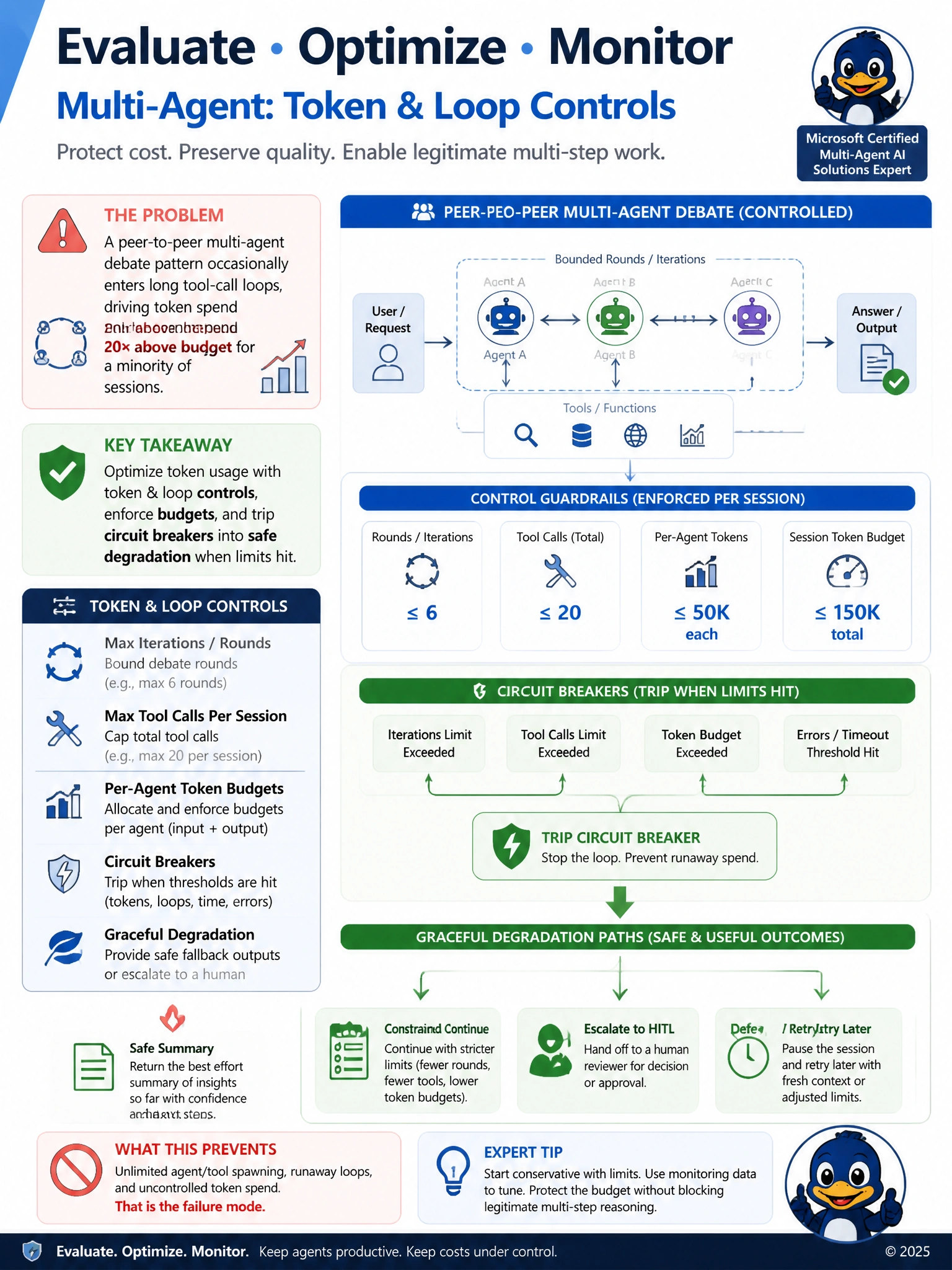
A peer-to-peer multi-agent debate pattern occasionally enters long tool-call loops, driving token spend 20× above budget for a minority of sessions. You need controls that protect cost without killing legitimate multi-step work. What should you implement?
Select an answer to reveal the explanation.
Short Explanation
Answer B. Optimizing token usage includes token limits, loop controls, and tool-call caps. Bound debate rounds and tools, enforce per-session budgets, and trip circuit breakers into a safe summary or HITL path. Unlimited spawning is the failure mode. Hiding cost metrics removes governance. Extreme temperature does not enforce budgets and harms quality.
Full Explanation
Correct answer: B. Design strategies for token usage and cost: limits, loop controls, tool-call ceilings, quotas, and chargeback visibility. For peer-to-peer patterns, hard-cap dialogue rounds and shared token pools; on breach, stop spawning, return best-so-far, and alert.
A is incorrect: uncontrolled spawning is a primary driver of runaway cost and chaotic traces.
C is incorrect: cost monitoring (usage, quotas, allocations, chargebacks) is an explicit exam skill.
D is incorrect: temperature does not implement financial or iteration governance and often increases verbose retries.
Pair controls with dashboards of tokens per workflow and alerts on budget outliers.