
Incidents in production show incomplete explanations: Azure Monitor has some dependency logs, but engineers cannot reconstruct which orchestrator decision led which subagent to call which tool for a single user session. What observability design is required?
Select an answer to reveal the explanation.
Short Explanation
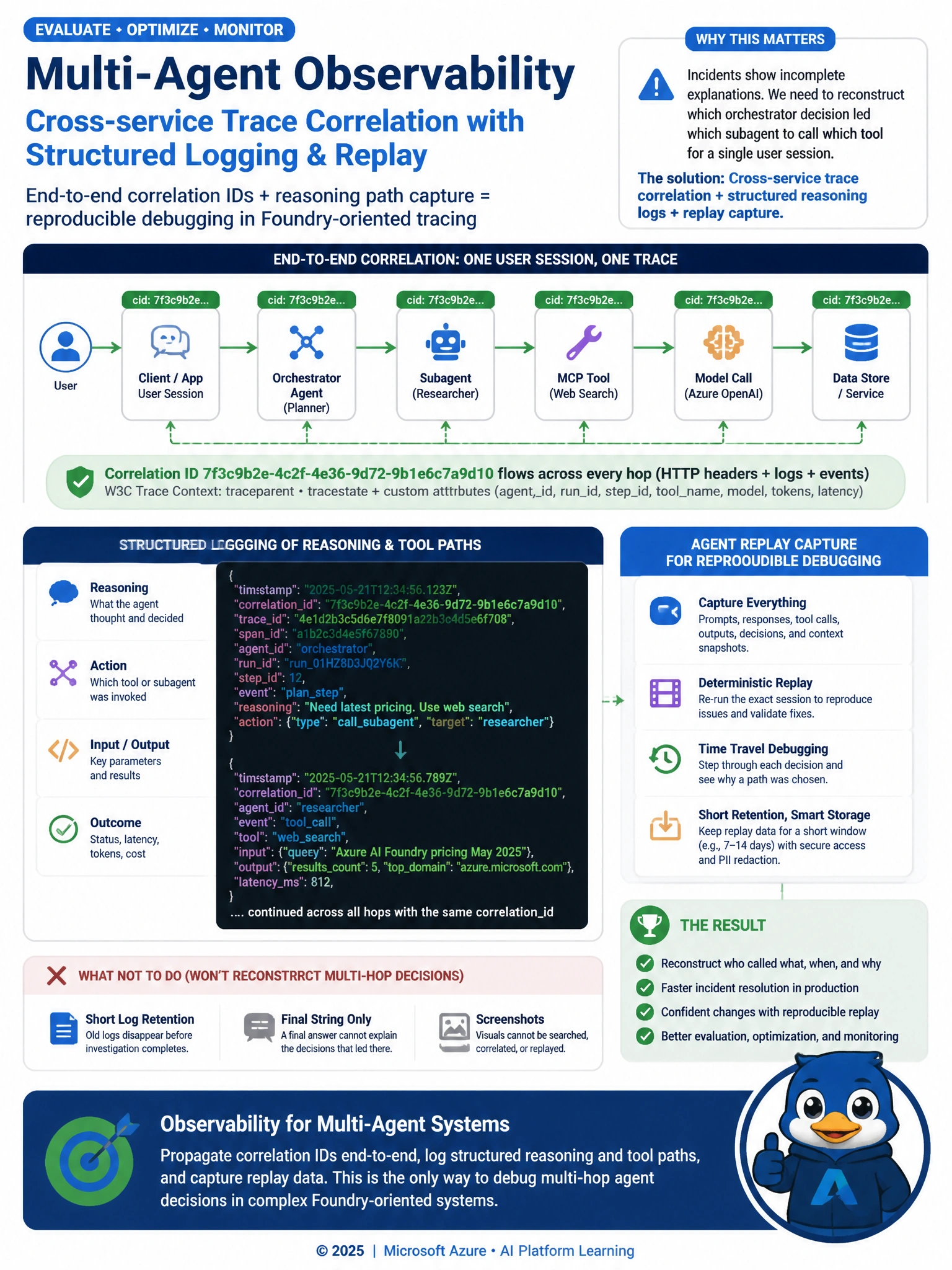
Answer A. Observability for multi-agent systems needs cross-service trace correlation, structured logging of reasoning/tool paths, and replay-friendly capture. Propagate correlation IDs from user session through orchestrator, subagents, MCP tools, and model calls. Short log retention, final-string-only logs, and screenshots cannot reconstruct multi-hop agent decisions.
Full Explanation
Correct answer: A. Design monitoring/observability for reliability: agent health, workflow failures, trace correlation, and remediation. Foundry tracing should cover tokens, prompts, correlation IDs, alerting, and execution tracking. Without distributed correlation, multi-agent graphs are undebuggable.
B is wrong: five-minute retention destroys forensic and quality analysis value.
C is wrong: user-visible text lacks tool inputs/outputs, model versions, and routing decisions.
D is wrong: manual screenshots do not scale and miss backend tool chains.
Also emit metrics for workflow failure rates and quality regression detectors tied to the same correlation model.