
In a multi-agent system, any specialist can currently invoke any registered tool, including high-risk actions such as wire transfers and customer data export. You must enforce authorization checks consistently without rewriting every agent prompt. What is the best design?
Select an answer to reveal the explanation.
Short Explanation
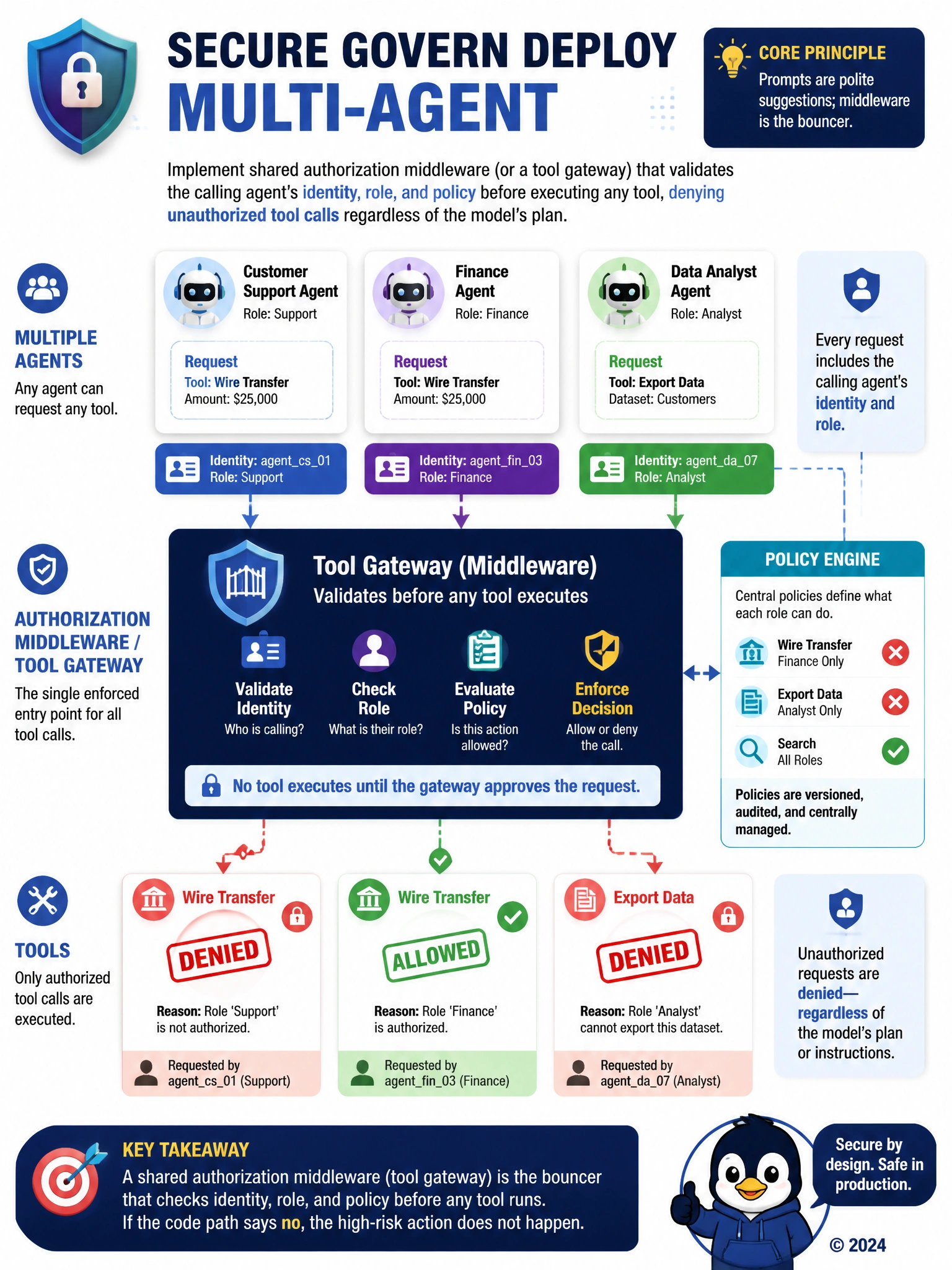
Correct answer: B. Prompts are polite suggestions; middleware is the bouncer. A shared tool gateway that checks the calling agent’s identity and policy before any high-risk tool runs means a jailbroken model still can’t wire money—because the code path says no.
Full Explanation
Building multi-agent systems requires tool permission boundaries and reusable middleware for authorization. Option B is correct: a centralized authorization layer or tool gateway enforces identity- and policy-based allow lists on every tool invocation, independent of the model’s generated plan, which is essential for high-risk tools.
Option A is incorrect: wiki documentation is not enforceable at runtime.
Option C is incorrect: eliminating tools may be safer but defeats automation goals and is not required when proper authz exists.
Option D is incorrect: prompt-only refusal is bypassable via injection and non-determinism; hard enforcement is required for security controls.
Exam tip: Prefer enforceable control planes (RBAC, gateways, middleware) over prompt-only security for tool access.