
A retailer wants a multi-agent solution that handles “resolve a late shipment”: detect delay, check inventory alternatives, propose options to the customer, and create a replacement order only after confirmation. How should you decompose the goal into agents and tools at the logical architecture level?
Select an answer to reveal the explanation.
Short Explanation
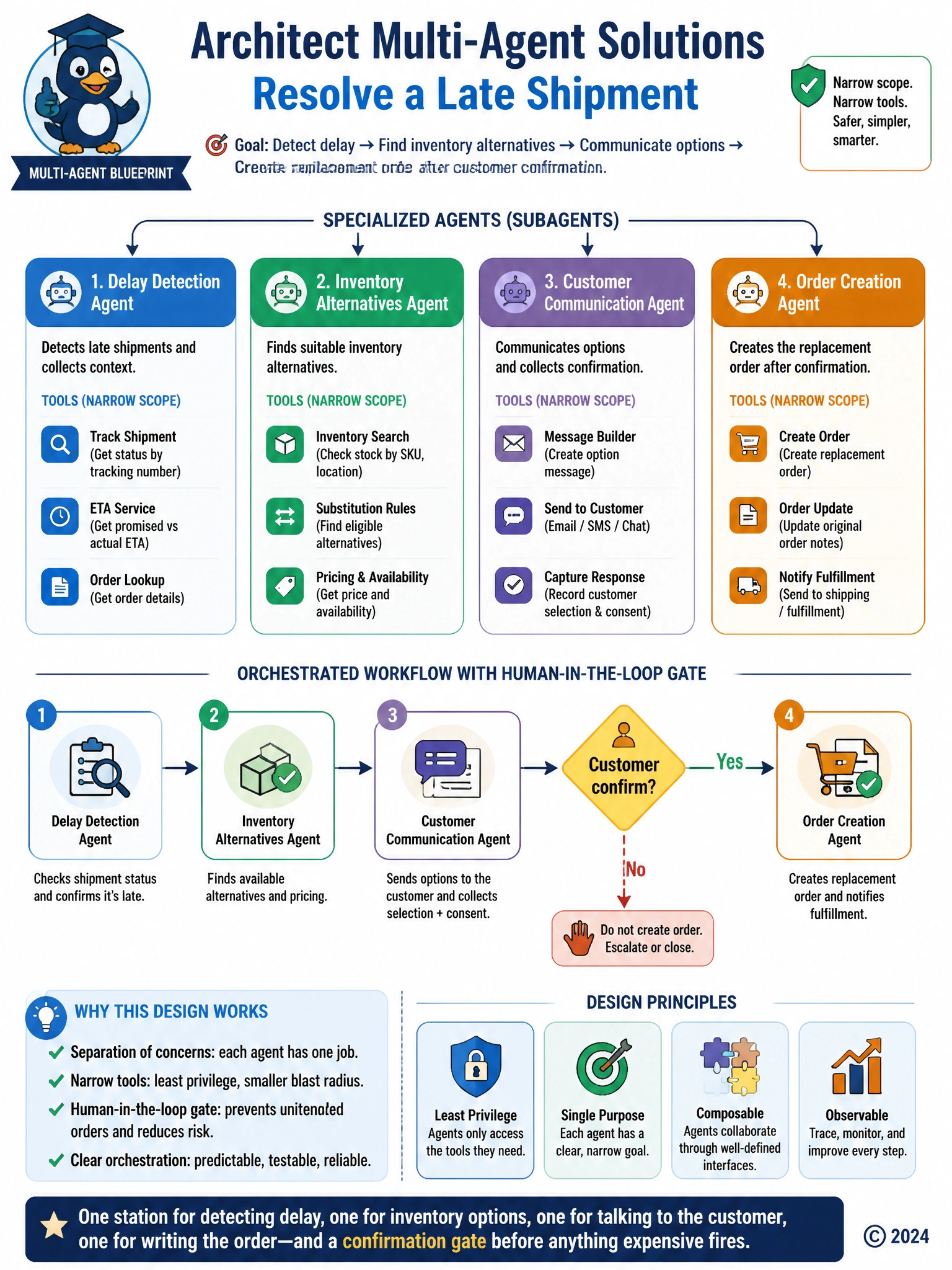
Correct answer: C. Good multi-agent architecture is mise en place: one station for detecting delay, one for inventory options, one for talking to the customer, one for writing the order—and a confirmation gate before anything expensive fires. Narrow tools beat one agent with keys to the kingdom.
Full Explanation
Architecting multi-agent solutions starts by decomposing goals into workflows, agents, and tools, including control loops and human-in-the-loop. Option C is correct: specialized agents/subagents map to sub-goals, tools are scoped per function, and order creation is gated on confirmation—matching autonomy boundaries and HAX/responsible automation.
Option A is incorrect: a monolithic agent with unbounded tools violates least-privilege tool design and makes evaluation and safety harder.
Option B is incorrect: HITL is compatible with multi-agent design; excluding software agents ignores the requirement to design an agentic solution.
Option D is incorrect: nightly ETL does not provide interactive resolution workflows with customer confirmation.
Exam tip: Look for decomposition into specialized agents + scoped tools + explicit HITL/control gates when goals include irreversible actions.