
A team maintains multi-agent definitions, tool registrations, prompt assets, and Azure infrastructure for Microsoft Foundry. They need repeatable promotions across Development, Test, Acceptance, and Production with auditability. Which approach best satisfies CI/CD and multi-environment requirements?
Select an answer to reveal the explanation.
Short Explanation
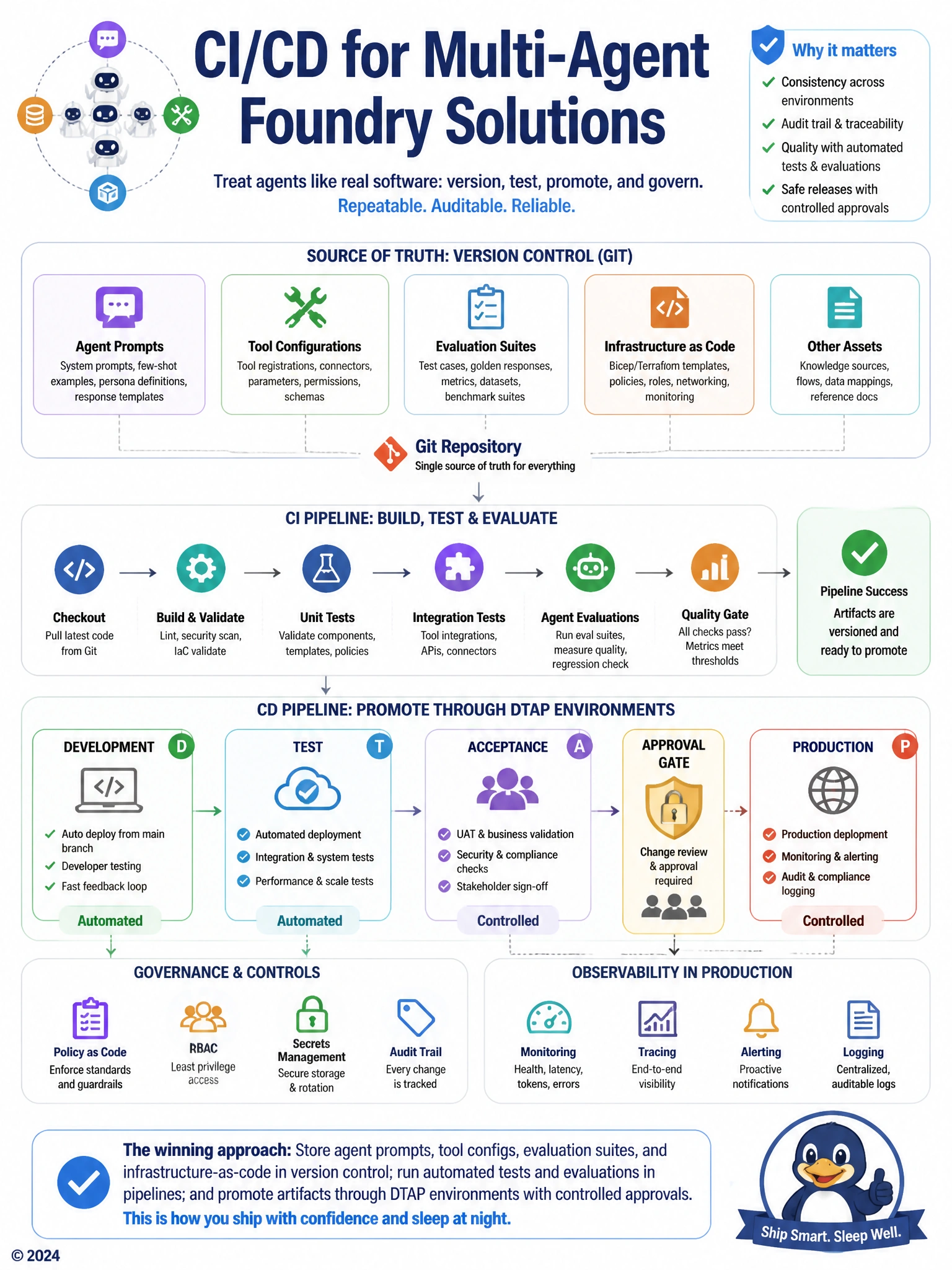
Correct answer: A. Treat agents like real software: prompts, tools, evals, and IaC live in Git, pipelines test them, and DTAP promotion with approvals is how you sleep at night. Click-ops-only production is how drift and mystery outages are born.
Full Explanation
Deploying multi-agent solutions requires choosing release methodology (including DTAP), multi-environment strategies, and CI/CD with IaC and automated testing/evaluations. Option A is correct: version-controlled assets (prompts, tools, evals, IaC), pipeline-automated validation, and staged DTAP promotion with approvals provide repeatability and audit trails.
Option B is incorrect: production-only portal click-ops prevents reproducible releases and creates configuration drift.
Option C is incorrect: secrets on laptops and manual recreation violate security and CI/CD principles.
Option D is incorrect: collapsing all stages into one environment removes isolation for testing and acceptance and increases production risk.
Exam tip: DTAP + IaC + automated evaluations in pipelines is the multi-agent release story; portal-only production edits are a common wrong answer.