
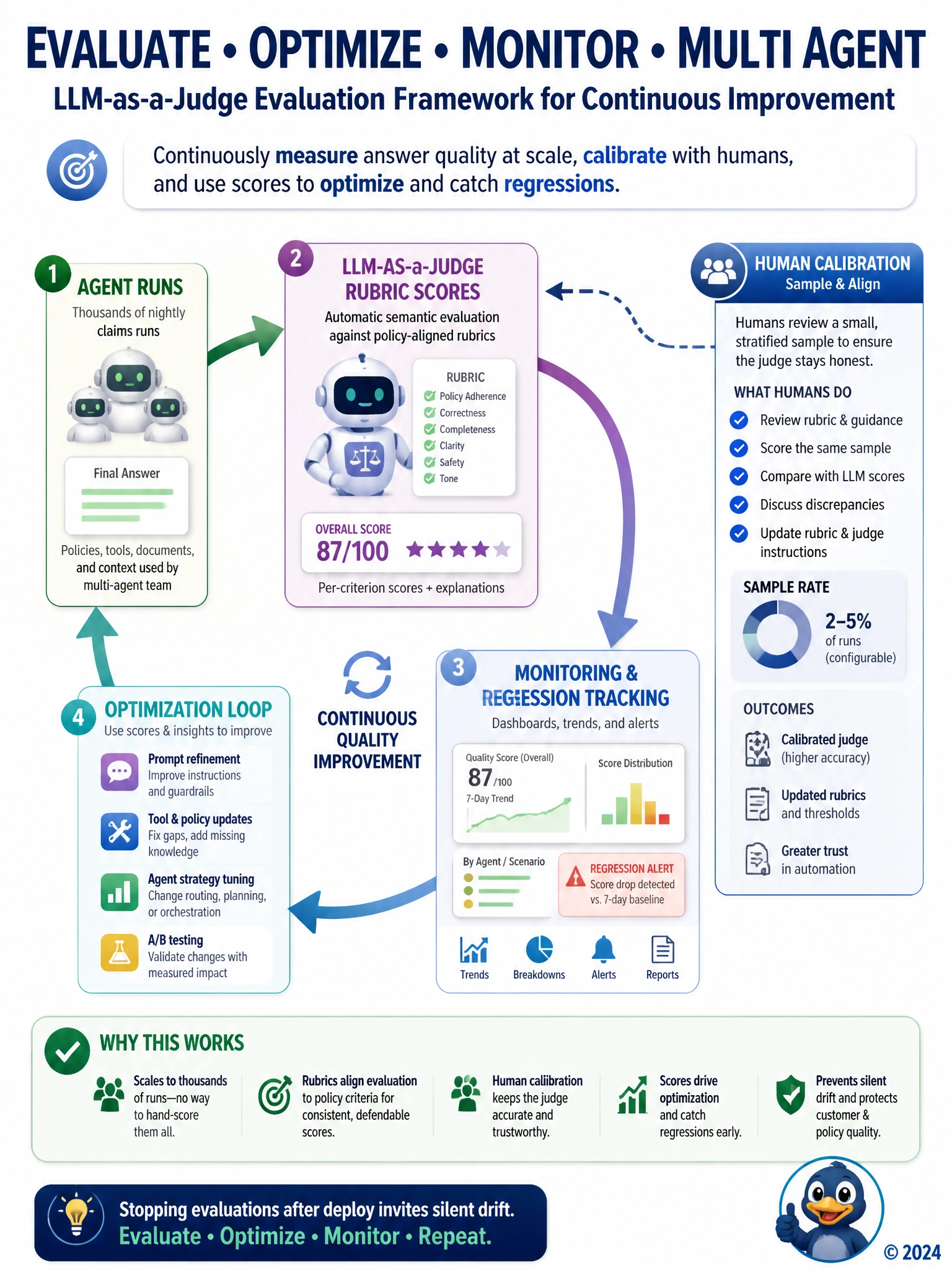
A multi-agent claims team needs continuous quality scoring on thousands of nightly agent runs. Human review can cover only a small sample. They want automated semantic scoring of final answers against policies, with periodic human calibration, feeding a semantic optimization loop. Which approach best fits Foundry-oriented continuous improvement?
Select an answer to reveal the explanation.
Short Explanation
You cannot hand-score thousands of runs nightly. LLM-as-a-judge with clear rubrics scales semantic evaluation; humans calibrate to keep the judge honest; scores feed optimization and regression detection. Character count rewards verbosity, not correctness. Stopping evals after deploy invites silent drift. VM CPU heat is not answer quality. B is the continuous-improvement pattern.
Full Explanation
Correct answer: B. Continuous improvement for multi-agent solutions includes LLM-as-a-judge frameworks, synthetic data generation, semantic optimization loops, and user feedback loops. Automated judges enable scale; human calibration maintains alignment; scores drive prompt/tool/model optimization and quality regression monitoring.
A is incorrect because length is a poor proxy for policy-correct claims answers.
C is incorrect because production multi-agent systems require ongoing evaluation for drift and regression.
D is incorrect because infrastructure telemetry is not a semantic quality metric for agent answers.
Exam focus: LLM-as-judge is a core continuous evaluation technique when human review cannot cover full volume.