
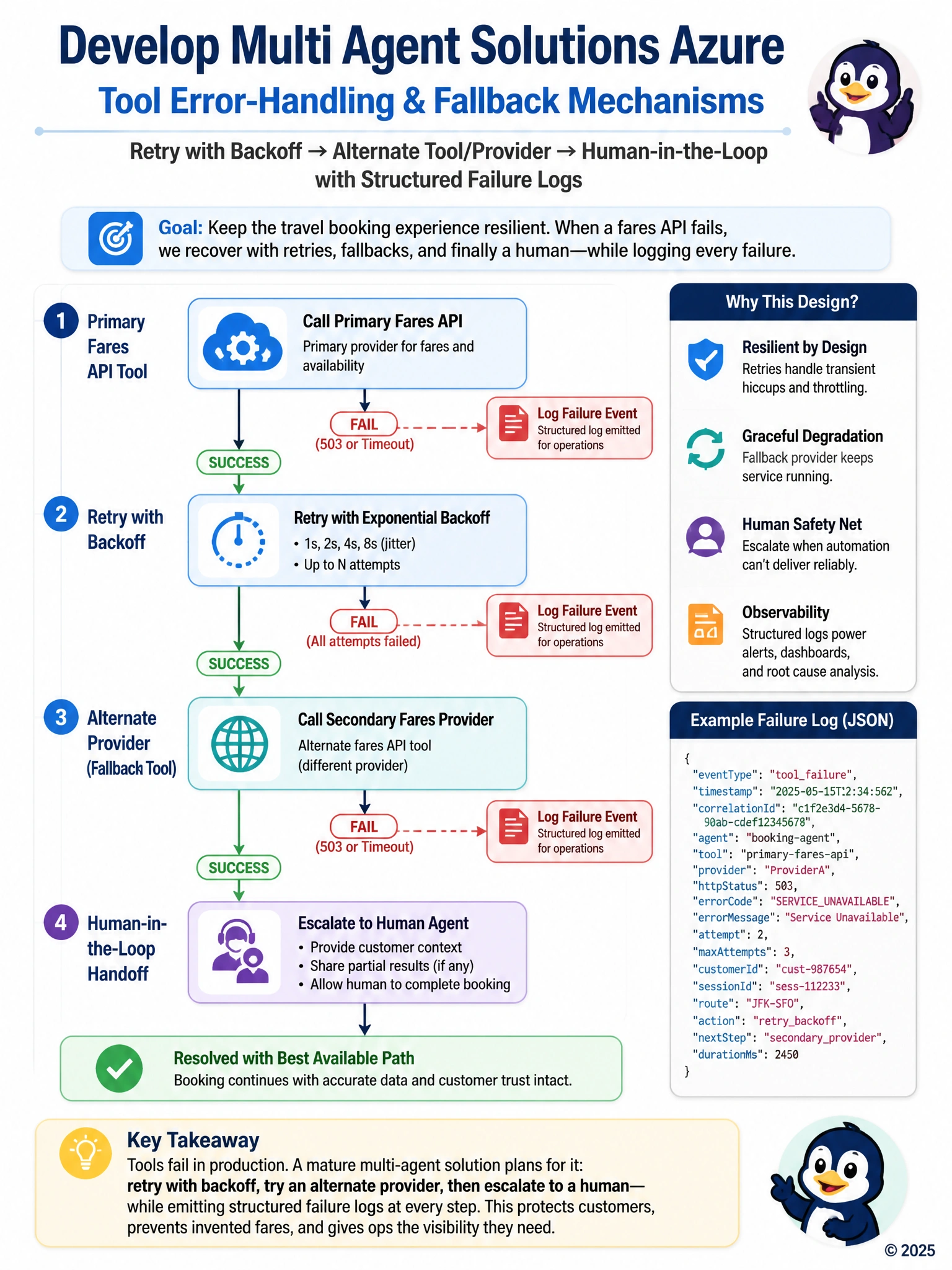
A travel multi-agent flow depends on a primary fares API tool. When that API returns 503 or times out, the booking agent currently crashes the whole workflow. The business wants degraded service: try a secondary fares provider, then offer human handoff if both fail, while logging failures for ops. Which design best implements this?
Select an answer to reveal the explanation.
Short Explanation
Tools fail in production. Mature multi-agent tool design plans for it: backoff retries, fallback tools/providers, then human escalation, all with logs. Inventing fares is dangerous. Deleting the agent is not resilience. UI animation speed is unrelated. A is the correct error-handling pattern.
Full Explanation
Correct answer: A. Designing tool ecosystems includes error-handling and fallback mechanisms. For critical dependencies, patterns typically include timed retries with backoff, alternate tools or providers, graceful degradation, and human escalation with observability.
B is incorrect because fabricating transactional data creates incorrect bookings and compliance risk.
C is incorrect because destroying the agent on first failure is not a controlled fallback strategy.
D is incorrect because UI animation does not implement tool resilience.
Exam focus: tool failures need explicit multi-step fallback, not silent invention or hard crashes.