
Support engineers debugging a multi-agent failure in Microsoft Foundry can see that a user request failed, but they cannot reconstruct which agent ran, which tools were called, how many tokens were consumed, or how child spans related to the parent request. Which observability implementation should the team prioritize?
Select an answer to reveal the explanation.
Short Explanation
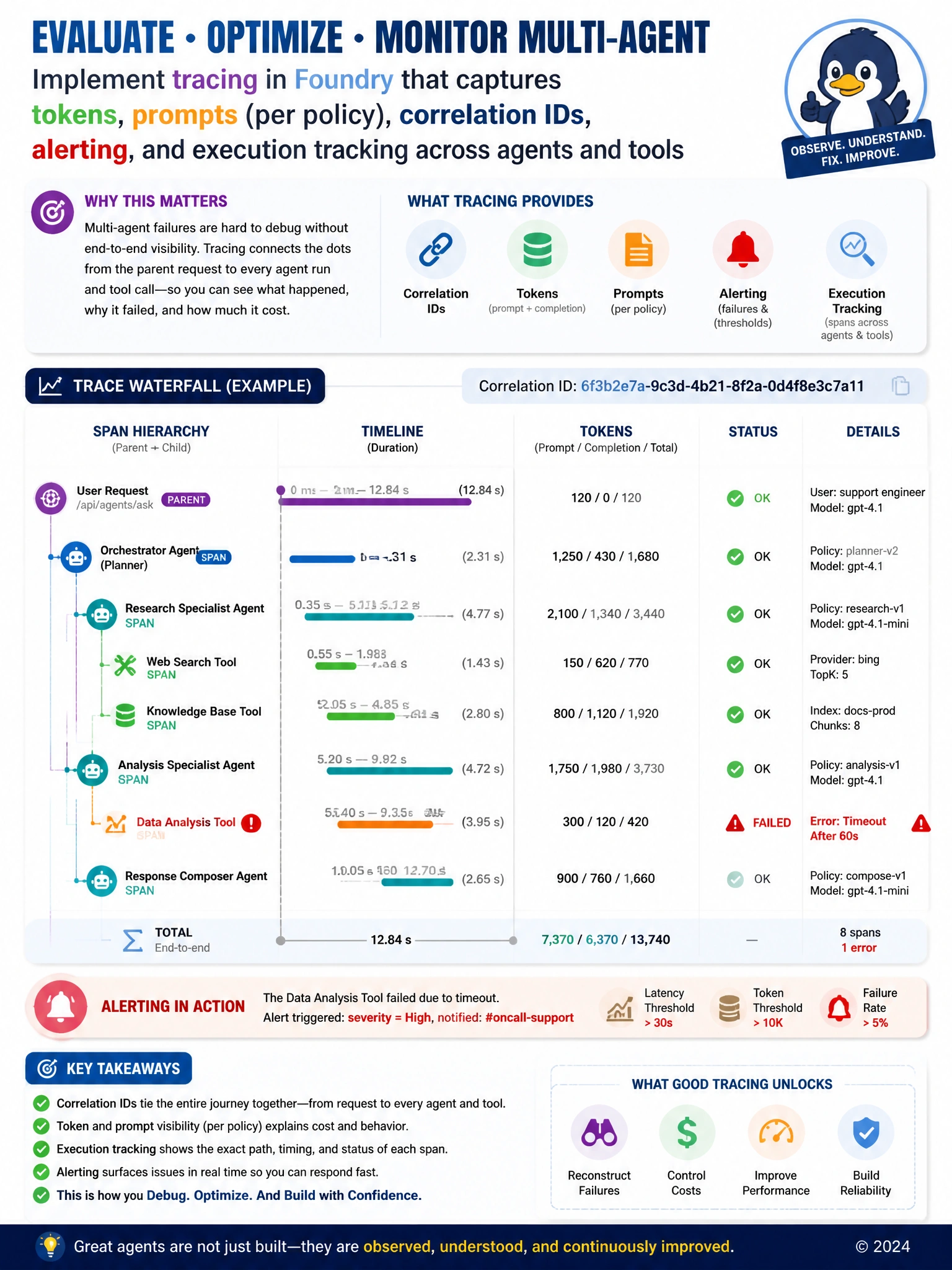
Multi-agent debugging needs end-to-end traces: correlation IDs tying parent requests to agent runs and tool spans, token and execution tracking, and alerting. Local-only prints without correlation do not help production. Screenshots are not traces. Turning logs off is sabotage. C matches Foundry tracing expectations.
Full Explanation
Correct answer: C. Observability for multi-agent solutions includes implementing tracing in Foundry covering tokens, prompts (subject to privacy policy), correlation IDs, alerting, and execution tracking so failures can be reconstructed across agents and tools.
A is incorrect because uncorrelated local prints do not provide production cross-agent forensics.
B is incorrect because user screenshots lack structured spans, tokens, and tool payloads needed for root-cause analysis.
D is incorrect because disabling logging prevents reliability monitoring and remediation.
Exam focus: correlation IDs + structured execution traces are essential multi-agent observability.