
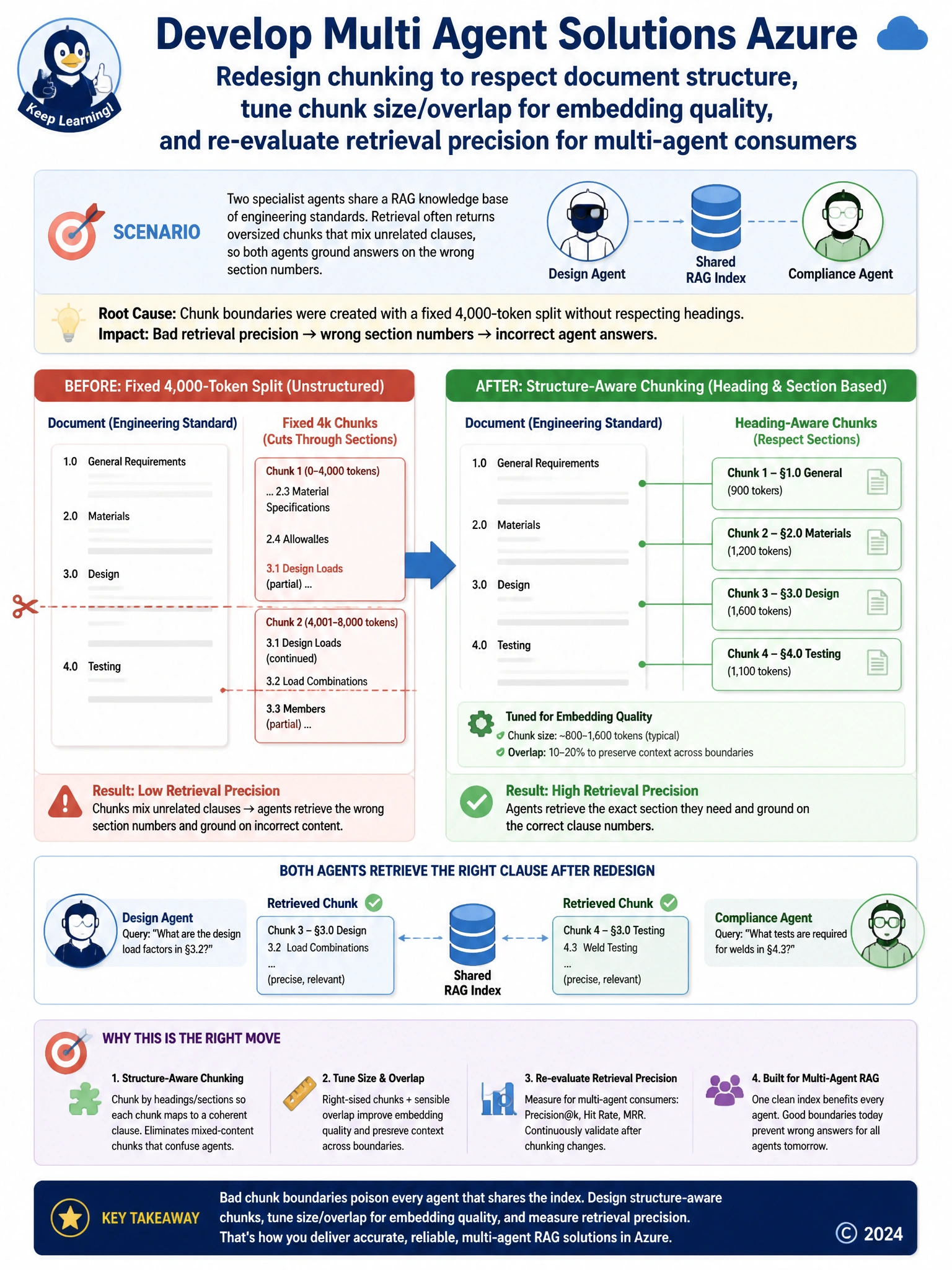
Two specialist agents share a RAG knowledge base of engineering standards. Retrieval often returns oversized chunks that mix unrelated clauses, so both agents ground answers on the wrong section numbers. Embedding quality is acceptable on short texts, but chunk boundaries were created with a fixed 4,000-token split without respecting headings. What should the team prioritize to improve multi-agent RAG precision?
Select an answer to reveal the explanation.
Short Explanation
Bad chunk boundaries poison every agent that shares the index. Structure-aware chunking, sensible size/overlap, and measuring retrieval precision are the multi-agent RAG fixes. Full-corpus fine-tuning for every update is heavy and still may not beat good retrieval for changing standards. Giant whole-document chunks hurt precision. Random shuffle destroys usefulness. D is the correct RAG architecture move.
Full Explanation
Correct answer: D. Multi-agent RAG architecture design includes chunking, embedding quality, and retrieval precision. Structure-aware segmentation improves the signal specialists receive when multiple agents consume the same knowledge base.
A is incorrect as a first-line fix because exclusive fine-tuning is costly, slow to update, and does not replace retrieval architecture for evolving document sets.
B is incorrect because whole-document retrieval reduces precision and overwhelms context windows.
C is incorrect because shuffling chunks harms consistent retrieval of the correct clause.
Exam focus: shared multi-agent knowledge quality starts with chunking and retrieval precision, not randomness.