
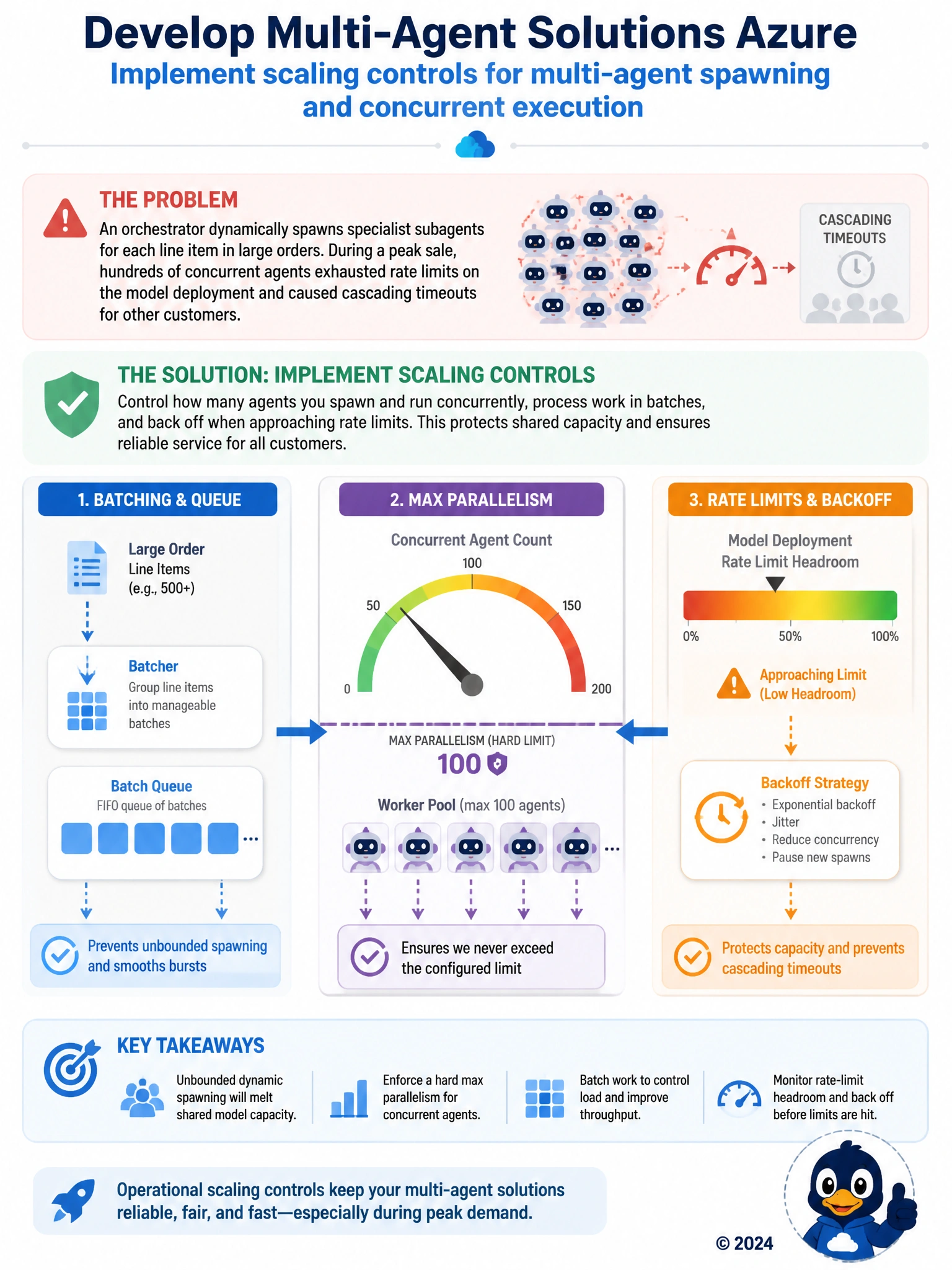
An orchestrator dynamically spawns specialist subagents for each line item in large orders. During a peak sale, a single request spawned hundreds of concurrent agents, exhausted rate limits on the model deployment, and caused cascading timeouts for other customers. Which control should the team implement?
Select an answer to reveal the explanation.
Short Explanation
Dynamic spawning without caps will melt shared model capacity. You need explicit concurrency controls: max parallel agents, batching line items, and backoff when rate limits approach. Unbounded spawn recreates the outage. Running on laptops is not a production multi-tenant fix. An infinite non-completing loop is not control. C is the operational scaling design.
Full Explanation
Correct answer: C. Multi-agent orchestration includes implementing scaling and control of multi-agent spawning, batching, and concurrent execution so peak demand does not exhaust model rate limits or starve other workloads.
A is incorrect because unbounded parallelism is what caused the failure mode described.
B is incorrect because local developer machines are not a scalable, governed production control plane for multi-agent Azure solutions.
D is incorrect because a non-completing single loop does not provide controlled concurrency or reliable throughput.
Exam focus: pair agent spawning with batching, caps, and rate-limit-aware backoff.