
Debugging a failed multi-agent run requires reconstructing which orchestrator decision led to which tool call and model response across services. Today logs are disconnected per component. What should you implement in Foundry-oriented observability?
Select an answer to reveal the explanation.
Short Explanation
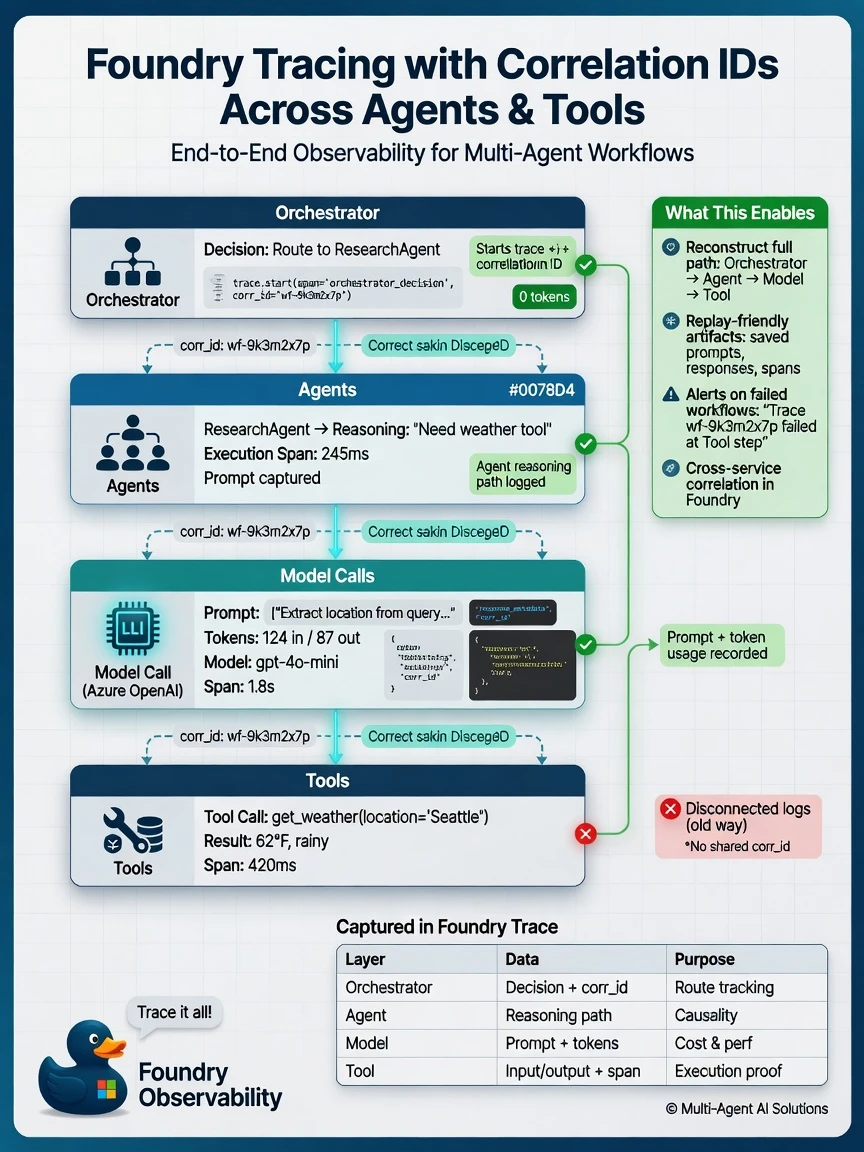
A is the observability design. Foundry tracing guidance covers tokens, prompts, correlation IDs, alerting, and execution tracking—plus the architecture skill of cross-service trace correlation and structured logging of agent reasoning paths. Correlation IDs stitch orchestrator → agent → model → tool into one story for debugging and alerts. Final-string-only logs hide causality. Unstructured prints without shared IDs cannot reconstruct multi-agent paths. LB probes do not explain agent failures. Invest in distributed tracing built for agent runs.
Full Explanation
Correct Answer — A
Implement tracing in Foundry that includes tokens, prompts, correlation IDs, alerting, and execution tracking. Cross-service correlation and structured agent-path logging (with replay-friendly capture where needed) let you reconstruct multi-agent failures end to end.
Why B is wrong: User-visible strings alone omit tool calls, model steps, and causation.
Why C is wrong: Without shared identifiers, multi-component logs cannot be joined.
Why D is wrong: Infrastructure probe health does not surface agent reasoning or tool failures.
Exam tip: Correlation IDs + spans for orchestrator, agents, models, and tools.