
Interactive multi-agent sessions truncate oldest turns when the context window fills. Users report that early constraints (“never email the customer directly”) disappear mid-session and agents violate them later. Which remediation best targets sliding-window amnesia?
Select an answer to reveal the explanation.
Short Explanation
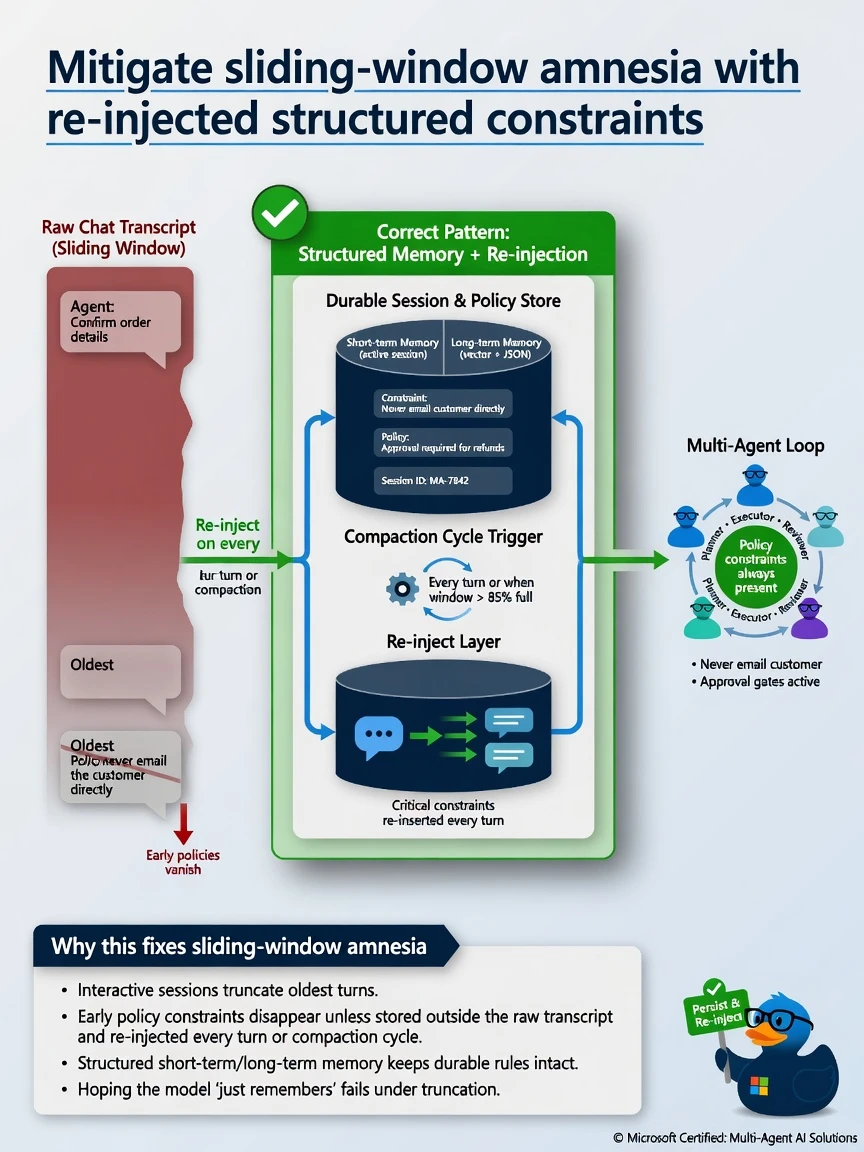
B fixes sliding-window amnesia. When oldest turns fall off, early policies vanish unless you store them outside the raw chat transcript and re-inject them. Structured session memory for durable constraints is the multi-agent context/memory design pattern. Hoping the model “just remembers” fails under truncation. Deleting policies or shrinking the window makes amnesia worse. Re-inject critical constraints every turn or after each compaction.
Full Explanation
Correct Answer — B
Sliding-window amnesia occurs when early tokens are dropped as the window fills. Mitigation is durable structured memory for session and policy constraints with systematic re-injection on each turn or compaction—not reliance on the original early chat turns remaining present.
Why A is wrong: Single early mentions are exactly what truncation removes.
Why C is wrong: Removing constraints saves tokens but guarantees policy violations.
Why D is wrong: Smaller windows increase truncation pressure and amnesia risk.
Exam tip: Durable constraints live in memory stores and are re-injected, not left only in early turns.