
A parallel research workflow spawns eight specialist agents that all hit the same model deployment and the same external search API. Median task duration has doubled; logs show frequent 429 responses. What optimization should you apply first?
Select an answer to reveal the explanation.
Short Explanation
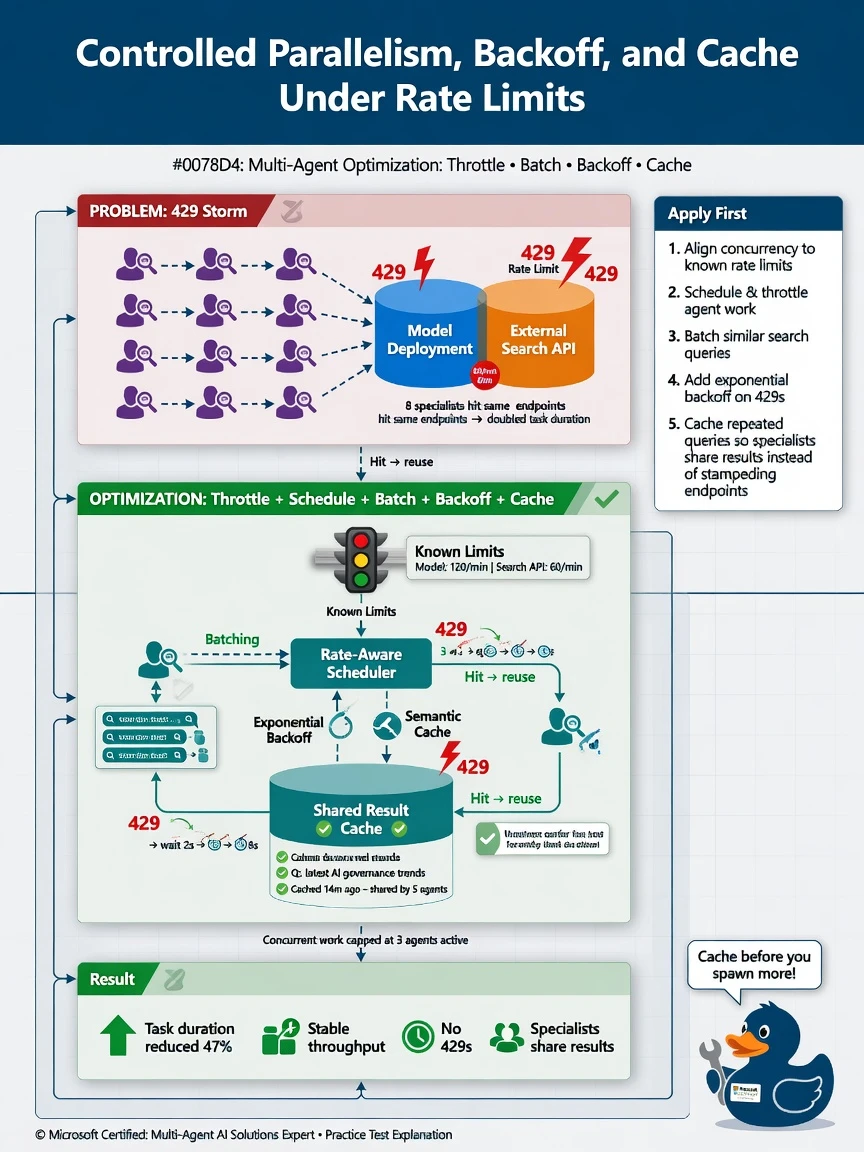
B is the practical fix. Task-duration optimization includes parallelism and rate limits—but unconstrained parallelism against shared quotas creates 429 storms that slow everything. Align concurrency with deployment and API limits, backoff on throttle, batch when the API allows, and use semantic/response caching so duplicate research queries are not repeated. More spawn chaos makes 429s worse. Blind full sequential may help limits but throws away safe parallelism. Dropping caches increases load. Design concurrency as a controlled resource, not “as many agents as possible.”
Full Explanation
Correct Answer — B
Optimizing task duration covers parallelism and rate limits. When parallel specialists share model deployments and external APIs, you must bound concurrency to quotas, implement backoff on 429s, batch where appropriate, and cache repeated queries so agents do not stampede identical endpoints.
Why A is wrong: Removing caches increases duplicate load and worsens throttling.
Why C is wrong: Raising concurrency under 429 conditions amplifies throttling and usually increases median duration.
Why D is wrong: Full sequentialization can reduce 429s but is a blunt instrument; controlled parallelism with caching is preferred when steps are independent.
Exam tip: Parallelism helps only within rate limits; add backoff + shared cache.