
After a release, overall task success drops. You suspect either degraded memory retrieval, a broken tool contract, or a prompt regression—but a single end-to-end pass/fail metric cannot tell you which. What evaluation approach should you implement?
Select an answer to reveal the explanation.
Short Explanation
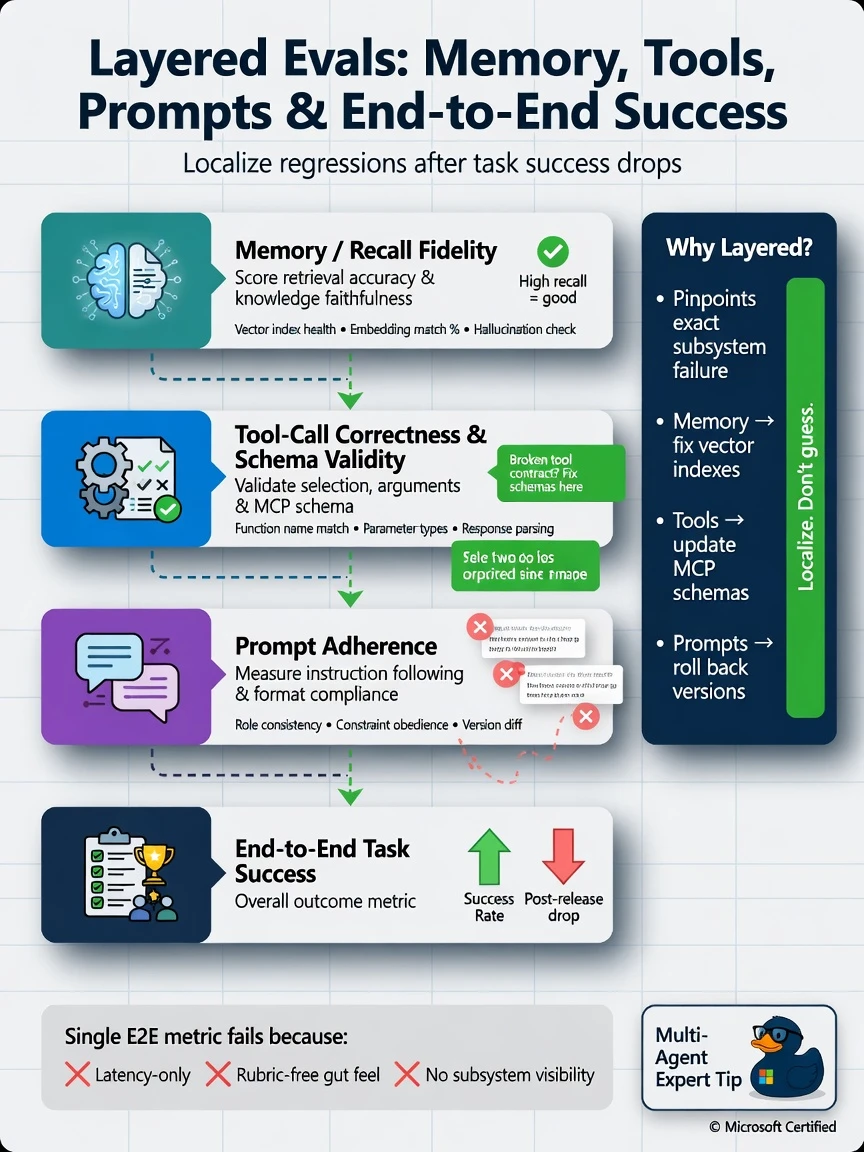
Choose A. When multi-agent quality slips, you need component-level evals: memory and knowledge retrieval quality, tool selection/arguments/validation, prompt adherence, plus E2E success. That localization tells you whether to fix vector indexes, MCP tool schemas, or prompt versions. Latency-only misses correctness. Rubric-free binary gut feel is noisy. Skipping subsystem evals is how teams thrash on the wrong layer. The blueprint explicitly calls out evaluations for memory, knowledge, tools, and prompts.
Full Explanation
Correct Answer — A
You should design evaluations for memory, knowledge, tools, and prompts—not only a single end-to-end score. Layered metrics localize regressions: memory fidelity vs tool correctness vs prompt adherence vs overall task success, enabling targeted fixes.
Why B is wrong: Latency optimizes speed, not correctness of memory, tools, or prompts.
Why C is wrong: Unstructured binary labels lack reliability and diagnostic value.
Why D is wrong: E2E alone cannot attribute failure to memory, tools, or prompts.
Exam tip: Evaluate subsystems separately to localize multi-agent regressions.