
A long-running multi-agent investigation repeatedly summarizes its own history to fit the context window. Over time, critical entity attributes change incorrectly in the summary (for example, customer region and contract tier), and later agents act on the wrong facts. Which diagnosis and remediation pair is best?
Select an answer to reveal the explanation.
Short Explanation
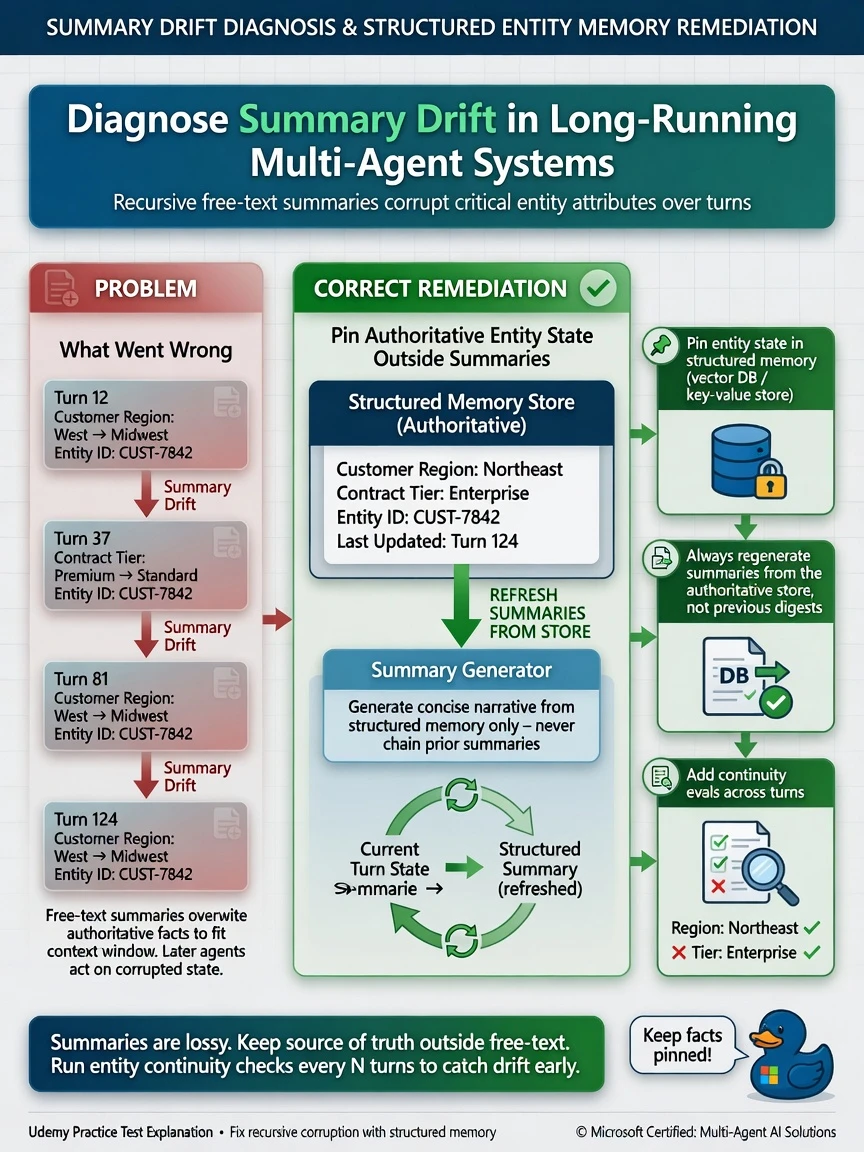
C nails it. This is summary drift—a known context-window failure mode when recursive free-text digests slowly corrupt entities. Fix by keeping authoritative structured entity state (memory store), generating summaries from that source of truth rather than only from previous summaries, and evaluating entity continuity across the trajectory. Summaries are not lossless. Infinite full history is not always feasible. Higher temperature increases inconsistency. Pair structured memory with continuity evals when you compact long multi-agent runs.
Full Explanation
Correct Answer — C
Context-window diagnostics include sliding-window amnesia, summary drift, vector-only recall issues, and entity continuity problems. Summary drift is mitigated by structured authoritative entity memory, summary regeneration grounded in that state, and evaluations that assert entity continuity across turns.
Why A is wrong: Recursive natural-language summaries are lossy and can mutate facts.
Why B is wrong: Unbounded full history often exceeds windows and cost limits; you still need a sound compaction strategy.
Why D is wrong: Higher temperature worsens factual stability of summaries.
Exam tip: Summary drift → structured entity memory + continuity evals.