
A customer onboarding workflow must (1) run KYC document checks, (2) provision cloud resources, and (3) send a welcome sequence. Steps 1 and 2 are independent and can run concurrently; step 3 must wait for both to succeed. Compliance requires a single coordinating agent to assign work and merge outcomes. Which orchestration pattern should you implement?
Select an answer to reveal the explanation.
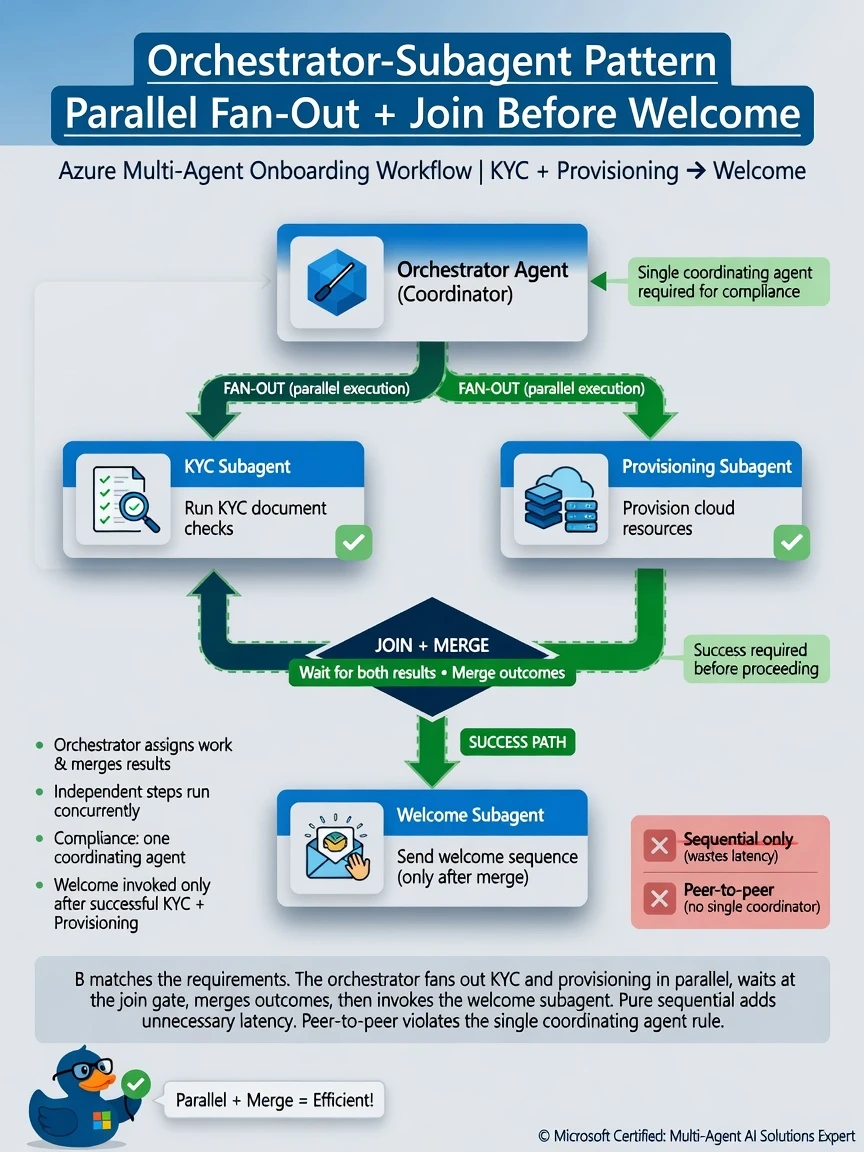
Short Explanation
B matches the requirements. You need a coordinator (orchestrator-subagent), parallel fan-out for independent KYC and provisioning, a join/merge gate, then the welcome step. Pure sequential works but wastes latency when steps are independent. Peer-to-peer without coordination fails compliance’s “single coordinating agent” need and complicates merge semantics. Making welcome the hub that starts first and fabricates KYC is unsafe and inverted. Orchestrator fans out, joins, then proceeds—classic multi-agent orchestration on Azure/Foundry stacks.
Full Explanation
Correct Answer — B
Multi-agent orchestration patterns include hub-and-spoke, sequential, parallel, peer-to-peer, and orchestrator-subagent. Here, independent KYC and provisioning need parallel execution under a single coordinator that merges results before a dependent welcome step—exactly orchestrator-subagent with parallel fan-out and a join barrier.
Why A is wrong: Sequential execution is valid but ignores the stated concurrency opportunity and unnecessarily lengthens onboarding.
Why C is wrong: Uncoordinated peer-to-peer lacks a single compliance coordinator and reliable merge semantics.
Why D is wrong: Starting welcome first and inventing KYC outcomes violates dependency and compliance requirements.
Exam tip: Independent branches → parallel under orchestrator; dependent step after join.