
A Fulfilment agent calls a warehouse inventory tool. Intermittent 503 responses and occasional schema-mismatched payloads cause the agent to invent stock levels and continue the workflow. You must implement robust tool integration behavior. What combination should you design?
Select an answer to reveal the explanation.
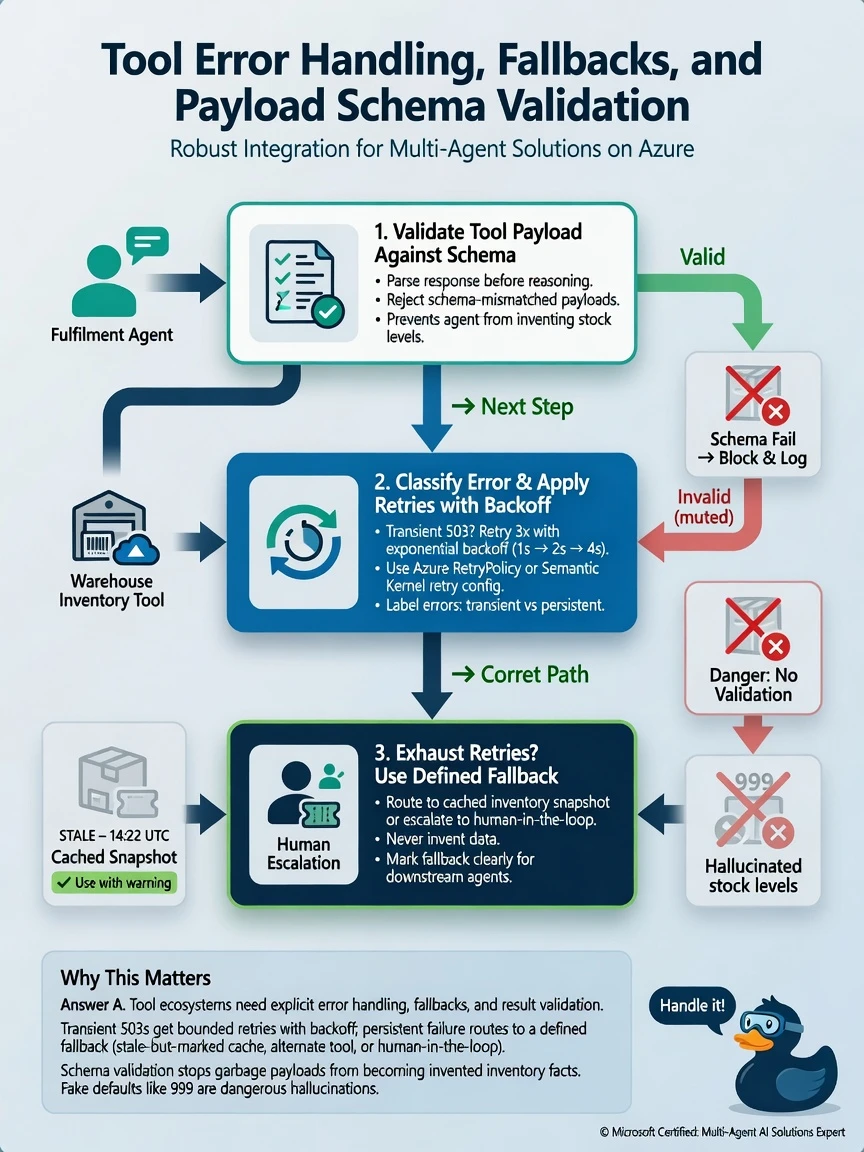
Short Explanation
Answer A. Tool ecosystems need explicit error handling, fallbacks, and result validation. Transient 503s get bounded retries with backoff; persistent failure routes to a defined fallback (stale-but-marked cache, alternate tool, or human-in-the-loop). Schema validation stops garbage payloads from becoming invented inventory facts. Fake defaults like 999 are dangerous hallucinations. No error handling invites fabrication. Infinite tight retries create thundering herds and cost spikes. Build the tool layer so agents only reason over validated results or explicit failure states.
Full Explanation
Correct Answer — A
Develop-domain guidance calls for tool error-handling and fallback mechanisms plus tool result validation and quality checks. Classify errors, retry transients with backoff, escalate or use safe fallbacks when exhausted, and validate schemas before agent reasoning. That prevents invented stock levels after 503s or malformed responses.
Why B is wrong: Fabricated defaults create incorrect fulfilment decisions and hide outages.
Why C is wrong: Unhandled tool failures commonly drive model hallucination rather than recovery.
Why D is wrong: Infinite tight retries harm downstream systems and do not guarantee recovery.
Exam tip: Retry + backoff + fallback + schema validation before the agent continues.