
A finance multi-agent system can draft vendor payments. Policy requires that any payment instruction above a threshold receive human approval before the payment tool executes. Agents must not bypass this for “urgency.” How should you implement human-in-the-loop?
Select an answer to reveal the explanation.
Short Explanation
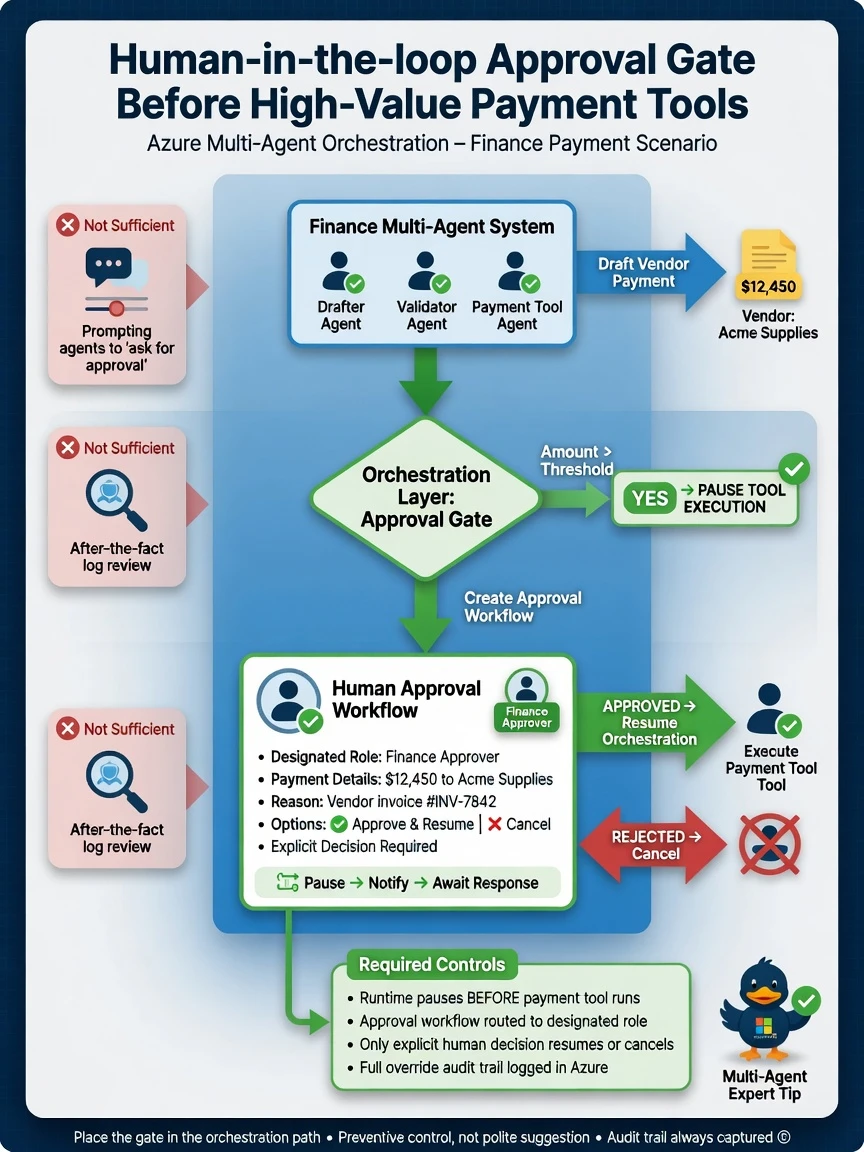
C is required. Human-in-the-loop for high-risk actions is an orchestration control, not a polite prompt hint. When amount exceeds threshold, the runtime must pause before the payment tool runs, open an approval workflow to the right role, and only then resume or cancel—with an audit trail for overrides. Soft suggestions get ignored under urgency. After-the-fact logs are detective, not preventive. Temperature does not enforce policy. Build HITL as a hard gate in the workflow graph (Agent Framework, LangGraph interrupt, Foundry approval pattern—conceptually the same).
Full Explanation
Correct Answer — C
Human-in-the-loop processes include approval workflows, overrides, and edge-case handling. For payment instructions above threshold, the orchestration must block tool execution until a designated human approves or rejects, recording overrides. That is a control-plane gate, not a stylistic prompt change.
Why A is wrong: Soft prompt suggestions are not enforceable and fail under social-engineering “urgency.”
Why B is wrong: Post-execution logging does not prevent unauthorized payments; it only supports later review.
Why D is wrong: Temperature affects sampling randomness, not authorization policy.
Exam tip: High-risk tools → hard approval interrupt in the orchestration path before execution.