
Your multi-agent assistant repeatedly re-embeds the same large policy preamble, re-asks identical FAQ questions, and re-calls a slow product catalog tool with the same SKU list within a short TTL. Latency and token costs are high. Which caching strategy should you implement?
Select an answer to reveal the explanation.
Short Explanation
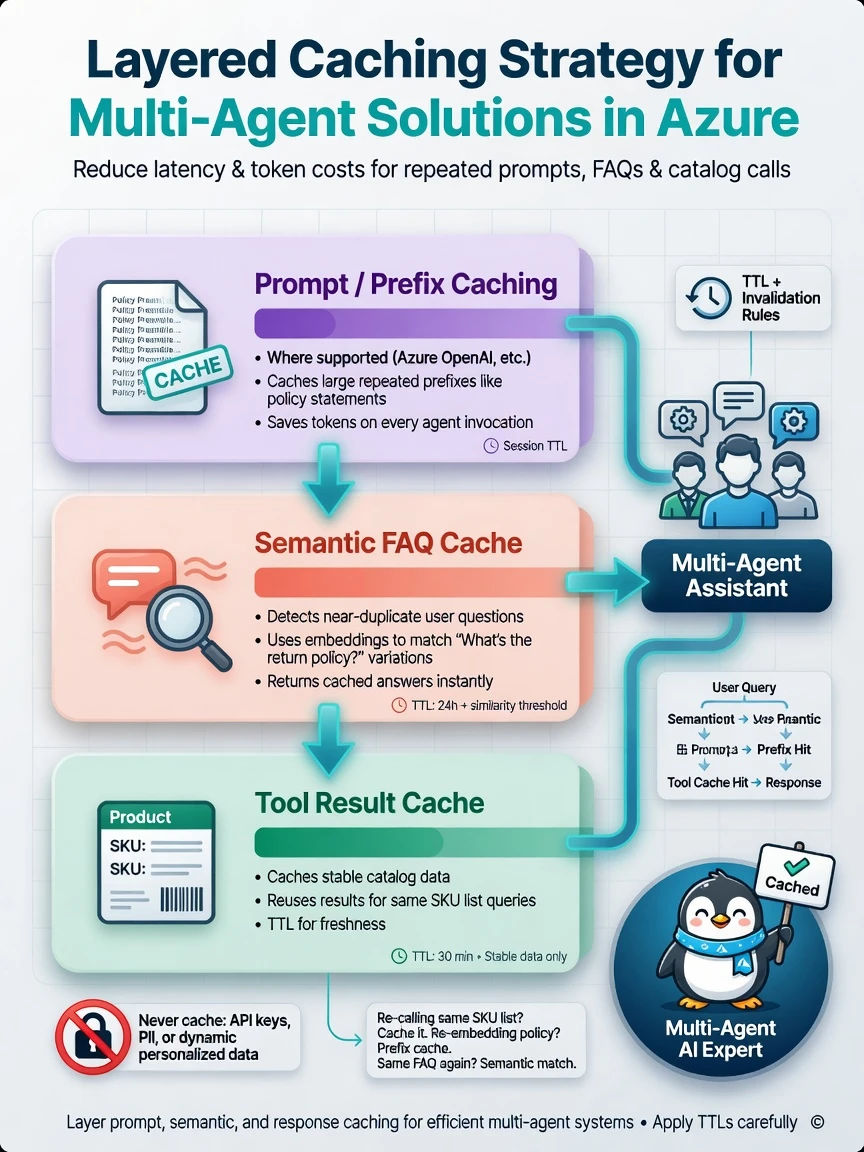
Correct answer: B. Multi-agent development includes prompt caching, semantic caching, and response caching. Layer them carefully with TTLs and invalidation. No caching (A) wastes money. Caching secrets at CDN (C) is unsafe. Reusing one answer for all questions (D) is incorrect. Cache stable tool results and repeated prompts, not sensitive or highly dynamic personalized data without rules.
Full Explanation
Caching strategies reduce token usage and tool load: prompt/prefix caching for large static system content, semantic caches for paraphrased FAQs, and response or tool-result caches for idempotent lookups. Multi-agent systems benefit when spokes share a cache of expensive retrievals under keying that includes tenant and permission context. Option A ignores cost/latency goals. Option C is a security anti-pattern. Option D breaks correctness. Define invalidation when catalogs or policies update, and never cache authorized personalized results in a way that leaks across users.