
You are implementing a multi-step research workflow on Azure that needs explicit graph control: conditional branches, cycles for refinement, and checkpointed state between nodes. The team is proficient in Python and open-source agent stacks used with Microsoft Foundry model deployments. Which approach best matches the orchestration requirement?
Select an answer to reveal the explanation.
Short Explanation
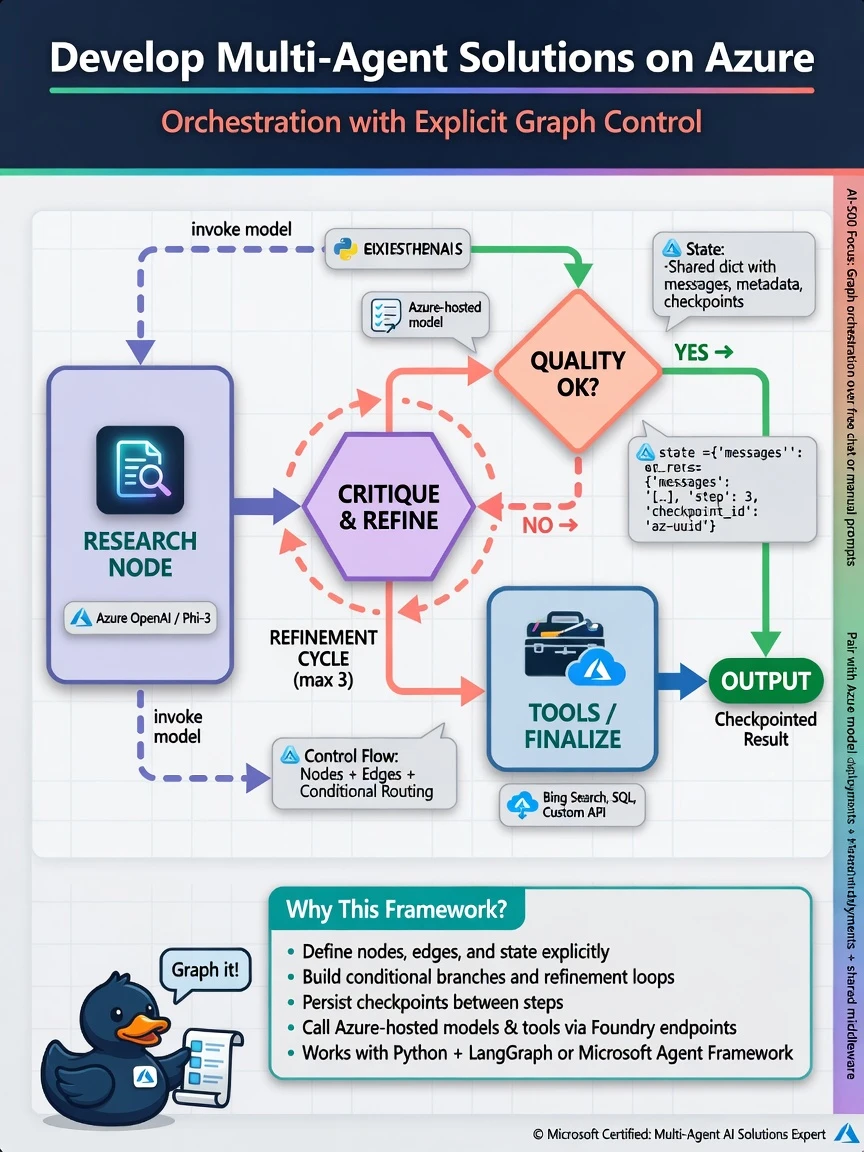
Correct answer: C. AI-500 calls out implementing orchestration with frameworks including Agent Framework, LangChain, and LangGraph. Graphs give explicit branches, loops, and state—unlike free chat (A), prompt-only control (B), or manual tabs (D). Pair frameworks with Foundry/Azure model endpoints and shared middleware.
Full Explanation
Complex multi-agent workflows need durable control flow, not only clever prompts. LangGraph and Microsoft Agent Framework provide primitives for nodes (agents/tools), conditional edges, cycles for critique/refine loops, and state passing. This supports testing, visualization, and HITL interrupts. Option A lacks determinism and testability. Option B overloads the model with governance that belongs in code. Option D is not production engineering. Integrate middleware for logging, authorization, and exception handling across nodes, and keep model calls pointed at governed Azure deployments.